
Sebron, Giant Steamboats at the Sugar Levee, New Orleans, LA, 1853
Image ID: 8208
Collection: Karen Halttunen
Topic(s): Nineteenth Century, Transportation, African Americans, Agriculture, Apartheid, Arts and Architecture, Business 19th century, Emerging industrial city, Environmental History, Expansion, Industrial Revolution, Labor, Market Economy, Nineteenth Century Slavery, Post Antebellum south, Railroad and steamboat, Slavery, Working, and Living Conditions, Southern Society, Symbols, Technology, Trade
Region(s): United States
CA Standard(s): 8.10 - The multiple causes, key events, and complex consequences of the Civil War, 8.12 - The transformation of the American economy and the changing social and political conditions…in response to the Industrial Revolution, 8.7 - The divergent paths of the American people in the South from 1800 to the mid-1800s , 8.8 - The divergent paths of the American people in the West from 1800 to the mid-1800s
National Standard(s): Expansion and Reform (1801-1861), Civil War and Reconstruction (1850-1877)
Card Text: Hippolyte V.V. Sebron, "Giant Steamboats" at the Sugar Levee, New Orleans, LA, 1853. The "Gipsy," "Grand Turk," and others line the wharf, which is busy with stevedores. New Orleans, at the mouth of the Mississippi River, was the primary trading hub for enslaved Africans and African Americans and the cotton they produced that fueled the growth of the southern economy. Nine new slave states entered the Union between 1789 and 1860, rapidly transforming the South into a region of expanded economic growth built on slave labor. In this painting, innumerable enslaved workers load cargo onto a steamship in the Port of New Orleans, the commercial center of the antebellum South, while two well-dressed white men stand together talking. Commercial activity extends as far as the eye can see.
By the mid-19th century, southern cities like New Orleans saw the greatest concentration of wealth in the United States. While most white southerners did not own slaves, many aspired to join the rich slaveholder class who dominated the politics of both the South and the nation. Meanwhile, slavery shaped the culture and society of the South, which rested on a racial ideology of white male supremacy and a vision of the US as a white man’s republic. Enslaved Africans and African Americans endured the traumas of bondage by creating their own cultures and using the Christian message of redemption to find hope for a world of freedom without hatred and violence. Oil on canvas. Deatil. 48.5 x 72.3" (123.1 x 183.8 cm).
Citation: Bateaux à Vapeur Géant, la Nouvelle-Orléans, 1853. Louisiana Digital Library. Copyright Tulane University Art Collection, Tulane University Library, 7001 Freret St, New Orleans, LA 70118. All rights reserved. Oct 13, 2022.

Sailors Throwing Slaves Overboard, 1862
Image ID: 8381
Collection: Karen Halttunen
Topic(s): Nineteenth Century, Antebellum Reform, Slavery and Abolition, Abolition, British Empire, Business 19th century, Colonial America, Early American Slavery, Early National Period, Eighteenth Century, Imperialism, Institutions and social disorder, Jacksonian Era, Moral lessons, National Politics, Nineteenth Century Slavery, Politics & Government, Prejudice and Discrimination, Slave Trading, Symbols, Transportation, Upper class ante bellum, Victorian Culture, Whites, non planters ante bellum
Region(s): United States, Africa, Caribbean, Europe
CA Standard(s): 8.10 - The multiple causes, key events, and complex consequences of the Civil War, 5.4 - Political, religious, social, and economic institutions that evolved in the colonial era. , 5.7 - People and events associated with the development of the U.S. Constitution and it's significance as the foundation of the American republic, 5.8 - The colonization, immigration, and settlement patterns of the American people from 1789 to the mid-1800s..., 8.1 - Major events preceding the founding of the nation and the development of American constitutional democracy, 8.2 - The political principles underlying the U.S. Constitution and compare the enumerated and implied powers of the federal government, 8.4 - The aspirations and ideals of the people of the new nation, 8.5 - U.S. foreign policy in the early Republic
National Standard(s): Civil War and Reconstruction (1850-1877) , Revolution and the New Nation (1754-1820s) , Expansion and Reform (1801-1861)
Card Text: "Sailors Throwing Slaves Overboard," 1862. In 1781, a British slave ship, the Zong, left Ghana with 442 enslaved Africans aboard – twice the number it was designed to carry – bound for Jamaica. The ship’s owners claimed that due to navigational errors, it took longer than anticipated to reach Jamaica, and as water was running low, the crew threw more than 130 live enslaved people overboard in order to save the rest. The truth was disputed and evidence suggested that a rainstorm during the voyage had provided the ship enough water. As was common practice, the ship owners had taken out insurance for their “cargo” of enslaved people. When news of the massacre reached England, the owners made a claim for compensation. The insurers refused to pay and the ship owners took them to court. The case shows that the law facilitated the trans-Atlantic slave trade, but also strengthened the campaign for abolition. It was, says James Walvin, professor emeritus of history at the University of York and author of the book "The Zong," “mass murder masquerading as an insurance claim.”
A jury heard the dispute, "Gregson v Gilbert," in London in 1783 and ruled in favor of the ship owners. The insurers appealed not on the basis of common humanity but because it occurred as a result of errors of navigation and mismanagement of the vessel, namely insufficient water onboard. The case came before the lord chief justice, Lord Mansfield, who in a previous judgment had ruled that there was never an English legal basis for slave ownership in England. He called for a retrial because of new evidence that suggested that the captain and crew had been at fault.
Apparently no trial ever took place, so the ship owners did not receive their insurance payment. While the facts of the Zong case were unusual, there would have been many claims under cargo insurance policies for the loss of enslaved Africans during their transportation. Slavers usually insured their slave cargo, and had the Zong simply sunk in a storm with a similar loss of life, the insurance claim for the value of the lost slaves would probably have been paid. The only restriction was that deaths had to arise from “perils of the seas” and would not cover deaths from disease or insurrection. Some scholars have suggested that the West Indian trade in enslaved humans plus slave-grown produce accounted for up to 40% of the cargo insurance premium in the London market of the late 18th century.
The Zong case was important in exposing the brutality of the trade, reducing African lives to chattels and mere items of trade or cargo that could be insured and claims made for their loss. After the first trial, anti-slavery campaigner Granville Sharpe attempted unsuccessfully to have the ship’s crew prosecuted for murder. Reports of the massacre increased momentum for the abolitionist movement, but not until 50 years later did the Slavery Abolition Act (1833) end slavery in most British colonies. The League of Nations (1926) Slavery Convention announce global prohibition of slavery and the slave trade. The UK introduced the Modern Slavery Act in 2015, combining previous laws to prevent and prosecute slavery, servitude, forced labor and human trafficking, and to make big businesses accountable for slavery and labor abuses in their supply chain. While international law has moved from permitting and regulating slavery to denying and outlawing it, Katarina Schwarz, University of Nottingham professor of antislavery law, stresses that there is still a long way to go: “Everyone assumes that slavery is illegal around the world, but almost half of all countries have no criminal offence of slavery and there are huge gaps in the laws, including in the UK, to combat slavery and protect and support survivors.” Woodcut.
Citation: Image: Austa Malinda French, "Slavery in South Carolina and the Ex-Slaves; or The Port Royal Mission" (New York: Negro University Press, 1969). Library of Congress, Washington, DC 20540. LC Control No.: 75082051. Text: Catherine Baksi, "The Story of the Zong Slave Ship: a mass murder masquerading as an insurance claim. A 1783 case exposed how the law facilitated the slave trade – and increased momentum for the abolitionist movement," 19 Jan 2021. https://www.theguardian.com/law/2021/jan/19/the-story-of-the-zong-slave-ship-a-mass-masquerading-as-an-insurance-claim. © 2023 Guardian News & Media Limited, 61 Broadway, New York, NY 10006. All rights reserved. Feb 25, 2023.
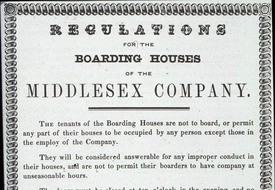
Boardinghouse Regulations, Middlesex Company, Lowell, MA, c.1846
Image ID: 8333
Collection: Karen Halttunen
Topic(s): Nineteenth Century, Lowell, Industrialization, Antebellum Reform, Business 19th century, Child labor, Civil Rights, Class Separation, Corporate Image, Early mills and factories, Early National Period, Emerging industrial city, Environmental History, Family to 1920, Gender-Bending, Immigrants, Individualism, Technology, Institutions and social disorder, Irish, Labor Organizations and Leaders, Market Economy, Mythology, National Politics, Reform, Strikes and Violence, Sweatshops, Technology, Temp to 1870's, Town and city planning, Urbanization, Victorian Culture, Women in labor movement, Women's work, Work and Housing, Working Conditions
Region(s): United States
CA Standard(s): 8.12 - The transformation of the American economy and the changing social and political conditions…in response to the Industrial Revolution, 5.8 - The colonization, immigration, and settlement patterns of the American people from 1789 to the mid-1800s..., 8.4 - The aspirations and ideals of the people of the new nation, 8.6 - The divergent paths of the American people from 1800 to the mid-1800s...with emphasis on the Northeast.
National Standard(s): Expansion and Reform (1801-1861), An Age of Revolutions, 1750-1914
Card Text: "Boardinghouse regulations, Middlesex Company," Lowell, MA, c. 1846. Each morning across New England, the factory bells tolled. And six mornings a week, the “Belles of New England” walked through the streets to the mills, trudging, talking, sometimes singing. The Mill Girls became a fixture in America’s brightest pictures of itself.
"O sing me a song of the Factory Girl/So merry and glad and free/ —The bloom on her cheeks, of health it speaks!/ — O a happy creature is she!"
But with time, a different picture emerged. The picture rarely appears in high school history, yet it tells of young women sparking the fight that continues to this day — the fight for a living wage.
The hiring of Mill Girls was driven by both capitalism and compassion. Francis Cabot Lowell had toured England’s “dark satanic mills.” He had seen children working 12-hour days, workers living in hovels, families hungry, desperate, ground into submission. Lowell had a better idea. Why not recruit farm girls? Lodge them in boarding houses? Enrich them with lectures and discussion groups? Hire older women as “keepers” to keep these “factory queens” moral and upright?
When word got out, the plan was widely praised. Poet John Greenleaf Whittier eulogized “Acres of girlhood... The young, the graceful... Who shall count your vocation as otherwise than noble and ennobling?”
At first, the girls agreed. Glad to be free of the farm, they earned enough — $2 a week — to buy clothes, save a little, and send money home. “The thought that I am living on no one is a happy one, indeed,” a New Hampshire girl wrote.
But the Iron Law of wages soon shackled them and the free market's “invisible hand” slapped them down. As more mills and more mill towns increased competition, pay was cut, hours increased. And then there were the mills themselves.
Power looms roared. Windows were nailed shut to keep cotton moist, filling rooms with lint and airborne diseases. Bosses could fire a girl for, as historian Philip Foner wrote, “levity, hysteria, impudence, or simply not being liked.”
The girls responded with spirit and charm. They pinned poetry to looms, put flowers in weaving rooms, tacked math problems on walls. “I defied the machine to make me its slave,” Lucy Larcom wrote. “Its incessant discords could not drown out the music of my thoughts if I would let them fly high enough.”
But as looms were speeded, the girls found themselves stretched as thin as the cotton they spun. Then in May 1824, mill owners in Pawtucket, Rhode Island lengthened the work week. A hundred girls walked out. New England was shocked. This first “turnout” lasted just a week, with the girls settling for only one extra hour in their workday, but it was a start.
In 1828, strikes began in earnest. For the next dozen years, hordes of girls, up to 800 in some towns, walked off the job protesting pay cuts and 12-hour workdays. In Dover, New Hampshire, striking girls formed a half-mile line marching behind a band. In Lowell, the “factory queens” met in secret, then walked out as one, going from mill to mill to gather more strikers. In 1834, America’s first female union, the Factory Girls Association, began collecting dues, forming strike funds, sticking together. Suddenly the pretty picture of pretty mill girls had a stark frame. Factory Girls Association president Sarah Bagley asked, “Is anyone such a fool as to suppose that out of six thousand factory girls in Lowell, sixty would be there if they could help it?” And girls were singing: "Oh! Isn’t it a pity that such a pretty girl as I/Should be sent to the factory to pine away and die?"
The fight for a 10-hour day had begun. By the time it was won — in 1874 — the myth of the Mill Girls was fixed in American history. But the girls themselves had gone home. Home where, as one wrote, “I shall not be obliged to rise so early in the morning, nor be dragged about by the factory bell, nor confined in a close noisy room from morning to night, just as though we were so many living machines.”
Economics provided another reason. The growth of mill towns made it impossible to find enough farm girls. By 1850, Irish immigrants were doing the work the girls had pioneered. And America’s Labor Movement -- "the folks that brought you the weekend" -- was taking root, its seeds sown by the Belles of New England.
Citation: Image: University of Massachusetts Lowell, One University Ave, Lowell, MA 01854. https://libguides.uml.edu/c.php?g=536409&p=3671354. Lowell Historical Society, P.O. Box 1826, Lowell, MA 01853. Text: Copyright Bruce Watson, "The Myth of the Mill Girls," The Attic. https://www.theattic.space/ home-page-blogs/2018/8/30/the-myth-of-the-mill-girls. All rights reserved. Aug 28, 2023.
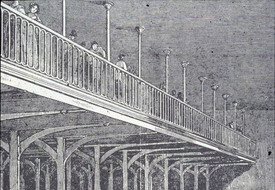
Cotton Mill Interior, England, 1851
Image ID: 8313
Collection: Karen Halttunen
Topic(s): Nineteenth Century, Industrialization, Architecture, British Empire, Business 19th century, Child labor, Cities, Class Structure, Early mills and factories, Emerging industrial city, Environmental History, Gender-Bending, Labor, Market Economy, National Events, Parents, Children, Families, Success 19th century, Sweatshops, Technology, Trade, Urbanization, Women in labor movement, Women's work
Region(s): Europe, United States
CA Standard(s): 8.6 - The divergent paths of the American people from 1800 to the mid-1800s...with emphasis on the Northeast. , 10.3 - The effects of the Industrial Revolution in England, France, Germany, Japan, and the United States. , 10.4 - Global change in the era of New Imperialism in Africa, Southeast Asia, China, India, Latin America, and the Philippines, 11.2 - The the relationship among the rise of industrialization, large-scale rural-to-urban migration, and massive immigration from Southern and Eastern Europe
National Standard(s): Expansion and Reform (1801-1861), Civil War and Reconstruction (1850-1877) , An Age of Revolutions, 1750-1914
Card Text: Mill interior, Dean Mills, The Doubling Room, 1851, detail. Women cotton workers at Dean Mills, a patterned textile factory in Barrow, England, owned by Robert Gardner, who turned it into a model industrial estate with housing and other amenities for workers. As the Industrial Revolution gathered pace, thousands of factories sprang up all over the country. There were no laws relating to the running of factories as there had been no need for them earlier, and then aggressive capitalists fought them to maximize their profits. As a result, dangerous machinery could and frequently did seriously injure and kill workers. To add to these dangers, people were required to work extremely long hours, often through the night. One of the worst features of this new industrial age was the use of child labor. Very young children worked exceedingly long hours and were severely punished for any mistakes. Arriving late for work could lead to a large fine and possibly a beating. Dozing at a machine could result in the accidental loss of a limb.
With time people recognized the danger of these conditions and started to campaign for improvements. Great resistance came from factory owners, who felt reforms would slow their factory production and and make their products more expensive. Many people also disliked government interference in their lives. Many poor parents, too, needed their children to go to work at a young age, as their wages were needed to help feed the family.
Not all factory owners kept their workers in dangerous conditions. Robert Owen, who owned a cotton mill in Lanark, Scotland, built the village of New Lanark for his workers. Here they had access to schools, doctors, and a house for each family who worked in his mills.
In 1833, the British government passed the first of many reform laws regulating working conditions and hours. At first, the government had only limited power to enforce them, but as the century progressed the rules were enforced more strictly. Nonetheless, the hours and working conditions were still inhuman by today’s standards, and no rules were in place to protect adult male workers.
Legislation was passed by the British Parliament to improve working conditions in factories:
1833: Textiles: No child workers under nine years of age; Reduced hours for children 9-13 years; Two hours schooling each day for children; Four
factory inspectors appointed.
1844: Textiles: Children 8-13 years could work only six and one-half hours a day; Reduced hours for women (12); and no night work.
1847: Textiles: Women and children under 18 years of age could not work more than ten hours a day.
1867: All Industries: The previous rules apply to workhouses (poorhouses) if more than five workers are employed.
1901: All Industries: Minimum working age raised to 12 years.
Citation: Image and text: "The 1833 Factory Act," The Illustrated London News, Oct 25, 1851. https://www.nationalarchives.gov.uk/education/resources/1833-factory-act/. The National Archives, Kew, Richmond TW9 4DU, UNITED KINGDOM. All content is available under the Open Government Licence v3.0, except where otherwise stated. Nov 26, 2022.

Lowell Co. Mills, 1868
Image ID: 8318
Collection: Karen Halttunen
Topic(s): Nineteenth Century, Lowell, Arts and Architecture, Business 19th century, Class and Status, Corporate Image, Early mills and factories, Early National Period, Emerging industrial city, Environmental History, Factory as symbol, Family to 1920, Future Progress, Immigrants, Individualism, Technology, Industrial Revolution, Invention, Irish, Labor, Mills Factories Post Civil War, National Events, Pullman and Model Towns, Success 19th century, Sweatshops, Technology, Trade, Upper Class to 1865, Urbanization, Whites, non planters ante bellum, Women in labor movement, Women's work, Work and Housing, Working Conditions
Region(s): United States
CA Standard(s): 8.10 - The multiple causes, key events, and complex consequences of the Civil War, 5.8 - The colonization, immigration, and settlement patterns of the American people from 1789 to the mid-1800s..., 8.4 - The aspirations and ideals of the people of the new nation, 8.6 - The divergent paths of the American people from 1800 to the mid-1800s...with emphasis on the Northeast.
National Standard(s): Expansion and Reform (1801-1861), Civil War and Reconstruction (1850-1877)
Card Text: Franklin Hedge, "Lowell Co. Mills," 1868. In 1814 on the Charles River in Waltham, Massachusetts, a group of Boston investors introduced the first integrated cotton textile mill. Here each step in the production of cloth from bale to bolt took place under one roof with machinery powered by water. Management also turned to an innovative source of labor, the daughters of New England Yankee farmers. The success of the "Waltham Experiment" encouraged investors to explore other sites on which to expand and print calico cloth. In 1821, they chose an area around the Pawtucket Falls on the Merrimack River at East Chelmsford, Massachusetts. This site became Lowell, the first large, planned, industrial city in America. The system of factories and power canals created here surpassed previous engineering schemes in both scale and sophistication.
At the Pawtucket Falls, the Merrimack River fell 32 feet over a series of drops and rapids in the space of a half mile. In 1796, a company called the Proprietors of Locks and Canals on Merrimack River built the Pawtucket Canal as a transportation canal to bypass these falls. The Boston investors purchased the Proprietors of Locks and Canals and some 250 acres of adjacent farmland for development in 1821. Between 1822 and 1848, they rebuilt Pawtucket Canal into a feeder canal. They planned and constructed a dam at the head of the falls, seven power canals, and 10 large companies consisting of more than 50 mill buildings, including two print works, a bleachery, and a machine shop. They also provided schools, churches, libraries, and housing for their workers. During this period, Lowell's population grew from about 2,500 to 33,000.
Lowell became America's model industrial city during the first half of the 19th century, offering the hope that the country would profit socially as well as economically by adopting industrialism as a way of life. The early Lowell system was distinguished by its state-of-the-art technology, the engineers and inventors who worked on its canal system, its mill architecture, enormous production capabilities, rational city planning, and most of all, by its much-heralded workforce of Yankee "mill girls."
Throughout the 19th century wave after wave of immigrants--Irish, French-Canadians, Greeks, Poles, and Portuguese--arrived in Lowell looking for job opportunities in the expanding textile industry. During this period Massachusetts implemented reform legislation affecting child labor, education, and working conditions that cut into investors' profit margins. In the 1920s, rather than reinvesting in aging Northern textile factories with high taxes, union labor, and expensive transportation, Lowell investors turned to new textile plants in the South. As a result, many of the textile companies in Lowell closed or moved south. A few companies diversified or produced specialized products, but from the 1920s until the 1970s, except for occasional economic booms such as during World War II, Lowell experienced some of the highest unemployment rates in the country.
Lowell was not, as sometimes claimed, the birthplace of the Industrial Revolution in America. Most of the industrial developments in the nation's history had their origins elsewhere, but at Lowell these developments converged in a revolutionary way. New forms of technology, power generation, finance, labor, and industrial organization were combined on a scale that foreshadowed today's industrialized and urbanized society.
The typical Lowell textile mill consisted of an integrated sequence of mechanized processes that transformed raw cotton into finished cloth. The system drew on diverse people and skills to make it work. Factory owners, workers, agents, overseers, machinists, millwrights, checkers, and boardinghouse keepers, together with machine belts, shafting, waterwheels, turbines, lighting and fire safety equipment, and even the building itself were all parts of an immense, complex process of interrelated functions. Viewed in its broadest perspective, the Lowell factory system reached far beyond the city limits. Vital raw material (cotton) was shipped from the American South, and finished textile products could be found in all sections of the United States, Europe, Central America, Canada, and even China. Included in this system were railroad workers, seamen, plantation owners, enslaved workers, sales agents, retail merchants, and cotton factors. From a more limited perspective, the factory system encompassed every aspect of activity confined within the walls of a given mill.
Two central components of the Boott Mills and others like the Boott were the power system and the production system. There were several other vital subsystems such as communications, lighting, heat and humidity, sanitation and safety, fire prevention, transportation, maintenance and repair, machine building, architecture and construction, management, and labor. Changes in these subsystems affected both power and production. In turn, innovations in either the power system or the production system affected the subsystems. As a result, many of the innovations and changes inherent in the founding and development of the factory system brought unanticipated consequences. In the factory system, change was the order of the day and the whole was greater than the sum of its parts.
In the United States, the first use of water-powered spinning frames took place at Slater Mill in Pawtucket, Rhode Island. Additional mills based on the Slater Mill pattern were quickly built. Using this "Rhode Island System," these mills borrowed heavily from standard English patterns, especially that of spinning in a factory and "putting out" the spun yarn to be woven into cloth at workers' homes. The spinning mills were housed in a variety of building types that were usually based on house types and buildings used for light industry in the region. Slater Mill was typical of early Rhode Island mills and used traditional building construction forms and techniques to meet the requirements of the evolving industry. Early wooden mills like Slater were replaced in the early 1800s by larger structures of either rubble stone or granite block with interior wood framing. They still looked like large houses, but they were more solid and provided better protection against the danger of fire.
Francis Cabot Lowell and his circle of Boston friends were the first to improve upon the design and organization of the early New England textile mills. Lowell's Boston Manufacturing Company was producing cloth by 1815, using power looms he had developed after observing similar machines in British factories. Their mill at Waltham, Massachusetts, was the first vertically integrated factory in the United States, meaning that all operations for its cloth production from raw materials to shipping product were accomplished under one roof. Construction of the second mill at Waltham in 1816-1818 completed the evolution of the physical form, structural system, and construction technique that later would be used in Lowell.
The standard Waltham factory plan was rectangular, 150'-160' long, reflecting the dependability of interior overhead line shafting, by 40'-50' wide, the optimum for spaces relying on exterior windows for natural light. The four stories of open floor space had a dormer-lit gable roof, brick construction with stone foundations, and a full-height exterior stair tower centered in one of the long elevations. Initially, these mills were built either as a series of similar structures, or constructed so they could easily be expanded. Drawing.
Citation: Charles Cowley, "History of Lowell" (1868) facing p. 52. First text: "Building America's Industrial Revolution: The Boott Cotton Mills of Lowell, Massachusetts (Teaching with Historic Places)," National Park Service, May 2023. https://www.nps.gov/articles/building-america-s-industrial-revolution-the-boott-cotton-mills-of-lowell-massachusetts-teaching-with-historic-places.htm. Compiled from Charles Parrott, "Industrial Heritage 1984 Guidebook: Lowell Excursion, The Fifth International Conference on the Conservation of the Industrial Heritage, 1984"; and Robert Weible, "Lowell National Historical Park" (Middlesex County, Mass.), National Register of Historic Places Registration Form, Washington, DC: National Park Service (1985). US Department of the Interior, 1849 C St NW, Washington, DC 20240. Second text: Adapted from the "Mill As A System: Developing the Interpretive Program and Three Historical Essays on 19th Century Lowell," Unpublished exhibit planning report for the Boott Mills Area, Lowell National Historical Park, by the Center for History Now, Williamsburg, Virginia, Sept 1983. Colonial Williamsburg, 101 Visitor Center Dr, Williamsburg, VA 23185. Oct 7, 2023.

Rail Truck, 19th c.
Image ID: 8230
Collection: Karen Halttunen
Topic(s): Nineteenth Century, Transportation, Agriculture, Business 19th century, Class Separation, Early National Period, Emigration and Passage, Environmental History, Expansion, Frontier, Future Progress, Immigration, Industrial Revolution, Invention, Labor, Luxury, Middle-Class Culture, National Events, Nationhood, Nature and Civilization, Railroad and steamboat, Railroads, Technology, The West, Trade, Whites, non planters ante bellum
Region(s): United States
CA Standard(s): 8.6 - The divergent paths of the American people from 1800 to the mid-1800s...with emphasis on the Northeast. , 5.8 - The colonization, immigration, and settlement patterns of the American people from 1789 to the mid-1800s..., 8.12 - The transformation of the American economy and the changing social and political conditions…in response to the Industrial Revolution, 8.8 - The divergent paths of the American people in the West from 1800 to the mid-1800s
National Standard(s): Expansion and Reform (1801-1861), Civil War and Reconstruction (1850-1877) , The Development of the Industrial United States (1870-1900)
Card Text: Rail trucks are swiveling carriages with four or six wheels beneath the front part of a locomotive or one end of a railway car. They allow rail cars to turn tight curves.
Travel in early railroad carriages was uncomfortable and sometimes dangerous. The first railroad passenger cars were built by carriage makers, so they looked like coaches mounted on four-wheeled railroad wagons. Passengers rode both inside the coach and on benches mounted on its top. Judge J.L. Gillis recalled his first railcar journey from Albany to Schenectady, NY, in 1831:
"The trucks were coupled together with chains or chain-links, leaving from two to three feet slack, and when the locomotive started it took up the slack by jerks, with sufficient force to jerk the passengers, who sat on seats across the top of the coaches, out from under their hats, and in stopping they came together with such force as to send them flying from their seats....There being no smoke or spark-catcher to the chimney or smoke-stack, a volume of black smoke, strongly impregnated with sparks, coals, and cinders, came pouring back the whole length of the train. Each of the outside passengers who had an umbrella raised it as a protection against the smoke and fire. They were found to be but a momentary protection...all having their covers burnt off from the frames... [and] the deck-passengers, each whipping his neighbor to put out the fire."
By 1834, mounted carriages were replaced by rectangular rail cars with wooden benches and a center aisle in a style recognizable today. The first cars were necessarily short to enable them to navigate tight curves. Later the cars were mounted on four-wheeled swiveling trucks, allowing the longer cars to easily navigate curves.
Early cars were called day coaches, since most trips were short and occurred during the day. A short journey was preferred because travel was extremely uncomfortable. Originally, cars were not segregated by social class; people of all walks of life rode together. By the 1840s, however, passage was sold on second-class cars and, in some cases, third-class or "emigrant" cars that carried settlers west. Passengers on the emigrant cars endured miserable conditions, often having to sit on a wooden bench along the wall. Some emigrant cars were freight cars fitted temporarily with wooden seats or benches for the trip to the Midwest and then filled with grain for the trip back East.
With westward movement, trains covered longer distances and passengers demanded increased amenities. As rail travel extended into the Midwest, a passenger from the East might sit on a hard, wooden seat for 48 hours to reach Chicago. Some effort was made to make the coaches more comfortable by upholstering the seats, but low ceilings, lack of heating and ventilation, and rudimentary suspension systems still made for an awful ride. As ridership and competition between railroads flourished, passengers reaped the rewards of improved car design.
Though sleeping cars were introduced early (Richard Imlay built the first sleeper in 1837 for the Cumberland Valley Railroad), they were often just folded-down wooden seat backs or wooden shelves hanging from the car ceiling. The passenger felt each jolt and sway. In the early years, with most trains operating only in daylight on fairly short runs, there was little demand for sleeping cars. By the 1850s, with travel distances lengthening, demand increased. When Pullman sleeping cars were introduced in the 1860s, long-distance travel became quite comfortable.
Though George Pullman did not invent the sleeping car, his name became synonymous with it. His first cars were fairly primitive but over time he raised ceilings, improved ventilation, increased comfort, and introduced a dedicated car attendant to make the beds and assist the travelers. By the 1860s and '70s, Pullman cars were elegant and even lavish, further distinguishing first class travel. Pullman eventually monopolized the sleeping car industry.
Food amenities were difficult to come by in the early years of train travel. Vendors sold sandwiches at some stations. On the longer routes, some stations had restaurants, but stops were short, with few tables, and passengers had to make a mad dash in hopes of being served in time. Many passengers supplied their own food for the journey. Dining cars came into fashion in the late 1860s but were expensive to build and operate. Because the high cost made them impractical, they were first used only in the Midwest to accommodate passengers travelling long distances. By the 1880s, dining cars were more common and more elegant. They were included on long-distance trains into the 20th century, but they almost always lost money and were maintained only as a convenience for the passengers.
Other specialty cars sprang up along the way. Originally, baggage travelled in the same car with the passenger, though dedicated cars soon followed. Trains carried mail as early as 1831, and by the early 1860s, mail was sorted and bundled in cars designed for the purpose and delivered along the rail line. Various "mailbag catchers" were designed to exchange mailbags on the fly as trains passed through towns. Refrigerator cars came into use in the 1860s, mainly to cool shipments by packing ice into insulated walls at the ends or in the middle of the cars. Livestock cars were designed to carry animals to market. As a demand of labor, the caboose evolved from use as a storage car to an office and living quarters for the conductor and crew.
Citation: Copyright Shelburne Museum, PO Box 10, Shelburne, VT 05482. All rights reserved. Text: "The Transcontinental Railroad: Rail Cars of the 19th Century."
https://railroad.lindahall.org/essays/rail-cars.html. Quotation from William H. Brown, "The History of the First Locomotives in America from Original Documents and the Testimony of Living Witnesses," 1871. ©2012 Linda Hall Library, 5109 Cherry St, Kansas City, MO 64110-2498. All rights reserved. Oct 24, 2022.

Two Women Weavers, Lowell, MA, 1860
Image ID: 8319
Collection: Karen Halttunen
Topic(s): Nineteenth Century, Lowell, Abolitionism, Americanization and Political Activity, Antebellum Reform, Arrival, Business 19th century, Child labor, Class and Status, Corporate Image, Domesticity, Early mills and factories, Early National Period, Emerging industrial city, Environmental History, Factory as symbol, Family to 1920, Immigrants, Industrial Revolution, Invention, Irish, Labor Organizations and Leaders, Market Economy, Moral lessons, National Events, Parents, Children, Families, Politics & Government, Prejudice and Discrimination, Pro feminist and suffrage, Pullman and Model Towns, Religion, Social disorder and order to 1865, Strikes and Violence, Success 19th century, Sweatshops, Technology, Urbanization, War of 1812, Whites, non planters ante bellum, Women in labor movement, Women's liberation, Women's organizations, Work and Housing, Working Class Culture, Working Conditions
Region(s): United States
CA Standard(s): 8.12 - The transformation of the American economy and the changing social and political conditions…in response to the Industrial Revolution, 5.8 - The colonization, immigration, and settlement patterns of the American people from 1789 to the mid-1800s..., 8.4 - The aspirations and ideals of the people of the new nation, 8.6 - The divergent paths of the American people from 1800 to the mid-1800s...with emphasis on the Northeast. , 8.9 - The early and steady attempts to abolish slavery and to realize the ideals of the Declaration of Independence.
National Standard(s): Expansion and Reform (1801-1861), Civil War and Reconstruction (1850-1877) , The Development of the Industrial United States (1870-1900)
Card Text: Two women weavers, Lowell, MA, 1860. Samuel Slater’s construction of a water-powered spinning mill in Rhode Island in 1790 pioneered the manufacturing wave that swept across New England after the War of 1812. Factory production helped to transform the United States from the mostly agrarian society Thomas Jefferson had envisioned to the dual agricultural and manufacturing giant of which George Washington had dreamed. Industrialization was a gradual process, but it profoundly affected the American economy and society. An early indication of change occurred in the 1830s and 1840s with the emergence of the factory system and a new, vocal sector of working-class women in and around Lowell, Massachusetts.
Women had actively participated in the US workforce before industrialization. In 1820, more than 90 percent of the population lived in the countryside or in villages of fewer than 2,500 inhabitants. More than 70 percent engaged in agriculture. But rural workers did not just milk cows and till fields. As in Europe, women did most of the pre-industrial manufacturing inside their own homes. Small Rhode Island spinning mills followed Slater’s example in employing whole families on site, including children, but generally outsourced the final steps of production to laborers who toiled at home. This process was called the Rhode Island or "outwork" system. Female domestic workers dominated this form of textile production in the early 19th century, producing more than two-thirds of the clothing manufactured in the US.
Working conditions were hard. In addition to sewing, knitting, and weaving, women working at home had to bear and raise children, prepare food, carry out domestic chores, and manage household finances. Nor could they enjoy the proceeds of their own labor except in common with their families. Their legal rights, particularly in the ownership of property, were almost nonexistent. In such circumstances, opportunities to work outside the home in the large, new textile factories arising in New England after 1814 looked attractive to many young, single women.
Boston merchant Francis Cabot Lowell visited Great Britain just before the War of 1812, observing the new technologies at use in the growing factories there. Unable legally to obtain printed specifications of these technologies, Lowell, like Samuel Slater, carried them in his mind. In 1813, he and master mechanic Paul Moody succeeded in replicating a British power loom. Lowell then partnered with other merchants to create the Boston Manufacturing Co. and built a large textile mill in Waltham, Massachusetts. This company started the Northeastern textile industry by building water-powered textile mills along suitable rivers and developing mill towns around them.
The old water-powered spinning mills produced yarn that workers finished at home on hand looms, but the new power loom allowed all this work to be finished in one process at one location. Lowell and his Boston Associates used an organizational method called vertical integration, in which a company controls all the stages of production from the raw materials to marketing. The creation of the plant itself encouraged technological innovations to the spinning machines that improved productivity from year to year. And the plant employed almost no children. Instead, Lowell and his colleagues chose to recruit a workforce of young, single women.
This new process, called the factory system, was extremely successful despite British efforts to dump cheap textiles into the North American market after the war in 1815. From its founding until 1823, Boston Manufacturing Co.’s sales increased from $3,000 annually to more than $300,000. In the 1820s, mills and mill settlements expanded along the Merrimack River in Massachusetts. The most important, the town of Lowell, was named in honor of the company’s founder, who died in 1817. Thanks to the success of its factories, Lowell grew quickly. Its population soared from 6000 in 1830 to 33,000 in 1850, making it second in population in Massachusetts only to Boston.
A few magnates, the Boston Associates, concentrated in their hands control of almost all of these mills. They worked together as a cartel on common policies for technology and labor, holding down wages and dictating working conditions. They frowned on competition among themselves and appointed an agent in Lowell to ensure that every aspect of their factory system was managed efficiently.
Eighty to 90 percent of the mill workers were women, who came to be known as the "Lowell Girls." Almost all were single, from rural or small-town families of modest means. Their testaments were published in their own periodical, the "Lowell Offering," and suggest they entered the factory system not under orders from their families or driven by want, but because they wanted to better their own lives and earn money before they married. In consequence, female mill workers tended to marry much later than other women. Their work also gave them new experiences that made them less likely to retain their parents’ values. And when they left the mills, they tended to settle in large towns rather than returning to farms.
The female workers made sacrifices, too. Unlike domestic industries, the factory environment was highly controlled. The women worked six days a week for 12 to 14 hours a day, with only three holidays and Sundays to rest. They had to work at least a year in any job and give two weeks’ notice before departure. If anyone violated these terms, the Lowell bosses "blackballed" her, making certain she never worked in their factories again. The work was repetitive and often dangerous, with no government oversight of working conditions for safety. Penny-pinching managers regulated every moment of the work day to ensure maximum productivity, essentially cutting laborers off from the outside world. Women rarely held supervisory responsibilities and were employed in part because they accepted such low wages.
The Lowell manufacturers required their female workers to board together in brick company housing, built in the 1830s to replace earlier ramshackle wooden structures. Up to forty women lived in a typical boardinghouse, with up to eight per room and two per bed. The houses were kept clean and reasonably comfortable, and the meals were adequate and regular. However, the women were expected to obey strict rules designed to ensure "moral" living, including regular church attendance. Boardinghouse keepers attempted to enforce these rules but could not be everywhere at once.
Ultimately, the women developed their own community values. Through working and boarding together in company housing, and by producing their own literature, they created a shared culture and experience. They did not fight the system as it stood, but when the Boston Associates colluded to reduce their wages in 1834 and 1836, the women went on strike. When management proposed rent increases for those living in company boarding houses, the female textile workers in Lowell responded in 1836 by forming the Lowell Factory Girls Association and organizing a “turn-out” or strike, and writing a constitution for their association, an early labor union. In doing so, they joined a wider pattern of labor organization and unrest across the country, spurred by the rise of the factory system.
By the 1840s, the Lowell Girls' labor activism had become fairly constant. The Ten-Hour Movement began during that decade as the women petitioned the state legislature every year to reduce the working day by two hours. They formed the Lowell Female Labor Reform Association (LFLRA) in 1844, and this group, well-organized and eventually offering sickness insurance to members, became a fully integrated and active part of larger New England labor organizations such as the New England Workingmen’s Association (NEWA). The NEWA made the newspaper "Voice of Industry" its organ in 1845, and the LFLRA’s president Sarah Bagley became a member of the paper’s three-person committee. Under Bagley's influence the paper protested the new, profit-driven economic system that we today call “capitalism.” An uncompromising advocate for women’s rights, publishing pieces about marriage, suffrage, and equality, the paper also addressed itself to a range of social issues including slavery, capital punishment, and war.
Workers did not always agree. Activists usually remained in the minority, competing with conservatives, who published their opinions in the "Lowell Offering." Yet the scale of this women’s labor movement was unprecedented even though the Ten-Hour Movement did not secure any meaningful concessions for workers at the time.
Shrugging off the labor agitation, the Boston Associates continued to grow, with output doubling between 1850 and 1860. The social implications were tremendous. Vast profits drove the growth of the wealthy class and the great expansion of the urban poor. By 1860, about 41 percent of the US workforce labored outside agriculture, and standardized production of cotton textiles and footwear in the factory system had become the norm. In New England, the creation of factories produced urbanization, with 36 percent of the population living in cities or large towns by 1860. Approximately 60,000 women worked in the large New England textile mills by this time. The factory system also fostered immigration, and in the wake of the Irish famine of 1846-1852, thousands of Irish immigrants moved to Lowell to work in the factories. The companies did not provide them houses, churches, or other services as they had for the mill girls earlier. By 1860, immigrants from Ireland, French Canada and Germany made up perhaps 50 percent of the Lowell factory workforce. Photo.
Citation: Image: Public domain. The American Textile History Museum, 491 Dutton St, Lowell, MA 01854 is defunct. Text: Adapted from Edward G. Lengel, The National World War II Museum, "The Lowell Girls." https://billofrightsinstitute.org/essays/the-lowell-girls. ©2022 Bill of Rights Institute, 1310 N. Courthouse Rd #620, Arlington, VA 22201. All rights reserved. Nov 27, 2022.

Welby, Place of Worship and Burial Ground at Ligonier Town, PA, 1821
Image ID: 8355
Collection: Karen Halttunen
Topic(s): Antebellum Reform, Religion, Beaches and Parks, Business 19th century, Class and Status, Drummers, Early National Period, Exhibition, Family to 1920, Frontier, Gender-Bending, Holy Land, Institutions and social disorder, Media, Moral lessons, National Events, Nineteenth and Twentieth Century, Numinous, Outdoor Life, Parents, Children, Families, Popular recreation to 1865, Prejudice and Discrimination, Shakers, Social Gospel and Missions, Southern Society, Success 19th century, Symbols of mass society, Temperance and Prohibition, Utopias pre 1860, Women's liberation
Region(s): United States
CA Standard(s): 8.1 - Major events preceding the founding of the nation and the development of American constitutional democracy, 8.4 - The aspirations and ideals of the people of the new nation, 5.8 - The colonization, immigration, and settlement patterns of the American people from 1789 to the mid-1800s..., 8.7 - The divergent paths of the American people in the South from 1800 to the mid-1800s , 8.8 - The divergent paths of the American people in the West from 1800 to the mid-1800s , 11.3 - The role of religion in the founding of America and its lasting moral, social, and political impacts, and issues regarding religious liberty.
National Standard(s): Expansion and Reform (1801-1861)
Card Text: Adlard Welby, "Place of Worship and Burial Ground" at Ligonier Town, PA, 1821. This camp-meeting ground north of Redstone, PA, was typical of those used by many frontier ministers for revivals and regular religious services. Between 1799 and 1805, the backcountry settlements of the early American frontier blazed with religious excitement. From western Pennsylvania to northern Georgia, middle Tennessee to the Carolina piedmont—but especially in the Bluegrass Country of Ohio—tens of thousands of frontier settlers gathered for multi-day, open-air religious meetings in which teams of Baptist, Methodist, and Presbyterian ministers preached from morning until late at night. The ministers claimed to have converted thousands at these camp meetings during the early 19th century. From innovations in theology and hymnody to church organization and denominational growth, this "Great Revival" shaped the development of early American evangelicalism and the southern Bible Belt.
The revivals also stimulated new religious practices known as the “bodily exercises,” in which some worshippers in the throes of conversion collapsed to the ground, then rose up, and began dancing. Others lay insensate for hours, enraptured with dramatic visions of heaven and hell. Camp meeting participants barked liked dogs, scampered up trees, engaged in trance walking, ran headlong through the woods, faced off in mock boxing matches, and burst into uncontrolled peals of "holy laughter." Observers heard worshippers speaking in unknown tongues and heard music issuing miraculously from the chests of young converts.
Of the various physical religious exercises that spread across the trans-Appalachian frontier and southern backcountry during the Great Revival, none drew more astonishment or opposition than “the jerks,” involuntary convulsions in which the worshippers’ heads lashed violently backward and forward. More than fifty years before the contemptuous phrase "holy roller" was coined to describe the ecstatic worship practices of Holiness and Pentecostal evangelicals in Appalachia, the subjects of these extraordinary bodily fits were known as “Jerkers.”
Although religious revivalism recurred periodically in 18th-century America, the Great Revival was unusual. First, its scale was unprecedented; the most famous of these open air religious meetings—the 1801 sacrament at the Cane Ridge meetinghouse near Paris, Kentucky—drew crowds estimated at 12,000. Observers learned to gauge the intensity of revival gatherings by the purported number of conversions and by the number of wagons and tents visible. Second, the frontier revivals were ecumenical affairs that attracted mixed audiences of Baptists, Methodists, and Presbyterians and blended their rituals, preaching styles, and singing traditions into unique “Union Meetings.” Most important, the camp meetings of the Great Revival transformed religious experience in the west. At first, ministers expressed joy at the conversion experiences of their audiences, but increasingly those experiences were physically dramatic as large numbers of converts were “struck down” to the ground while listening to powerful sermons. Soon the “falling exercise” included uncontrollable weeping, shaking, holy laughter, ecstatic dancing, and trance phenomena. For many participants, the worshippers' movements signaled the descent of God’s Holy Spirit upon the bodies of the faithful. But others struggled to account for these increasingly extravagant “bodily exercises” that seemed destructive of order in worship. "The jerks" sometimes manifested as spasmodic “shuddering” gesticulations of neck and head, and other accounts described jerkers as bouncing from “place to place like a foot-ball” or thrashing like a “fish, when thrown out of the water.” "The jerks" purportedly struck riders on horseback, men plowing in the fields, boys at their school desks, young girls drinking tea, families at supper, people in bed, musicians at play, and nursing mothers. They erupted without warning and without regard to age, class, gender, or physical constitution. Pious saints and notorious sinners were “taken,” “seized,” or “attacked” by the jerks, which often traveled from person to person like a “sympathetic contagion.” Witnesses even recounted stories of the jerkers’ preternatural strength, of diminutive women hurling 200-pound men to the ground and of floundering men leaving imprints of their knuckles on the massive timber walls of pioneer log churches.
The jerks incited vigorous debates in newspapers, magazines, religious tracts, medical dissertations, and tavern conversations. This astonishing "nervous affection” of “violent twitching and jerking” was “awful to behold,” “dreaded and hated, and even cursed by some,” and “altogether without precedent in Christian lands.” Eventually, most ministers and lay people decried the “corporeal agitation” of revival gatherings as the “inspirations of fanaticism” or, worse, signs of madness, witchcraft, or demonic possession. Yet for some, the jerks remained a “judgment sent from God…to bring sinners to repentance.”
Within a decade of the first outbreak of the jerks in east Tennessee, ministers of all persuasions began distancing themselves from what one Methodist clergyman later called a "very strange as well as disgusting exercise." Bodily exercises, recalled one pastor in 1833, “were of unspeakable injury to the church.” Even as Presbyterian, Baptist, and Methodist ministers turned against the jerks, however, migrating settlers were importing the distinctive bodily practice to new settlements on the prairies of the Midwest. Itinerant preachers occasionally encountered jerkers as far south as the Mississippi Territory. Abraham Lincoln undoubtedly witnessed them near his law office in New Salem, Illinois.
By the mid-19th century, the chaotic bodily exercises of the Great Revival were rapidly receding into folklore, at least among "respectable" Protestant writers. Their autobiographies featured "jerker tales" of two distinct genres: humorous accounts of dancing masters, drunkards, and other notorious sinners, or outspoken revival critics who boasted they would never be taken by the jerks only to be seized by them almost instantly; and lurid stories of jerkers experiencing physical violence and even death. While ministers, physicians, and skeptical laypeople belittled the jerks as a nervous disorder, others saw the convulsions as a form of spirit possession in which the Holy Spirit violently wrenched reluctant sinners into the new birth. Not only did the jerks fuel the explosive growth of the earliest Shaker communities in the west, they also guided the growth of the distinctive religious culture of the Appalachian mountain region. Rooted in a deep tradition of Scots-Irish popular piety, jerking and snake handling have been dynamic innovations in worship by a people long thought to be conservative and backward. Today the “involuntary movements” of the Great Revival remain central to the religious experiences of many Appalachian mountain Protestants, just as they have for more than a century and a half. These serpent-handling descendants of the early jerkers are often still derided as "holy rollers," but evangelical Christian revivals have persisted and grown in the early 21st century. Drawing.
Citation: Adlard Welby, Esq, "A Visit to North America and the English Settlements in Illinois with a Winter Residence at Philadelphia: solely to ascertain the actual prospects of the emigrating agriculturist, mechanic, and commercial speculator," South Rauceby, Lincolnshire (London, 1821; reprinted [Cleveland, OH: Arthur H. Clark Co., 1905]). Library of Congress Rare Book and Special Collections Division, Washington, DC 20540. LC Control No.: 01028364. Text: Adapted from Douglas L. Winiarski, Religious Studies Department, University of Richmond, "A History of the Jerks: Bodily Exercises and the Great Revival: A digital archive of first-person accounts from the turn of the 19th century chronicling an unusual display of religious ecstasy." Copyright © 2019 Omohundro Institute of Early American History and Culture. This article first appeared in The William and Mary Quarterly 76:1 (2019): 111-150. All rights reserved. April 9, 2018

Delia Page, Lowell Worker, c. 1860
Image ID: 8325
Collection: Karen Halttunen
Topic(s): Nineteenth Century, Lowell, Antebellum Reform, Business 19th century, Child labor, Class Structure, Corporate Image, Early mills and factories, Early National Period, Environmental History, Factory as symbol, Family to 1920, Industrial Revolution, Invention, Labor, Market Economy, National Events, Nineteenth Century Children, Parents, Children, Families, Pro feminist and suffrage, Pullman and Model Towns, Strikes and Violence, Sweatshops, Technology, Urbanization, Women in labor movement, Women's organizations, Women's work
Region(s): United States
CA Standard(s): 5.8 - The colonization, immigration, and settlement patterns of the American people from 1789 to the mid-1800s..., 8.3 - The foundation of the American political system and the ways in which citizens participate in it, 8.4 - The aspirations and ideals of the people of the new nation, 8.6 - The divergent paths of the American people from 1800 to the mid-1800s...with emphasis on the Northeast.
National Standard(s): Expansion and Reform (1801-1861), An Age of Revolutions, 1750-1914
Card Text: Delia Page, a Lowell worker about 19 years old, c. 1860, photo. A factory "operative" from New Hampshire, Delia was not a published writer but she did save the letters she received in Lowell, in which her family tried to dissuade her from associating with a young man who proved to be a ruffian.
Another Lowell mill girl describes the workers' experience:
"The early mill girls were of different ages. Some were not over ten years old; a few were in middle life, but the majority were between the ages of 16 and 25. The very young girls were called 'doffers.' They 'doffed,' or took off, the full bobbins from the spinning frames, and replaced them with empty ones. These mites worked about 15 minutes every hour and the rest of the time was their own. When the overseer was kind they were allowed to read, knit, or go outside the mill yard to play. They were paid two dollars a week. The working hours of all the girls extended from five o'clock in the morning until seven in the evening, with one half-hour each, for breakfast and dinner. Even the doffers were forced to be on duty nearly 14 hours a day. This was the greatest hardship in the lives of these children. Several years later a ten-hour law was passed, but not until long after some of these little doffers were old enough to appear before the legislative committee on the subject, and plead, by their presence, for a reduction of the hours of labor. Those...mill girls who had homes generally worked from 8 to 10 months in the year; the rest of the time was spent with parents or friends. A few taught school during the summer months. Their life in the factory was made pleasant to them. In those days there was no need of advocating the doctrine of the proper relation between employer and employed. The most prevailing incentive to labor was to secure the means of education for some male member of the family. To make a gentleman of a brother or a son, to give him a college education, was the dominant thought in the minds of a great many of the better class of mill girls. I have known more than one to give every cent of her wages, month after month, to her brother, that he might get the education necessary to enter some profession. I have known a mother to work years in this way for her boy. I have known women to educate young men by their earnings, who were not sons or relatives. There are many men now living who were helped to an education by the wages of the early mill girls.
"One of the first strikes that ever took place in this country was in Lowell in 1836. When it was announced that the wages were to be cut down, great indignation was felt, and it was decided to strike or 'turn out' en masse. This was done. The mills were shut down, and the girls went from their several corporations in procession to the grove on Chapel Hill, and listened to incendiary speeches from some early labor reformers. One of the girls stood on a pump and gave vent to the feelings of her companions in a neat speech, declaring that it was their duty to resist all attempts at cutting down the wages. This was the first time a woman had spoken in public in Lowell, and the event caused surprise and consternation among her audience.
"It is hardly necessary to say that, so far as practical results are concerned, this strike did no good. The corporation would not come to terms. The girls were soon tired of holding out, and they went back to their work at the reduced rate of wages. The ill-success of this early attempt at resistance on the part of the wage element seems to have made a precedent for the issue of many succeeding strikes."
Citation: Copyright holder unknown. Mildred Tunis. Text: Harriet Hanson Robinson, "Loom and Spindle, or Life Among the Early Mill Girls," 1898. Robinson (1825-1911) was a women's rights advocate and abolitionist who worked in the Lowell mill from 1832 (age 7) until her marriage in 1848. She published an autobiography of her experiences at the mill in 1898, contributed works to the "Lowell Offering," and published a book on women’s voting entitled "Massachusetts in the Woman Suffrage Movement" from 1774 to 1881.

Pre-Industrial Shoemaking Shop, Lynn, MA,1880
Image ID: 8306
Collection: Karen Halttunen
Topic(s): Nineteenth Century, Industrial Revolution, 18th Century Interiors, Agrarian Reform, Arts and Architecture, Black Education and Self Help, Business 19th century, Child labor, Class Separation, Domesticity, Early mills and factories, Early National Period, Emerging industrial city, Environmental History, Individualism, Technology, Invention, Labor, Market Economy, Masculinity, Mills Factories Post Civil War, Naive Art, Nineteenth Century Interiors, Parents, Children, Families, Pre-Industrial Work - Misc., Success 19th century, Sweatshops, Trade, Urban poverty, Whites, non planters ante bellum, Work and Workers
Region(s): United States
CA Standard(s): 8.4 - The aspirations and ideals of the people of the new nation, 5.8 - The colonization, immigration, and settlement patterns of the American people from 1789 to the mid-1800s..., 8.10 - The multiple causes, key events, and complex consequences of the Civil War
National Standard(s): Revolution and the New Nation (1754-1820s) , Expansion and Reform (1801-1861), The Development of the Industrial United States (1870-1900)
Card Text: Pre-industrial shoemaking shop: "Shoemakers in a 'ten-footer' shop," 1880. Like many other industries, shoe manufacturing changed in the early 19th century. Until then most shoemakers worked in their homes or small workshops (called “ten-footers”), where they performed every stage of production. With the turn of the century, spurred by the increasing demand for cheap shoes, entrepreneurs established factories based on a division of labor. Production was divided into a number of stages that could each be completed by less-skilled workers. Those who owned larger shops prospered, while many skilled workers suffered as they were forced to become wage workers. By the time this engraving was published in 1880 of a master and journeymen making shoes in a workshop attached to the master's home, the shoemaker's “ten-footer” was only a memory.
Traditional craft production centered around an independent master artisan, his journeymen, and the apprentice helpers who worked together in small shops. Apprentices worked alongside masters and received training in the “mysteries of the craft” in exchange for their labor. Journeymen looked forward to becoming proprietors when they accumulated sufficient capital and skill. In his "Sketches of Lynn" (1880), David Johnson recalled the masculine work culture and small-scale shoe industry in early-19th century Lynn, Massachusetts. With transportation improvements and growing commercial activity, manufacturing moved from small shops engaged in custom work to large-scale production of ready-made goods. No town experienced greater dislocation than Lynn, where shops multiplied, the division of labor increased, and some masters opened larger central shops. Less skilled workers, including women and children, replaced journeymen, apprenticeship declined, and the world that Johnson described faded.
Lasting is the part of the process that sets the final shape of a shoe and holds it in place so the outsole can be permanently attached. Designing a machine to perform the lasting was thought to have been impossible. It took a young Black immigrant from Surinam, Jan Ernst Matzeliger (1852–89), to automate this task. He revolutionized the industry of shoemaking with his lasting machine. It cut the cost of manufacturing shoes in half, thereby making shoes more affordable. He worked for 10 years developing the machine and in 1883 received a patent for it. The first public demonstration of the machine took place in 1885, when the machine broke a record by lasting 75 pairs of shoes. He later received several other patents for shoe-manufacturing machinery. Unfortunately, in pursuing his work, Matzeliger sacrificed his health by working long hours and not eating for long periods. He died of tuberculosis three weeks before his 37th birthday, never reaping the profit of his invention. Print.
Citation: Courtesy of The New York Public Library, Fifth Ave at 42nd St, New York, NY 10018. Our thanks to the NYPL for its generosity. First text: M. Newhall in David N. Johnson, "Shoemakers in a “ten-footer” shop," in "Sketches of Lynn, or the Changes of Fifty Years" (1880). https://historymatters.gmu.edu/d/ 6716/ and https://historymatters.gmu.edu/search.php?function=find. Second text: "David Johnson Recalls the Shoemakers’ Shops of Lynn, Massachusetts." https://historymatters.gmu.edu/d/6382/#:~:text=of%20Lynn%2C%20Massachusetts-,David%20Johnson%20Recalls%20 the%20 Shoemakers'%20Shops%20of%20Lynn%2C%20Massachusetts,worked%20together%20in%20small%20shops. "History Matters: The US Survey Course on the Web." Created by the American Social History Project / Center for Media and Learning (Graduate Center, CUNY) and the Roy Rosenzweig Center for History and New Media (George Mason University). Copyright 1998-2023 American Social History Productions, Inc. Last updated: March 22, 2018. All rights reserved. Third text: Adapted from Tamara Shiloh, "Jan Ernst Matzeliger’s Invention Revolutionized Shoe Manufacturing," June 9, 2022. https://www.postnewsgroup.com/jan-ernst-matzeligers-invention-revolutionized-shoe-manufacturing/. Copyright ©2021 Post News Group, Inc., 360 14th St, Lower Level, Oakland, CA 94612. All rights reserved. Nov 16, 2023.

American Stage Waggon, Spread Eagle Tavern, Stafford, PA, 1798
Image ID: 8219
Collection: Karen Halttunen
Topic(s): Nineteenth Century, Transportation, 18th Century Exteriors, Arts and Architecture, Business 19th century, Class and Status, Early Images -- America, Early National Period, Emerging industrial city, Environmental History, Expansion, Frontier, Individualism, Technology, Invention, Labor, Middle-Class Culture, Nationhood, Nature and Civilization, Nineteenth Century Furniture, Outdoor Life, The West, Victorian Culture
Region(s): United States
CA Standard(s): 8.6 - The divergent paths of the American people from 1800 to the mid-1800s...with emphasis on the Northeast. , 5.8 - The colonization, immigration, and settlement patterns of the American people from 1789 to the mid-1800s...
National Standard(s): Revolution and the New Nation (1754-1820s) , Expansion and Reform (1801-1861)
Card Text: Isaac Weld, Jr. (Irish, 1774-1856), "American Stage Waggon" at the Spread Eagle Tavern, Stafford, PA, on the "Great Road" between Philadelphia and Lancaster, 1798. Dubliner Isaac Weld sailed to Philadelphia in 1795 and spent two years traveling the east coast of Canada and the newly-formed United States on horseback, foot, and canoe along rivers and through dense forests. During his travels he met George Washington and Thomas Jefferson. His trip was intended partly to find places suitable for Irish immigration. In the end, he preferred Canada to the US, finding Americans too materialistic, and he found the quality of US taverns “indifferent." In this American scene, a stagecoach is pulling away from a rural tavern.
The predecessor of the early 19th-century stagecoach was the so-called "stage waggon" in common use during the latter part of the 18th c. The first so-called stage coaches in upstate New York were primarily inventions of a local carriage or wagon-maker. As soon as wagon roads were broken through the forests, the primitive "stage-waggon," as it was called, made its appearance. The "stage-waggons" or "coachees" were in use throughout the country, all of the same general design. As early as 1767 a "stage-chaise" was operating between Salem and Boston, Massachusetts, while "stage-coaches" and "stage-waggons" plied other shorter routes out of Boston. After the Revolutionary War, the stagecoach business expanded into New York State, where the familiar "stage-waggon" woodcuts adorned advertisements as early as 1795. The wagon body was long in proportion to its breadth and contained four seats, each holding three passengers, who sat facing forward. From the height of the seats the coach was open all around. The roof was supported by slender shafts rising at the corners and sides. In wet weather a leather apron was let down at the sides and back, and fastened to buttons. A curtain in the front separated the driver from the passengers. The wagon had no door and the passengers got in through the front, stepping over the seats as they went to the end of the wagon. The driver sat on the front seat with a passenger on either side. The heavier luggage and trunks were fastened behind on a frame while smaller articles and the nail bag were stuffed under the seats, to the great annoyance of the passengers, who were frequently forced to sit with their knees up to their chins. One traveler remarked that the passengers' feet were squeezed between two trunks, "where they are most lovingly compressed whenever the vehicle makes a lurch into a rut." The body of the wagon, as in the the early stagecoaches, was suspended on two leather straps lengthwise under it and secured on strong horizontal bars in front and behind. There were no backs on the benches to support passengers during a rough and fatiguing journey over a new, poorly constructed road. The first three passengers in had the advantage of resting their shaken frames on the back of the wagon. Women were usually given these seats and it was "amusing" to some to watch them crawl over the seats; if the women happened to be late, they had to straddle over the men who sat in front. This vehicle was in use on the road west of Albany as late as l8l8. One visitor noted two classes of "stage-waggons" in use: "The light waggons are on the same construction, and are calculated to accommodate from four to twelve people. The only difference between a small waggon and a coachee is that the latter is better finished, has varnished panels, and doors at the side. The former has no doors, but the passengers scramble in the best way they can, over the seat of the driver. The waggons are used universally for stage carriages." Stories were told of the driver's requesting passengers to lean out of the carriage, first to one side and then the other, to prevent the stage from overturning in deep ruts. Contradicting the frequency of stories of accidents, another visitor to the US noted in 1807: "Though the roads are in general very bad, yet the clumsy waggon is proportionably strong to encounter the shocks; and accidents but rarely happen." Gradually this "stage waggon" was replaced by a new type of coach that had just three seats and a door at the side. The driver's seat was outside and separate from the interior, and the front seat faced backward. On the New York to Albany route there was a locked box under this seat for the through mail. Only the postmasters at each end had keys to open mail sacks. This type of coach was encouraged by the Post Office Department and was designed for it by Levi Pease, proprietor of a stage line between New York and Boston. J. Stoner engraving of drawing.
Citation: Isaac Weld, "Travels Through the States of North America, and the Provinces of Upper and Lower Canada, during the Years 1795, 1796, and 1797," (London, England, 1799). Library of Congress Prints and Photographs Division, Washington, DC 20540. LC-USZ62-1800. Second text: Adapted from Richard F. Palmer, "Stagecoach Days: Evolution of the Stagecoach," Oct 9, 2011. http://stagecoachdays.blogspot.com/2011/10/evolution-of-stagecoach.html. Copyright Richard F. Palmer. All rights reserved. Sept 6, 2023.

Pomarede, View of Early St. Louis, 1832-35
Image ID: 8207
Collection: Karen Halttunen
Topic(s): Nineteenth Century, Transportation, Arts and Architecture, Business 19th century, Cities, Developing Nations, Early National Period, Emerging industrial city, Environmental History, Expansion, Frontier, Industrial Revolution, Jacksonian Era, Labor, Market Economy, Nationhood, Railroad and steamboat, Success 19th century, Technology, The West, Trade
Region(s): United States
CA Standard(s): 8.6 - The divergent paths of the American people from 1800 to the mid-1800s...with emphasis on the Northeast. , 5.8 - The colonization, immigration, and settlement patterns of the American people from 1789 to the mid-1800s..., 8.4 - The aspirations and ideals of the people of the new nation, 8.5 - U.S. foreign policy in the early Republic, 8.8 - The divergent paths of the American people in the West from 1800 to the mid-1800s
National Standard(s): Expansion and Reform (1801-1861)
Card Text: Leon Pomarede, (French, c. 1807-92), "View of St. Louis" with steamboats, 1832-35. St. Louis, MO, was the “Gateway to the West,” a thriving metropolis and trade center during the 19th century. Explorers, fur trappers, hunters, merchants, and settlers all passed through the busy hub on the Mississippi River. Pomarede, a Frenchman who immigrated to the US around 1830, lived and worked in St. Louis for over 50 years. In this painting, he captured the bustling activity of ferryboat traffic. He took this view looking west from the Illinois side of the river..
A journey to St. Louis lasted many days as each steamboat pulsed past the tangled, heavily wooded banks of the Ohio River from Pittsburgh or Cincinnati, or pushed up against the Mississippi current from New Orleans. Passengers knew they were near their destination when they caught sight of the chimneys of flour mills and breweries spewing smoke into the blue prairie sky. As the boat drew closer, they saw church spires, and then the city itself, three parallel streets of pink brick stores and houses, on a limestone bluff on the left bank. St. Louis was halfway across the continent, and by the 1830s the former French trading post had a population approaching 10,000. With its warehouses, provision merchants, gunsmiths, saddlers, horse dealers, and wagon makers, this city was the marketplace of the frontier, dominating western trade and commerce. Most passengers were arriving to do business: insurance agents and corn dealers, salesmen from the East bringing samples of hardware or fabrics, soldiers and government officials heading to new postings. The age of the steamboat had arrived, with as many as eighty vessels in the river at once. As each boat nosed in, tying up at a diagonal, a throng of porters, carters, and runners for hotels and rooming houses rushed toward it. The air was filled with a cacophony of sound: The roar from the boats releasing steam from their high-pressure boilers, the shouting from the crowds of vendors and touts, and the clattering of wheels on cobbles. Oil on canvas. 29 x 39" (73.7 x 99.1 cm).
Citation: Image and first text: Copyright Crystal Bridges Museum of American Art, 600 Museum Way, Bentonville, AR 72712. Acc. No: 2007.16. Acquired 2007. All rights reserved. In "The Growing Years, The Life History of the U.S.," Vol. 3, Time-Life Books, 1974, p. 167. Second text: Peter Pagnamenta, "Prairie Fever: British Aristocrats in the American West 1830-1890," 2012. Copyright W.W. Norton & Co, Inc, 500 Fifth Ave, New York, NY 10110. All rights reserved. Aug 9, 2022.

Lowell Offering, by Factory Girls, 1845
Image ID: 8335
Collection: Karen Halttunen
Topic(s): Nineteenth Century, Lowell
Region(s):
CA Standard(s): 8.6 - The divergent paths of the American people from 1800 to the mid-1800s...with emphasis on the Northeast.
National Standard(s):
Card Text: "Lowell Offering," by "Factory Girls," 1845. The Transcendentalist reformer Orestes Brownson first published "The Laboring Classes" in his journal, the Boston Quarterly Review, in July 1840. It is an attack on the entire wage system but particularly focuses on how factory jobs harm the mill girls. In response, "A Factory Girl" published a defense of the mill girls in the December 1840 issue of the "Lowell Offering," a journal of articles, fiction, and poetry written by and for the Lowell factory operatives. The author was probably Harriet Jane Farley, a mill girl who eventually became editor of the Lowell Offering.
Mr. Brownson, "The Laboring Classes," Boston Quarterly Review, July 1840:
"The operatives are well dressed, and we are told, well paid. They are said to be healthy, contented, and happy. This is the fair side of the picture . . . There is a dark side, moral as well as physical. Of the common operatives, few, if any, by their wages, acquire a competence . . . the great mass wear out their health, spirits, and morals, without becoming one whit better off than when they commenced labor. The bills of mortality in these factory villages are not striking, we admit, for the poor girls when they can toil no longer go home to die. The average life, working life we mean, of the girls that come to Lowell, for instance, from Maine, New Hampshire, and Vermont, we have been assured, is only about three years. What becomes of them then? Few of them ever marry; fewer still ever return to their native places with reputations unimpaired. 'She has worked in a Factory,' is almost enough to damn to infamy the most worthy and virtuous girl."
A Factory Girl, "Factory Girls," Lowell Offering, December 1840:
"Whom has Mr. Brownson slandered? . . . girls who generally come from quiet country homes, where their minds and manners have been formed under the eyes of the worthy sons of the Pilgrims, and their virtuous partners, and who return again to become the wives of the free intelligent yeomanry of New England and the mothers of quite a proportion of our future republicans. Think, for a moment, how many of the next generation are to spring from mothers doomed to infamy! . . . It has been asserted that to put ourselves under the influence and restraints of corporate bodies, is contrary to the spirit of our institutions, and to that love of independence which we ought to cherish. . . . We are under restraints, but they are voluntarily assumed; and we are at liberty to withdraw from them, whenever they become galling or irksome. Neither have I ever discovered that any restraints were imposed upon us but those which were necessary for the peace and comfort of the whole, and for the promotion of the design for which we are collected, namely, to get money, as much of it and as fast as we can; and it is because our toil is so unremitting, that the wages of factory girls are higher than those of females engaged in most other occupations. It is these wages which, in spite of toil, restraint, discomfort, and prejudice, have drawn so many worthy, virtuous, intelligent, and well-educated girls to Lowell, and other factories; and it is the wages which are in great degree to decide the characters of the factory girls as a class. . . . Mr. Brownson may rail as much as he pleases against the real injustice of capitalists against operatives, and we will bid him God speed, if he will but keep truth and common sense upon his side. Still, the avails [benefits] of factory labor are now greater than those of many domestics, seamstresses, and school-teachers; and strange would it be, if in money-loving New England, one of the most lucrative female employments should be rejected because it is toilsome, or because some people are prejudiced against it. Yankee girls have too much independence for that. . . . And now, if Mr. Brownson is a man, he will endeavor to retrieve the injury he has done; . . . though he will find error, ignorance, and folly among us, (and where would he find them not?) yet he would not see worthy and virtuous girls consigned to infamy, because they work in a factory.
Citation: American Textile History Museum, 491 Dutton St, Lowell, MA 01854. Text: Orestes Brownson, "The Laboring Classes: An Article from the Boston Quarterly Review," Boston: Benjamin H. Greene, 1840.

Women Mill Workers, Lowell, MA, c. 1870
Image ID: 8317
Collection: Karen Halttunen
Topic(s): Nineteenth Century, Lowell, Business 19th century, Class Structure, Early mills and factories, Early National Period, Emerging industrial city, Environmental History, Industrial Revolution, Labor, Market Economy, Mills Factories Post Civil War, National Events, Sweatshops, Technology, Urban poverty, Victorian Culture, Women in labor movement, Women's liberation, Women's work, Work and Workers
Region(s): United States
CA Standard(s): 8.6 - The divergent paths of the American people from 1800 to the mid-1800s...with emphasis on the Northeast. , 5.8 - The colonization, immigration, and settlement patterns of the American people from 1789 to the mid-1800s..., 8.10 - The multiple causes, key events, and complex consequences of the Civil War, 8.11 - The character and lasting consequences of Reconstruction, 8.12 - The transformation of the American economy and the changing social and political conditions…in response to the Industrial Revolution, 11.2 - The the relationship among the rise of industrialization, large-scale rural-to-urban migration, and massive immigration from Southern and Eastern Europe
National Standard(s): Expansion and Reform (1801-1861), Civil War and Reconstruction (1850-1877) , The Development of the Industrial United States (1870-1900)
Card Text: Women mill workers, Lowell, MA, c. 1870. Who were the “mill girls”? Antebellum newspapers and periodicals used the term for the young Yankee women, generally 15 to 30 years old, who came to work in the large New England textile factories of the 19th century. They were also called “female operatives.” Female textile workers, too, often called themselves "mill girls" while affirming the virtue of their class and the dignity of their labor. During early labor protests, they asserted that they were “the daughters of freemen” whose rights could not be “trampled upon with impunity.” Despite the hardship of mill work, women remained an important part of the textile workforce for many years. By 1840, Lowell, Massachusetts, had 32 textile factories and was a bustling city. Between 1820 and 1840 the number of factory workers increased eightfold. In the late 19th century, women held nearly two-thirds of all Lowell textile jobs, with many immigrant women joining the Yankee "mill girls" in the industry.
Wanting cheap labor for their mills in early Lowell, the textile corporations recruited young women from New England farms and villages. These “daughters of Yankee farmers” had few economic opportunities, and many were enticed by the prospect of monthly cash wages and room and board in a comfortable boardinghouse. Beginning in 1823, with the opening of Lowell’s first factory, large numbers of young women moved to the growing city. In the mills, they faced long hours of toil under grueling working conditions, but many were able to save money and gain a measure of economic independence. In addition, the city’s shops and religious institutions, along with its educational and recreational activities, offered an exciting social life that most village women had never experienced. Most women who came to Lowell were from farms and small villages, and some had labored in small textile mills. Others had produced cotton or woolen goods or shoes under the domestic system: merchants had employed them to work in their homes and paid them according to the number of pieces they produced. On many farms, the father was the property owner and head of household. Legally, the mother usually owned nothing as she was a type of property herself. Family members shared daily and seasonal tasks. Mothers and daughters performed strenuous outdoor chores and labored in the home, cooking, cleaning, and making clothes. This hardscrabble life proved increasingly difficult for young women, and by the early 1800s a growing number of Yankee farm families faced poverty. For many young rural women, the decision to leave home for a city like Lowell was born of necessity. For most, Lowell’s social and economic opportunities were limited by the powerful textile corporations, which controlled the lives of their workers. The men who ran the corporations and managed the mills sought to regulate the women's moral conduct and social behavior. In the factory, overseers were responsible for maintaining work discipline and meeting production schedules. In the boardinghouses, the keepers enforced curfews and strict codes of conduct. Male and female workers were expected to observe the Sabbath and temperance was strongly encouraged. The clanging factory bell summoned operatives to and from the mill, constantly reminding them that their days were structured around work. Most textile workers stood and toiled for 12 to 14 hours a day and half a day on Saturdays; the mills were closed on Sundays. Typically, mill girls were employed for nine to ten months of the year, and many left the factories during part of the summer to visit their families back home.
Most mill girls in Lowell lived in boardinghouses. These large, corporation-owned buildings were often run by a female keeper, or a husband and wife, with control over the young women. A typical boardinghouse consisted of eight units, with 20 to 40 women living in each unit. For most young women, life in the boardinghouse was dramatically different from life on the farm. They usually shared a room with three to seven other women, sleeping two to a bed. A fireplace in each room provided warmth in the colder seasons. The keeper prepared three meals a day, and the women workers dined together in a common room. The women usually formed friendships with other female boarders, and these bonds helped new workers adjust to the rigorous demands of factory life. During labor protests, the boardinghouses often became informal centers of organizing activity.
Lowell’s textile corporations paid higher wages than those in other textile cities, but always much less to their female employees than the males. Work was arduous and conditions were frequently unhealthy and unsafe. Although the corporations threatened labor reformers with firing or blacklisting, many mill girls protested wage cuts and dangerous working conditions. Female workers struck twice in the 1830s. In the 1840s, female labor reformers banded together to promote the ten-hour day in the face of strong corporate opposition. Few strikes succeeded, however, and Lowell’s workforce remained largely unorganized. Adding to the difficulties of organizing Lowell’s workers was the changing ethnic composition of the workforce. The number of Irish immigrants employed in Lowell’s mills rose dramatically in the 1840s as they fled their famine-struck land. These immigrant workers were mostly women with large families who were willing to work longer for lower wages than the American women could. These immigrants often had to demand their children work as well. This reliance on immigrant workers slowly turned into a system that exploited the lower classes and made them permanently dependent on low-paying mill jobs.
Although most of the original Lowell mill girls were laid off and replaced by immigrants by 1850, the grown, single women who had been used to earning their own money often ended up using their educations to become librarians, teachers, and social workers. In this manner, the Lowell system was seen as producing some "benefits for the workers and the larger society."
Thousands of immigrants from many countries settled in Lowell after the Civil War, yet women remained a major part of Lowell’s cheap labor force. They played prominent roles in the large strikes against the textile manufacturers in 1903 and 1912. One of Lowell’s early leading labor leaders was a "mill girl" named Sarah Bagley. Born on a New Hampshire farm in 1806, Bagley arrived in Lowell in 1836 and worked in a number of mills. She became a powerful speaker on behalf of workers and women's rights, promoted the 10-hour workday, and edited the labor newspaper, "The Voice of Industry." In 1846, Bagley promoted the labor reform publication, "Factory Tracts," as representing the interests of those “who are not willing to see our sex made into living machines to do the bidding of the incorporated aristocrats and reduced to a sum for their bodily services hardly sufficient to keep soul and body together.” Although the struggles of Bagley and other mill girls to achieve legislation for a 10-hour day failed, Lowell’s textile corporations did reduce the workday to 11 hours. In 1844, Bagley and five other women formed the Lowell Labor Female Reform Association, one of the earliest successful organizations of women workers in the United States. With time, the mill women's struggles for workers' rights bore fruit for US - and international - labor.
By the 1850s, the Lowell system was considered a failed experiment and its mills began using more immigrant and child labor. In the 1890s, the South emerged as the center of US textile manufacturing. The South grew cotton locally and at lower labor costs, partly due to the subjugation of newly-freed slaves, suppression of labor unions, and cheaper energy. By the mid-20th century, all of the New England textile mills, including the Lowell mills, had either closed or relocated south. Photo.
Citation: Image: Public domain. University of Massachusetts, One University Ave, Lowell, MA 01854. Text: "The Mill Girls of Lowell." https://www.nps.gov/lowe/ learn/history/culture/the-mill-girls-of-lowell.htm. Lowell National Historical Park, 67 Kirk St, Lowell, MA 01852. National Park Service, US Department of the Interior, 1849 C St NW, Washington, DC 20240. Last updated: Nov 15, 2018. June 15, 2023.

Oneida Community, Oneida, NY, 19th c.
Image ID: 8378
Collection: Karen Halttunen
Topic(s): Nineteenth Century, Antebellum Reform, Agrarian Reform, Arts and Architecture, Business 19th century, Children, Civil Rights, Class Separation, Domesticity, Early National Period, Eden Imagery, Environmental History, Family to 1920, Future Progress, Gender-Bending, Immigrants, Individualism, Technology, Industrial Revolution, Institutions and social disorder, Labor Organizations and Leaders, Masculinity, Middle-Class Culture, Moral lessons, National Events, Nature and Civilization, Politics & Government, Prejudice and Discrimination, Pro feminist and suffrage, Pullman and Model Towns, Religion, Shakers, Socialism, Success, Utopias, Women's liberation
Region(s): United States
CA Standard(s): 8.6 - The divergent paths of the American people from 1800 to the mid-1800s...with emphasis on the Northeast. , 5.8 - The colonization, immigration, and settlement patterns of the American people from 1789 to the mid-1800s..., 8.1 - Major events preceding the founding of the nation and the development of American constitutional democracy, 8.4 - The aspirations and ideals of the people of the new nation, 8.9 - The early and steady attempts to abolish slavery and to realize the ideals of the Declaration of Independence.
National Standard(s): Expansion and Reform (1801-1861), Civil War and Reconstruction (1850-1877) , The Development of the Industrial United States (1870-1900)
Card Text: Oneida Community at pea-shelling bee, Oneida, NY, 19th c. The Oneida Community was founded in 1848 as a polyamorous communist Christian utopia. In operation for over three decades, the Community was revolutionary for its time, paving the way for advances in women’s and workers’ rights. At the commune, headquartered on the Oneida River in upstate New York, women cut their hair short, ditched the corset, and did the same work as the men. Everyone worked four to six hours a day, and no one accumulated material possessions—not furniture, not fine clothing, and certainly not silverware. Commune members engaged in a system of “complex marriage,” believing that loving, open sexual relationships could bring them closer to God. They believed that the liquid electricity of Jesus Christ’s spirit flowed through words and touch, and that a chain of sexual intercourse would create a spiritual battery so charged with God’s energy that the community would transcend into immortality, creating heaven on earth.
Oneida’s early enterprises included canning fruits and vegetables and manufacturing animal traps, chain link, and silk sewing thread. In 1877 they started making spoons. The original religious commune broke up in 1880 and reorganized into a corporation. In the 1890s, the Oneida Community, Limited, began to focus on the cutlery market. For roughly 100 years, the silverware corporation—eventually renamed Oneida Limited—thrived under the leadership of the Community’s descendants. However, the 21st century has not been kind to Oneida; its executives had to file for bankruptcy in 2006 and sell the brand, now owned by a houseware conglomerate. The company had touted its patriotism and contributions to American capitalism, as well as its devotion to social equality and the golden rule.
Oneida began as most utopias do with the vision of one charismatic leader, in this case, a preacher named John Humphrey Noyes. Born in 1811 to a well-off family in Putney, Vermont, Noyes, an awkward and introverted redhead, grew up lamenting his feelings of sexual frustration. When his religiously devout mother sent him to a tent revival in 1831, the 20-year-old virgin discovered he could channel all his erotic energy into Christianity. At the time, the growing industrialization in the US was threatening to upset Americans’ agrarian lives. Before 1800, most Americans believed they’d left the ugly, inequitable English factory system. While the South had its large slave plantations, New Englanders thought freedom meant living in small villages where artisans and farmers owned their own land and thrived on subsistence agriculture. White men were the only Americans with full legal rights in the early 19th century, including the rights to own land and slaves, and they essentially owned their wives and children. The dog-eat-dog system of free-market capitalism was not yet a part of the American dream. Wage labor was seen as near-slavery, and the notion of an individual pursuing his own wealth and self-interest above that of the community was an appalling, grievous sin.
Amid this growing social and economic uncertainty, Christian sects sprang up, attracting legions of converts through traveling tent revivals in a movement that became known as the Second Great Awakening. Many of these new denominations, such as Methodists and Baptists, rejected the Puritan belief that only God’s chosen people could go to heaven. They believed that by choosing to follow Christ through their human free will, anyone could receive God’s grace and be redeemed from their sinful natures. So-called "Perfectionists" took that a step further, saying that accepting God’s grace made true believers “perfect” and free from sin.
It was a volatile time in American history. The Industrial Revolution was beginning in tandem with the market and transportation revolutions. The familiar ways of living in small, tight-knit communities in a seemingly classless society were beginning to break apart. People felt vulnerable and did not know how to identify themselves. Today, the dominant economic narrative holds that Americans were always ardent capitalists, gung-ho about the free market and individualism. But when the market economy began, the idea of competition, of struggle against the neighbor to make a living, horrified Americans. They refused this new, self-centered model for the economy, a concept that haunted people. That is one reason John Humphrey Noyes attracted followers.
In that moment of upheaval, many of the tent-revival pastors spreading Baptist, Methodist, or Perfectionist ideology asserted the imminence of Christ’s return. They adopted a literal reading of the Book of Revelation(s), which says that Jesus will return and rule the earth for 1,000 years. To prepare for his impending arrival, “reform Christians” sought to improve conditions on Earth, eliminating slavery (abolitionism), providing voting rights for women (the suffrage movement), and preventing women from suffering abuse at the hands of alcoholic husbands (the temperance movement). Satan would be bound in chains, but after 1,000 years, he would break out and the Last Judgment would lead to the final reconciliation of heaven and earth. Many 19th-century reform movements were based in religion. With the social and economic instability of the 19th century, many Americans felt their world was ending and that the Millennium was just around the corner. Noyes’ commune was one of many sects that predicted how that would happen. The idea was that Christ is coming back, and they'd better get their house in order.
Traveling tabernacle sermons allowed proper middle-class Americans—who normally kept their emotions hidden, according to 19th-century mores—to sob, yell, tremble, moan, and dance. The experience was similar to sexual release, and the free expression was so novel and liberating that documents show it often led charged-up worshippers to have sex after the revival. While Noyes did not, he did feel called to join the ministry, and attended seminary at Andover in Newton, Massachusetts, for a year and then at Yale, where he took the concepts of Perfectionism even further: In February 1834, he claimed he had achieved complete holiness on Earth, and therefore nothing he did would ever be a sin. He also felt liberated from obedience to governmental laws. For his heresy, Yale kicked him out and stripped him of his right to preach. As his friends in New Haven, Connecticut, fell away, Noyes managed to convert one young woman, Abigail Merwin, to his concept of perfect holiness, and she stood by him in the face of public disgrace. Ostracized, Noyes left Merwin in New Haven in May of 1834 for a crime- and disease-ridden neighborhood in Manhattan, where, after hallucinating a passionate encounter with God’s spirit, he imagined he was besieged by the devil. For three weeks, dirty and deprived of sleep and food, he roamed the streets desperately warning of Christ’s impending judgment. Although Noyes believed he emerged triumphant from his trial with the devil, his family and friends thought he’d lost his mind. After this brief, wild stint in New York City, he bounced around New England, publishing Perfectionist newsletters and trying to repair the sect’s reputation for sexual impropriety. In 1835, Noyes was devastated to learn that Merwin, whom he saw as his partner in his crusade, was engaged to another man. To comfort himself, he embraced the popular 19th-c. concept of “spiritual spouses,” that couples married for earthly reasons such as financial stability, but a man or woman’s true soulmate could be someone else, who would be their husband or wife in heaven, where they would engage in “angel sex.” Noyes wrote Merwin a letter to explain her status as his spiritual wife. Then he followed the couple to Ithaca, New York, where he tried to persuade her to rejoin his movement. She wouldn’t talk to him.
In 1837, Noyes wrote to a friend, explaining his shift from believing in spiritual wives to spiritual polyamory, which would be enacted on earth once Jesus arrived: “When the will of God is down on earth as it is in heaven there will be no marriage. Exclusiveness, jealousy, quarreling have no place at the marriage supper of the Lamb. I call a certain woman my wife. She is yours, she is Christ’s, and in him she is the bride of all saints. She is now in the hands of a stranger, and according to my promise to her I rejoice...” This "Christian free love" letter was published and prompted all Noyes' subscribers to cancel, leaving him in debt.
That same Fall, a Vermont convert, a wealthy young woman named Harriet Holton, sent Noyes’ $80 to pay off his creditors, and the two began corresponding. In 1838, Noyes asked Holton to marry him, on the condition that they wouldn’t be exclusive “in the free fellowship of God’s universal family.” He moved with Holton back to Putney, where he recruited several family members to his cause. Two more of Noyes’ converts, George and Mary Cragin, joined his family in 1841. With the help of the Noyes’ inheritance from their father, the group established The Society of Inquiry, investing $38,000 in the community, or $1 million in today’s dollars. Noyes further developed his idea of “Bible Communism,” in which converts shared everything they possibly could. By 1843, the Society had 35 recruits.
The transition from Noyes’ theoretical polyamory to actual extramarital sex took place in 1846, with two couples agreeing to the Society’s first “complex marriage” engagement, to be acted on when the kingdom of Christ arrived. However, Noyes decided that God’s kingdom had already arrived, and it was the Society’s job to create and spread paradise on earth. Three other couples joined the marriage that year, and the ten agreed that “all individual proprietorship either of persons or things is surrendered” and “John H. Noyes is the father and overseer whom the Holy Ghost has set over the family thus constituted.” John and Harriet Noyes moved into the Cragins’ home, while Noyes’ sisters welcomed another couple into their home nearby. The 25 other members of the Society were kept in the dark about this new marital arrangement but it would not remain a secret for long. Noyes, who had started practicing faith healings (one that worked, and another that failed), confided in a new friend about his multiple relationships. In 1847, that friend betrayed him and took the news of Noyes’ extramarital affairs to a Vermont attorney. Noyes was arrested on charges of adultery but released on bail. The Putney villagers’ outcry about the group’s amoral behavior caused them to flee to a Perfectionist’s farm on Oneida Creek in New York, part of the former Oneida Native American reservation, in early 1848.
At Oneida, Noyes decided that in order to abolish “egotism and exclusiveness” the members of the group, now called the Community, whose ranks had swelled to 84, should live under one roof. The Community had attracted a large number of craftsmen who helped to construct a three-story dwelling called the Mansion House. Not satisfied to contain the kingdom of heaven in this little rural outpost, Noyes set up branches in Brooklyn (1849-55) and Wallingford, CT (1851-80). In Brooklyn, Noyes launched a weekly newspaper, “The Free Church Circular,” to promote his theology of Bible Communism.
Most religions have a mystical branch that wants to dissolve the separate, individual selves into some larger whole that some call heaven. To create heaven on earth, Noyes expected his followers to dissolve their egos into the greater whole through full communal living. Noyes’ communist philosophy goes back to the Bible. He quotes the Acts of the Apostles, which says that on the day of Pentecost, "all the believers were together and had everything in common. They sold property and possessions to give to anyone who had need." (Acts 2:44-45).
The first tenet of Noyes’ Bible Communism was to let go of emotional attachment to other people, be they spouses or even children, in exchange for a communal spirit fed by God’s love. Married couples who joined the commune were told to give up their “marriage spirit” of sexual possessiveness and jealousy. Mothers and children or pairs of lovers who showed too much attachment or “sticky love” were punished with periods of separation.
The Supreme Court's decision to outlaw polygamy in Utah in 1879 was the death knell for non-monogamy. Until then it had been up in the air whether polygamy would be tolerated in the United States.
Citation: Copyright The Oneida Community Mansion House, 170 Kenwood Ave, Oneida, NY 13421. All rights reserved. Text: Adapted from Lisa Hix, "The Polyamorous Christian Socialist Utopia That Made Silverware for Proper Americans." https://www.collectorsweekly.com/articles/the-polyamorous-christian-socialist-utopia-that-made-silverware-for-proper-americans/. Collectors Weekly. © 2007–2023 Auctions Online USA Ltd. All rights reserved. Jan 9, 2023.

Pendleton, View of Lowell, Mass., 1834
Image ID: 8312
Collection: Karen Halttunen
Topic(s): Nineteenth Century, Lowell, Arts and Architecture, Business 19th century, Class Separation, Early National Period, Emerging industrial city, Environmental History, Expansion, Immigrants, Industrial Revolution, Irish, Labor, National Events, Success 19th century, Sweatshops, Technology, Trade, Transportation, Urbanization, Whites, non planters ante bellum, Women in labor movement, Women's work, Work and Workers
Region(s): United States
CA Standard(s): 8.6 - The divergent paths of the American people from 1800 to the mid-1800s...with emphasis on the Northeast. , 5.8 - The colonization, immigration, and settlement patterns of the American people from 1789 to the mid-1800s..., 11.2 - The the relationship among the rise of industrialization, large-scale rural-to-urban migration, and massive immigration from Southern and Eastern Europe
National Standard(s): Expansion and Reform (1801-1861), Civil War and Reconstruction (1850-1877) , The Development of the Industrial United States (1870-1900)
Card Text: William S. Pendleton, "View of Lowell, Mass.," 1834. Lowell as seen from across the Merrimack, from the house of Elisha Fuller, Esq. in Dracutt, with the junction of the Concord and Merrimack Rivers at left and a bridge over each river. The foreground shows cows and sheep in rural pastureland.
The decision to allow the rise of industry was one of the most important issues that faced the new nation. The subject of passionate arguments from the 1790s through the early 19th century, industrialization frightened and worried many Americans who resisted its development. Many saw British factory life as miserable, immoral, and oppressive. By 1800 most Americans wanted the United States to remain an agrarian society, believing that agriculture was the only true and legitimate source of wealth, and that the maintenance of their hard-won liberty and their virtue depended upon the stability of a rural freeholding farming society whose relation to the land was simple, harmonious, and responsible. Yet American industrialization had already begun.
Lowell was the first planned company mill town, the cradle of America’s Industrial Revolution. In 1813, Boston financiers founded the town when they constructed a textile factory on a canal bypassing the Merrimack River’s Pawtucket Falls. By mid-century, Lowell was the largest industrial complex in the United States. The textile economy relied on cotton grown by enslaved workers in the South. The factory jobs initially attracted young women from rural New England and, later, immigrants from French Canada, Germany, and Ireland. This view shows the mills that dominated the city’s landscape as seen from the north side of the Merrimack River.
The textile manufacturing industry was established in Lowell with the first mill. In 1826 the city had 2,500 inhabitants; by 1836 there were 17,633, and by 1845 nearly 30,000. In response to this population growth, the first regular stagecoach route was established in 1822 and the Boston-Lowell railroad line was completed in 1835. By 1843 there were 33 mills in Lowell, employing 6295 women, 2345 men, and producing over 1.4 million yards of cotton cloth per week. Lithograph.
Citation: After Eliza Ann Farrar. Courtesy of The Worcester Art Museum, 55 Salisbury St, Worcester, MA 01609. The Charles E. Goodspeed Collection. Museum purchase (1910.48.3567). All rights reserved. Our thanks to The Worcester Art Museum. First text: E.A. Farrar, "View of Lowell, Mass." Map. (Boston, Mass: Jacob Farrar, 1834.) Norman B. Leventhal Map Center Collection, Boston Public Library, 700 Boylston St, Copley Square, Boston MA 02116. https://collections.leventhalmap.org/ search/commonwealth:x059c994q. All rights reserved. Second text: Jadviga M. da Costa Nunes, "The Industrial Landscape in America, 1800-1840: Ideology into Art," IA. The Journal of the Society for Industrial Archeology, Vol. 12, No. 2, IA IN ART (1986), p. 19. https://www.jstor.org/stable/40968108. Third text: "View of Lowell, Mass." http://fitzhenrylaneonline.org/catalog/entry.php?id=444. Fitz Henry Lane Online. Copyright Cape Ann Museum, 27 Pleasant St, Gloucester, MA 01930. All rights reserved. May 29, 2023.

Hamilton Co. Mills, Lowell, MA, 1834
Image ID: 8322
Collection: Karen Halttunen
Topic(s): Nineteenth Century, Lowell, Architecture, Business 19th century, Class Structure, Corporate Image, Early mills and factories, Early National Period, Emerging industrial city, Environmental History, Factory as symbol, Family to 1920, Industrial Revolution, Invention, Labor, Market Economy, National Events, Parents, Children, Families, Pullman and Model Towns, Religion, Success 19th century, Sweatshops, Technology, Temp to 1870's, Town and city planning, Trade, Urbanization, Utopias pre 1860, Women in labor movement, Women's work, Work and Housing
Region(s): United States
CA Standard(s): 8.10 - The multiple causes, key events, and complex consequences of the Civil War, 8.4 - The aspirations and ideals of the people of the new nation, 8.6 - The divergent paths of the American people from 1800 to the mid-1800s...with emphasis on the Northeast. , 11.2 - The the relationship among the rise of industrialization, large-scale rural-to-urban migration, and massive immigration from Southern and Eastern Europe
National Standard(s): Expansion and Reform (1801-1861), The Development of the Industrial United States (1870-1900)
Card Text: Hamilton Co. Mills with bell tower, Lowell, MA, 1834, rebuilt in 1846. The Hamilton was the second manufacturing company founded in Lowell (1825), and it went out of business in 1929. Like the Appleton, many of the buildings in the complex were demolished and rebuilt in the late 19th and early 20th centuries. The Hamilton Manufacturing Company produced flannels, jeans, ginghams, shirtings, and worsted dress goods.
The narrow brick building in front is the Hamilton Counting House, built in 1870 as the office and headquarters for the company. The building had to be built to fit between the canal and the railroad line that once ran right beside this building up and down Jackson Street. The six-story mill across the canal is Mill #6, built in 1881.
Hamilton Penstocks funnel water down into the turbine, which turns and spins the driveshaft to operate the gears and machinery in the mill. To power the mills, water was rushed through the canals and into long, wide pipes called penstocks that delivered it to the turbines underneath the mill buildings. The large steel gate controlled the flow of water into the penstock. It was raised or lowered depending on the amount of power needed from the turbines. Below the gate, a series of slats alternating with openings formed the trash rack, meant to keep debris from entering the penstock and damaging the turbine. These penstocks are still in use today. Though the waterpower is no longer necessary to run textile machines, the turbines still work and are connected to generators that produce electricity that is sold into the power grid. The Hamilton Manufacturing Company boardinghouses once stood on Jackson Street.
Hamilton Storehouse, built in 1865, was used as a storehouse for the Hamilton Manufacturing Company. The arched openings allowed supplies and finished goods to be loaded and unloaded from the factory to the trains that ran along the tracks. Mill building #4 (the second building in) is a 48 X 317 brick bearing-wall structure of six stories topped by a flat roof. The first four stories, dating from the 1840s building period, are Greek Revival in style with rock-faced granite sills and lintels. This portion of No.4 is the earliest structure remaining in the Hamilton complex. Mills No.1 (1826), No.2 (1827), No.2 "New Part" (1846), and No.3 (1830) were razed and replaced by Hamilton Mill No. 7 early in the 20th century. The Hamilton Print Works complex (1830s and 1840s) was also demolished, leaving only Mill No.4 to represent the pre-1850 phase of Hamilton's architectural development. Mill building #7 was built between 1911 and 1920. At 135' wide and 653' long, it was one of the largest mill buildings ever built in New England.
"Hamilton Company - Factory Rules," from the Handbook to Lowell 1948:
"Regulations to be observed by all persons employed in the factories of the Hamilton Manufacturing Company. The overseers are to be always in their rooms at the starting of the mill, and not absent unnecessarily during working hours. They are to see that all those employed in their rooms, are in their places in due season, and keep a correct account of their time and work. They may grant leave of absence to those employed under them, when they have spare hands to supply their places, and not otherwise, except in cases of absolute necessity.
"All persons in the employ of the Hamilton Manufacturing Company are to observe the regulations of the room where they are employed. They are not to be absent from their work without the consent of the over-seer, except in cases of sickness, and then they are to send him word of the cause of their absence. They are to board in one of the houses of the company and give information at the counting room, where they board, when they begin, or, whenever they change their boarding place; and are to observe the regulations of their boarding-house.
"Those intending to leave the employment of the company are to give at least two weeks' notice thereof to their overseer.
"All persons entering into the employment of the company are considered as engaged for twelve months, and those who leave sooner, or do not comply with all these regulations, will not be entitled to a regular discharge.
"The company will not employ any one who is habitually absent from public worship on the Sabbath, or known to be guilty of immorality.
"A physician will attend once in every month at the counting-room, to vaccinate all who may need it, free of expense.
"Any one who shall take from the mills or the yard, any yarn, cloth or other article belonging to the company, will be considered guilty of stealing and be liable to prosecution.
"Payment will be made monthly, including board and wages. The accounts will be made up to the last Saturday but one in every month, and paid in the course of the following week.
"These regulations are considered part of the contract, with which all persons entering into the employment of the Hamilton Manufacturing Company, engage to comply." –John Avery, Agent.
Citation: First text: "Hamilton Manufacturing Company, Redevelopment Rove Part 2." https://www.nps.gov/lowe/planyourvisit/ redevelopment-rove-part-2.htm. Lowell National Historical Park, 67 Kirk St, Lowell, MA 01852. National Park Service, US Department of the Interior, 1849 C St, NW, Washington DC 20240. Image: "Plan of the City of Lowell Massachusetts from actual surveys by Sidney & Neff," 1850. https://libguides.uml.edu/early_lowell/1850. "The Town & the City: Lowell before and after The Civil War: Buildings & Houses 1850." And "Lowell History: 19th Century Documents: Hamilton Company - Factory Rules. From the Handbook to Lowell 1948." https://libguides.uml.edu/c.php?g=529205&p=3619725. Library, University of Massachusetts, Lowell, MA 01854. Image Courtesy of Columbia University Press, 61 W 62nd St, New York, NY 10023. In John Coolidge, "Mill and Mansion: A Study of Architecture and Society in Lowell, Massachusetts 1820-1865" (1942) fig. 46. Our thanks to Columbia University Press. June 1, 2023.

Interior, Central Pacific Railroad Passenger Station, Sacramento, CA
Image ID: 8236
Collection: Karen Halttunen
Topic(s): Transportation, Agriculture, Beaches and Parks, Business 19th century, Business 20th century, Chinese, Class Separation, Coal, Emerging industrial city, Emigration and Passage, Environmental History, Expansion, Future Progress, Gilded Age, Indian-White Relations Since Revolution, Industrialization, Irish, Labor, Mills Factories Post Civil War, National Events, Nature and Civilization, Nineteenth and Twentieth Century, Parks and Cemeteries, Politics & Government, Pro-Immigration, Prostitution, Pullman and Model Towns, Railroad and steamboat, Reconstruction, Taxes, Technology, The West, Upper Class since 1865, Urbanization
Region(s): Canada, United States
CA Standard(s): 8.6 - The divergent paths of the American people from 1800 to the mid-1800s...with emphasis on the Northeast. , 8.8 - The divergent paths of the American people in the West from 1800 to the mid-1800s , 11.2 - The the relationship among the rise of industrialization, large-scale rural-to-urban migration, and massive immigration from Southern and Eastern Europe, 11.4 - The rise of the United States to its role as a world power in the twentieth century
National Standard(s): Civil War and Reconstruction (1850-1877) , The Development of the Industrial United States (1870-1900) , The Emergence of Modern America (1890-1930)
Card Text: Interior, Central Pacific Railroad Passenger Station, Old Sacramento State Historic Park. The Station today is a faithful reconstruction of the 1876 western terminus of the first US transcontinental railroad. Visitors peer over the counter at Station Master Samuel Robinson’s ticket office, hear the dots and dashes emanating from the telegraph office, and look into George Smith’s crowded baggage room and separate waiting room intended for ladies and children only. Inside the train shed are vintage railroad locomotives, cars, and other equipment.
The Central Pacific was founded in 1861 by a group of California merchants known later as the “Big Four”: Collis Huntington, Leland Stanford, Mark Hopkins, and Charles Crocker, all remembered for having built part of the first US transcontinental rail line. The line was first conceived and surveyed by an engineer, Theodore Judah, who obtained the financial backing of the Big Four and won federal support in the Pacific Railway Act of 1862, which provided land grants and taxpayer subsidies to the Central Pacific and Union Pacific. Each company was granted financial support through government bonds and awarded sizable parcels of land along the entire length of their route as an added incentive, which enriched these corporations.
Huntington represented the company in the East, handling the financing, purchasing, and political lobbying. Crocker was in charge of construction. Stanford, the governor of California in 1862–63, saw to the company’s financial and political interests in the West. Hopkins was company treasurer. The men subscribed some of their own money initially, but most of the construction capital came from public (taxpayer) funds and grants. The Big Four became enormously wealthy, and Stanford went on to found Stanford University.
The Central Pacific began laying track eastward from Sacramento in 1863, and the Union Pacific started westward from Omaha, Nebraska, two years later. To meet its hunger for cheap labor, the Central Pacific hired thousands of Chinese workers, including many recruited from farms in Canton. The Chinese crew had the formidable task of laying the track that crossed the rugged Sierra Nevada, blasting nine tunnels to accomplish it. The crew of the Union Pacific, largely Irish immigrants and Civil War veterans, had to contend with Native people's attacks and the Rocky Mountains. On May 10, 1869, after completing 1,800 miles (2,900 km) of track, the two rail lines met at Promontory, Utah, today memorialized at the Golden Spike National Historic Site. The event's famous photographs exclude the Chinese and Irish laborers who built the railroad. In subsequent years feeder lines of the Central Pacific were established throughout California, some of them under the umbrella of the Southern Pacific Company of California. Southern Pacific acquired existing tracks along southern routes to Texas and New Orleans, Louisiana. On March 17, 1884, a new Southern Pacific Co. was incorporated to act as holding company for the several railroads. The Central Pacific was leased to it until 1959, when they merged, enriching their investors.
Citation: Image and First text: Courtesy of The California State Railroad Museum Library, 111 I St, Sacramento, CA 95814. https://www.californiarailroad.museum/ visit/outside-the-museum. All rights reserved. Our thanks to the Museum. Second text: Eds. of Encyclopaedia Britannica, "Central Pacific Railroad," Copyright Encyclopedia Britannica, Aug 28, 2019. Revised and updated by Erik Gregersen. https://www.britannica.com/topic/Central-Pacific-Railroad. All rights reserved. Oct 23, 2022.

Lecherous Bishop of Canterbury Whips Beautiful Young Woman, c. 1234?
Image ID: 8356
Collection: Karen Halttunen
Topic(s): Anti feminist and suffrage, Arts and Architecture, Catholicism, Founding Myths, Masculinity, Medieval, Moral lessons, Mythology, Naive Art, Nature and Civilization, Prejudice and Discrimination, Religion, Utopias pre 1860, Women, Gender-Bending, Institutions and social disorder, Numinous, Personalization, Salem Witch Trials, Women's image
Region(s): Canada, Europe, North America, South America
CA Standard(s): 7.6 - The geographic, political, economic, religious, and social structures of the civilizations of Medieval Europe, 10.1 - The relationship of moral and ethical principles in ancient Greek and Roman philosophy, Judaism and Christianity to the development of Western political thought, 11.3 - The role of religion in the founding of America and its lasting moral, social, and political impacts, and issues regarding religious liberty.
National Standard(s): Three Worlds Meet (Beginnings to 1620) , Intensified Hemispheric Interactions 1000-1500 CE
Card Text: "ST. EDMUND, Bishop of Canterbury, while studying at Paris, was tormented by a very beautiful young woman: summoning her to his study, he administered such a Flagellation that her body was covered with weals," c. 1234? A tonsured monk looks with fury at a young woman, who is stepping out of an overskirt, with a curtained bed in the back. The ascetic monk, a future bishop and Catholic saint, holds a short whip behind his back, preparing to hit her repeatedly for tempting him sexually.
"In Paris, Edmund once played the part of Joseph to a fair siren, and behaved with less than his usual chivalry. A certain young girl, who had taken a shine to him, invited the Abingdonian [Edmund] to a private assignation, but Edmund invited the University authorities, who proceeded to lay bare the back of the frail maiden and the offending Eve was whipped out of her!" The young woman, "the Offending Eve," is blamed and punished for threatening the monk’s control of his sexual desire, which he projects onto her. Thus women have been seen for millennia: as "inherently lustful beings," and condemned as evil in its spiritual combat against good: in this case, monks who fight for God.
A cleric was seen to be truly chaste if he not only renounced all sexual partners and eschewed all forms of sexual activity, including masturbation and impure thoughts. It was possible both to lose one’s virginity without having sexual relations of any kind, and to regain spiritual virginity even after having sexual relations. The problematic nature of clerical sexuality and clerical virginity is illustrated by the case of a young monk who had been physically attacked by a demon. Whenever this monk prostrated himself in prayer, "an evil spirit approaches him, places its hands on his genital organs, and does not stop rubbing his body with its own until he is so agitated that he is polluted by an emission of semen." The young monk was otherwise of good behavior. Yet Bishop Hildegard of Le Mans (1096-1125) ruled that the monk could no longer be considered a virgin, since he had been "polluted…through masturbation" and tempted by the devil into a "shameful act of fornication."
These conceptual and linguistic complications have delayed modern understandings of medieval sexualities, and in particular have resulted in the significance of male virginity being downplayed by students of medieval holy men. Yet the extent to which this phenomenon has been underestimated is suggested by the example of the medieval English episcopate. By using a case study of this culturally significant group of religious men, we can begin to explore the significance of virginity to later medieval holy men- and also to deepen our understanding of episcopal sexuality in a crucial phase for the formation of clerical identities.
Between the late 11th and early 14th centuries, episcopal sainthood experienced a golden age across western Europe, especially in England. The country produced over half of the bishops officially canonized (sainted) during this period, and nine of the fourteen canonizations held in the country between 1198 and 1431 related to former members of the English episcopate. As a 12-year-old boy, Edmund of Abingdon (later archbishop of Canterbury, 1233-40) "vowed to give his virginity to Mary, the chaste mother of God, and promised to preserve it all the days of his life" - a vow which he was reputed to have kept. Of course, not all bishops discovered their religious vocation at such a young age. Thomas Becket spent many years as a royal servant, exposed to the many temptations of the world, before becoming archbishop of Canterbury (1162-70), but he too was celebrated as a life-long virgin. Indeed, his sexual purity was a key component in the case for his sanctity, demonstrating that he was possessed of a life-long commitment to God that went far beyond conventional piety.
Virginity was not an absolute requirement for a male saint, but it was seen in a very positive light. Consequently, hagiographers (biographers of saints) were usually very keen to demonstrate that their subject possessed this virtue, and did so by deploying one or more of a small set of literary motifs. Bishops of the 12th and 13th centuries were obliged to administer the sacraments to both men and women. As women bore the blame for male sexual temptation, numerous bishops avoided contact with them. William de Wycombe wrote of Robert de Béthune, bishop of Hereford (1131-48):
"Concerning the preservation and proof of his chastity, as far as we know, he was wont never to fix his eyes on a woman. For he had read that he who so fixes his eyes is the abomination of the Lord. He nowhere presumed to sit or speak alone with a woman except in the presence of appointed companions, not even in confession or any secret matter....as far as I know, he died an old man still a virgin." Like his predecessor at Hereford, Thomas Cantilupe sought to avoid the company of women. From his youth he would draw his hood over his face when a woman passed, and as bishop he scorned the company of the female sex, including his own sisters. Contact with women was dangerous for two reasons: firstly (and most obviously) because the bishop might fall prey to lust, but also because medieval optical theory suggested that gazing on an object would cause the onlooker to absorb some of the properties of that object - in this case the sexual corruption they believed inherent in all women. However, a few bishops deliberately sought out the company of women to show that they could resist temptation. Edmund of Abingdon seems to have been one such man, but such a strategy was not without its problems, since his visits to holy women prompted scandalous rumors. Virginity was a quality highly valued in bishops, both by prelates themselves and by those who wrote about them. These virgin-bishops were center-stage in English ecclesiastical and political life. Bishops needed to be more than merely good men. They were to be model men, living their lives in emulation of the saints and providing their flocks with an example of Christian living. It might even be claimed that he was the perfect man: a virgin. Black and white engraving
Citation: William M. Cooper (James Glass Bertram), "Flagellation and The Flagellants: A History of the Rod in All Countries..." (London, 1877) pl. 9, opp. p. 134. The Huntington Library, Art Collections, and Botanical Gardens, 1151 Oxford Rd, San Marino, CA 91108. In "The American Historical Review," April 1995, p. 317. Text: Adapted from Dr. Katherine Harvey, "Episcopal Virginity in Medieval England," 2017. https://www.ncbi.nlm.nih.gov/pmc/articles/PMC5405854/. Copyright National Library of Medicine, 8600 Rockville Pike #2E-17B, Bethesda, MD 20894. J Hist Sex. 2017 May; 26(2):273-293. doi: 10.7560/JHS26205. PMID: 28458500; PMCID: PMC5405854. All rights reserved. Feb 7, 2023.

Le Sueur, Interior of a Flatboat, 1826
Image ID: 8218
Collection: Karen Halttunen
Topic(s): Nineteenth Century, Transportation, Arts and Architecture, Business 19th century, Developing Nations, Domesticity, Early National Period, Emigration and Passage, Environmental History, Expansion, Frontier, Immigration, Indian-White Relations Since Revolution, Industrial Revolution, Jacksonian Era, Luxury, Nationhood, Nature and Civilization, Nineteenth Century Interiors, Parents, Children, Families, Pre-Industrial Work - Misc., Railroad and steamboat, Technology, The West, Trade, Work and Housing
Region(s): United States
CA Standard(s): 8.6 - The divergent paths of the American people from 1800 to the mid-1800s...with emphasis on the Northeast. , 8.4 - The aspirations and ideals of the people of the new nation, 8.8 - The divergent paths of the American people in the West from 1800 to the mid-1800s
National Standard(s): Revolution and the New Nation (1754-1820s) , Expansion and Reform (1801-1861)
Card Text: Charles-Alexandre Le Sueur, "Interior of a Flatboat," 1826. A large cauldron bubbles in a fireplace at the end of a flatboat cabin, below an open window and a hatchway to the upper deck. A barrel at left serves as a stepstool for entering and leaving the cabin. A kneeling crew member prepares a meal as the legs of another man disappear - or appear - through the hatch. Additional barrels of supplies stand at right.
Livestock and cargo were carried in the open area of the boat; the family slept and ate in the cabin. Flatboats built primarily as cargo vessels, particularly those of the mid- to late-19th century, were often completely roofed over with no open deck space. Roof hatches allowed the crew to enter the cabin and cargo areas of the boat. Cabins on such flatboats could be elaborate, with bunks, fireplaces, tables, chairs, and other furnishings provided for the comfort of the travelers and crew. French artist and naturalist Le Sueur sketched the interior of this cabin during his journey down the Ohio River in the 1820s. This sketch shows its large brick fireplace, and a roof hatch that provided access to and egress from the cabin, but no furniture. The tops of barrels and crates were used as makeshift tables. Shelves and hooks along the cabin walls were used to store cups, buckets, bottles, and a coffee grinder. The fireplace contained a large pot or kettle on top of a roaring fire, and the irregular, solid-colored area in front of it may represent a layer of sand laid down to protect the wooden floor. The brick lining of the fireplace failed to protect the wooden walls of the cabin from charring. To correct this problem, Le Sueur and his companions reinforced the back of the fireplace with limestone slabs that they obtained by dismantling, without permission, a prehistoric Native American stone-lined grave they discovered at Cave in Rock, Illinois. Watercolor.
Citation: Charles-Alexandre Lesueur, "Interior of Captain Paul Anderson’s Flatboat," 1826. CL 42 003-2, MHNH. Vail #361, Leland #206. Copyright American Antiquarian Society, 185 Salisbury St, Worcester, MA 01609-1634. All rights reserved. Text: Mark J. Wagner, "The Wreck of the 'America' in Southern Illinois: A Flatboat on the Ohio River," 2015, pp. 11-13. Copyright Board of Trustees, Southern Illinois University, 1263 Lincoln Dr, Carbondale, IL 62901. All rights reserved. Aug 10, 2022.