
Clock Shop Sign with Eagle, c. 1875
Image ID: 8302
Collection: Karen Halttunen
Topic(s): Nineteenth Century, Industrial Revolution, Americanization and Political Activity, Ancient History, Arts and Architecture, Business 19th century, Columbian Exchange, Corporate Image, Developing Nations, Early Images -- America, Early National Period, Environmental History, Individualism, Technology, Luxury, Market Economy, Middle-Class Culture, Mythology, Naive Art, National Politics, Nature and Civilization, Nineteenth Century Furniture, Politics & Government, Revolution to 1880, Roman, Statuary, Stores, Symbols, Trade, US Nationalism, Work and Workers
Region(s): United States
CA Standard(s): 8.6 - The divergent paths of the American people from 1800 to the mid-1800s...with emphasis on the Northeast. , 8.4 - The aspirations and ideals of the people of the new nation, 8.5 - U.S. foreign policy in the early Republic, 8.9 - The early and steady attempts to abolish slavery and to realize the ideals of the Declaration of Independence.
National Standard(s): Civil War and Reconstruction (1850-1877) , The Development of the Industrial United States (1870-1900)
Card Text: Clock shop sign, eagle with watch, c. 1875. Folk art. Nineteenth-century signboards usually combined symbols and texts but many, like this sign, lacked wording altogether. Strictly pictorial signage was quite effective. Inns, taverns, and other businesses depended heavily on word of mouth. Anyone who needed this proprietor's services or goods would have been directed readily to "the sign of the eagle." Business owners' names usually appeared in broadsides and newspaper notices but often ran last, in small typeface, almost as afterthoughts, with primary focus being given to the businesses' symbols. Wordless signage had a distinct advantage: when the business changed hands, costly re-lettering was unnecessary. Some eagles functioned as multi-purpose trade signs. Obviously, the owner of this eagle sign was a proud patriot, eager to attract a like-minded clientele. A spread eagle bearing a striped shield on its chest was the central motif of the Great Seal of the United States of America adopted in 1782; soon thereafter, the image gained recognition as a symbol of the new nation.
In the early years of the American nation, the need for a national symbol was acutely felt. The new nation appropriated many existing symbolic forms, but none were to become as pervasive as the eagle. Before the eagle was officially sanctioned as the symbol for the United States, a partially clothed indigenous woman wearing a feather headdress had served that function. This representation soon gave way to goddess-like personifications of the social virtues upon which the United States was founded. In 1776, the Continental Congress appointed a committee to design an official seal for the country to accompany its newly minted flag. Finally, in 1782, a design was accepted. Its main feature was an eagle, the ancient symbol of Jupiter, king of the gods, and, therefore, a symbol of ultimate authority. The young nation was eager to model many of its institutions on the Roman Republic, so the eagle, proposed by Pennsylvania scholar William Barton, seemed a natural choice despite Benjamin Franklin’s preference for the turkey. Charles Thomson, secretary of the Continental Congress, modified the design by inserting an American bald eagle, blending the classical symbol with a species native to the New World. That eagle holds arrows in one claw and an olive branch in the other, symbolizing its birth in warfare but its hope for a prosperous, peaceful nation. In 1783, at the end of the American Revolution, the Treaty of Paris officially recognized the country as a sovereign, united whole. Symbols of unity proliferated as a result, and the eagle, with its majestic, visually simple form, served as the dominant emblem. The eagle, a predatory bird, was an appropriate symbol of American military and economic prowess. Most early depictions of the American eagle showed an immature, somewhat gawky animal with a small wingspan. As time progressed and the new nation matured into its place in the world, the eagle developed into a bold, imperial bird. This gilded wooden eagle exemplifies this new, majestic type of representation that also proliferated in domestic decorative arts. All over the new nation, the bald eagle was incorporated into designs for furniture, architecture, textiles, metalwork, and porcelain. Today, the eagle remains one of the most prevalent symbols of the nation. From its genesis as an inelegant bird with a small wingspan, it has evolved into the magnificent form that graces the Seal of the United States today.
Citation: Copyright Shelburne Museum, PO Box 10, Shelburne, VT 05482. All rights reserved. First text: "Eagle Signboard." https://emuseum.history.org/objects/ 85559/eagle-signboard. Copyright © 2023 The Colonial Williamsburg Foundation. All rights reserved. Second text: Adapted from Amy Liebster, "Eagles After the American Revolution” (June 2012). http://www.metmuseum.org/toah/hd/eagl/hd_eagl.htm. In Heilbrunn Timeline of Art History, The Metropolitan Museum of Art, 1000 Fifth Ave, New York, NY 10028. All rights reserved. Nov 13, 2023.

Privy in Jail Cell, Williamsburg, VA, 1704
Image ID: 8339
Collection: Karen Halttunen
Topic(s): Antebellum Reform, 18th Century Interiors, Architecture, British Empire, Class Separation, Colonial America, Early cities, Early Virginia, Eighteenth Century, Environmental History, Institutions and social disorder, Moral lessons, National Politics, Nineteenth Century, Politics & Government, Pre-Industrial Work - Misc., Prejudice and Discrimination, Slavery, Working, and Living Conditions, Social disorder and order to 1865, Southern Society, Temp to 1870's, Urban poverty, Victorian Death, Williamsburg, Women's misc., Working Class Culture
Region(s): United States
CA Standard(s): 5.4 - Political, religious, social, and economic institutions that evolved in the colonial era. , 5.5 - The causes of the American Revolution, 5.8 - The colonization, immigration, and settlement patterns of the American people from 1789 to the mid-1800s...
National Standard(s): Colonization and Settlement (1585-1763), Revolution and the New Nation (1754-1820s) , Expansion and Reform (1801-1861), Civil War and Reconstruction (1850-1877)
Card Text: Privy in jail cell, Williamsburg, VA. Thieves, runaway enslaved workers, murderers, cutthroats, pirates, debtors, political prisoners, and the criminally insane once paced the smelly, filthy cells of the 1704 Public Gaol as they waited to be tried - and perhaps hanged. In this two-story brick prison, the incarcerated didn’t just wake up to austere and depressing cells. With fellow occupants, including bloodthirsty pirates and traitors, they were also often greeted by belligerent bunkmates itching for conflict. The prisoners had only piles of straw for beds. Rodents, cockroaches, and lice infested the cells, the food was horrible, and typhus was common. The windows had no glass so the prisoners, chained in heavy leg irons and handcuffs, were at risk from the weather. The poor living conditions and overcrowding caused more inmates to die of starvation and disease than hanging.
When Williamsburg became the capital of the Colony of Virginia in 1699, city officials realized that with economic growth came crime, and with heightened political activity, corruption. They therefore hired the best building contractor in the state, Henry Cary, to construct “a strong sweet prison” in 1701. Initial specifications for the gaol kept it small and simple because it was not intended to house murderers, thieves, and other dangerous miscreants. At first the Public Gaol had only three rooms: two for inmates and one for the gaoler. But officials soon realized that the city’s population of wrongdoers was larger than they’d estimated; a 30- x 20-foot building simply could not house all the enslaved runaways, thieves, Tories, and spies sentenced to prison. An exercise yard was therefore added in 1703, a “Debtor’s Prison” in 1711, and a separate brick dwelling for the gaoler in 1722.
Unfortunately, despite all these additions, the Public Gaol failed to live up to its “strong and sweet” expectations. It was an inhumane environment. The food was beyond terrible (soggy peas and overly salted beef, for instance); the cells were freezing (many inmates shivered to death); and the cleaning staff left much to be desired (“Gaol fever,” or typhus, plagued prisoners and jailers alike).
Incarceration in such an inhumane place is arguably a fitting punishment for evil pirates, especially if they served under the infamous Blackbeard. They were the gaol's most notorious inmates, captured with him in 1718. Before Edward Teach earned that name and a reputation for terrorizing the seas, he was just a humble sailor. Once he joined Benjamin Hornigold’s Flying Gang of pirates, however, he quickly learned their ways and became one of the most feared pirates to roam colonial coastlines. When Blackbeard sailed the "Queen Anne’s Revenge" to the Carolinas, Virginia Governor Alexander Spotswood ordered Lt Robert Maynard to engage and capture Blackbeard and his crew, but the pirate captain was killed during the bloody hand-to-hand conflict that followed. Some say that the governor had a pike fixed with Blackbeard’s skull displayed prominently on the banks of the Hampton River to scare off other freebooters and prevent them from landing. As for Blackbeard’s 15 henchmen who survived the struggle:
“Taken to Williamsburg to stand trial, they were held in the public 'gaol' on Nicholson Street just north of the Capitol. At least some faced an admiralty court...one was acquitted, one pardoned and the rest sentenced to hang.” In 1719, the remaining pirates left the Public Gaol and walked down the streets of Williamsburg. They rode on top of their own coffins, a custom of the time, along Gallows Road to be hanged. Their bodies were allowed to rot for months in cages at the city entrance to deter would-be pirates.
Another of the gaol’s most famous occupants was Governor Henry Hamilton. Hamilton’s ability to forge friendships with Indian chiefs had earned him two nicknames, which he detested: the “Scalp-taker” and the “Hair-Buyer General.” Rumors had spread of Hamilton's purchasing the scalps of dead settlers from Native American raiding parties, and he was captured by Colonel George Rogers Clark in 1779 to face these allegations. As he awaited trial, the poor governor discovered that even political prominence did not exempt him from brutal treatment at the Public Gaol: He was refused pen and paper, shackled in a tiny cell with six other criminals, and forced to eat disgusting food.
Many prisoners, of course, belonged in a hospital, not a jail, but only in 1773 did Williamsburg open its first public hospital. Before the colonists understood the huge difference between lawbreakers and “lunaticks,” the mentally ill were forced to bunk with convicts - to everyone's disadvantage.
In Virginia, at least four people were incarcerated in the Public Gaol in the 1760s, and it had a substantial female population. The ghosts of two women are still rumored to lurk in the gaoler’s upstairs quarters. The women’s animated conversations and the thumping of their heavy shoes are yet heard coming from the deserted room. It is as if the evil thoughts of criminals, and the pain of the innocent, have all seeped into the prison’s walls, where they remain to this day. One tourist recalls: “I went in there and I felt really, really, like there was something wrong, like something’s in there. I walked in further and further until I got to the very end where I could barely see light coming out from the door I walked in. Then, I noticed the chains moving and the ball, because it’s the ball and chain that hang on a wall, and I noticed it was moving and I was like, that’s kinda cool."
Citation: Karen Halttunen photo. Text: "Public Gaol Cell Yard," Colonial Williamsburg, Williamsburg, VA. https://www.colonialwilliamsburg.org/locations/public-gaol-cell-yard/. "The Public Gaol." https://colonialghosts.com/public-gaol-and-wythe-house/. ©2022 The Colonial Williamsburg Foundation, 101 Visitor Center Dr, Williamsburg, VA 23185. All rights reserved. Dec 5, 2022.

Building, Mill and Mill Race, with Foundation, 1810
Image ID: 8272
Collection: Karen Halttunen
Topic(s): Nineteenth Century, Industrial Revolution, Arts and Architecture, British Empire, Business 19th century, Early mills and factories, Early National Period, Emerging industrial city, Environmental History, Greece Ancient, Invention, Labor, Lowell, Mills Factories Post Civil War, National Events, Sturbridge, Technology, Trade, Urbanization, Work and Workers
Region(s): United States
CA Standard(s): 8.12 - The transformation of the American economy and the changing social and political conditions…in response to the Industrial Revolution, 5.8 - The colonization, immigration, and settlement patterns of the American people from 1789 to the mid-1800s..., 8.6 - The divergent paths of the American people from 1800 to the mid-1800s...with emphasis on the Northeast. , 11.2 - The the relationship among the rise of industrialization, large-scale rural-to-urban migration, and massive immigration from Southern and Eastern Europe
National Standard(s): Revolution and the New Nation (1754-1820s) , Expansion and Reform (1801-1861)
Card Text: Building, mill and millrace, with mill foundation, 1810. Water flowing from rivers and streams is a valuable energy resource. People learned to use the power of running water to operate the small mills that were important to their families. Gristmills ground the grain the farmers grew, sawmills cut their lumber, and carding mills combed the wool sheared from their sheep. Their water-powered machines cut nails and shingles, turned wood for furniture parts, and performed other useful tasks.
The three main principles of water power are: Flow, Head, and Efficiency. Flow is the volume (amount) of water; the greater the flow, the more power obtained. Head is the height of the fall of the water; the greater the height, the more power obtained. Efficiency is the measure of how well a waterwheel captures the weight (from the flow) and force (from the head) of the water; the greater the efficiency, the more power obtained.
Water can do its work only when there is both head and flow. The earliest mill sites in New England had a natural fall of water that created head and flow. If there was no natural fall, head was created by building a dam, and the kind of dam was determined by the type of stream bed and the resources available. There were many options, and dam builders could mix and match features. Dams often created ponds behind them that stored water and
effectively increased flow as well. Drawing.
Citation: Copyright Houghton Mifflin Co, 222 Berkeley St, Boston, MA 02116. All rights reserved. In David Macaulay, "Mill," 1989, p. 34. Text: "The Power of Water," p. 3. https://www.osv.org/the-power-of-water. Copyright Old Sturbridge Village, 1 Old Sturbridge Village Rd, Sturbridge, MA 01566. All rights reserved. Jan 22, 2022.

Harper Brothers, Largest American Printing Co.,1850s
Image ID: 8262
Collection: Karen Halttunen
Topic(s): Nineteenth Century, Industrial Revolution, Architecture, Arts and Architecture, Business 19th century, Class Structure, Coal, Corporate Image, Early mills and factories, Early National Period, Emerging industrial city, Environmental History, Factory as symbol, Invention, Labor, Market Economy, National Events, Nineteenth Century Interiors, Success 19th century, Symbols of mass society, Technology, Trade, Urbanization, Whites, non planters ante bellum, Women's work, Work and Workers
Region(s): United States
CA Standard(s): 8.6 - The divergent paths of the American people from 1800 to the mid-1800s...with emphasis on the Northeast. , 8.3 - The foundation of the American political system and the ways in which citizens participate in it, 8.4 - The aspirations and ideals of the people of the new nation, 11.2 - The the relationship among the rise of industrialization, large-scale rural-to-urban migration, and massive immigration from Southern and Eastern Europe
National Standard(s): Expansion and Reform (1801-1861), The Development of the Industrial United States (1870-1900)
Card Text: Harper Brothers was the largest US printing company in the 1850s, employing 500 workers and 30 power presses. At top left are the hydraulic presses. At top right is the front of the building on Franklin Square, with its iron façade.
The Harper buildings were located on half an acre in New York City, and consisted of two blocks of buildings with a court between them. The blocks were united by a series of iron bridges. The factory was five stories in height, with a cellar and sub-cellar, making seven floors in all. The seven floors are illustrated in the sectional view below.
The Basement contained the engine and machinery that supplied the moving power for all the operations; this power was conveyed to the floors above by a system of axles, pulleys, and bands extending from story to story. The main work of this engine was to drive the presses on the floor above. The First floor held the great press-room; the weight of these presses was about five tons each. The Second story was the drying and pressing-room; here the printed sheets, as fast as they were taken from the presses below, were brought to hydraulic presses where the sheets were dried and pressed after being printed. In the Third story folding-room, young women folded the sheets of pressed paper and prepared them to be stitched or sewn. The Fourth story housed heavy hydraulic presses for pressing the folded sheets into compact forms ready for sewing the backs and binding. The Fifth floor finishing room forwarded the books, prepared and fitted the covers, pasted down the fly-leaves, and trimmed the edges; the row of standing-presses pressed the books after being sewn and assembled; this was the fourth pressing in the process. At least 25 presses were required for all these operations. There were 33 printing presses, all massive machines of great power, driven by steam, in the principal press-room and on the floor below. Marbling the covers and gilding the page ends finished the process. The Top floor, the upper story, held the great composing-room, the room for type-setting and electrotyping.
Citation: Image: Jacob Abbott (1803-79), "The Harper Establishment; or How the Story Books Are Made," 1855. Image and text: In Kenneth Day, ed., "Book Typography 1815-1965 in Europe and America" (1966), Plate 9, after p. 352. Copyright University of Chicago Press, 1427 E 60th St, Chicago, IL 60637. All rights reserved. Oct 29, 2022.

Coffin in Jail Cell, Williamsburg, VA, 1704
Image ID: 8343
Collection: Karen Halttunen
Topic(s): Nineteenth Century, Antebellum Reform, 18th Century Interiors, Architecture, British Empire, Class and Status, Colonial America, Early cities, Early National Period, Early Virginia, Eighteenth Century, Environmental History, Institutions and social disorder, Moral lessons, National Politics, Nineteenth Century Interiors, Politics & Government, Pre-Industrial Work - Misc., Prejudice and Discrimination, Social disorder and order to 1865, Southern Society, Temp to 1870's, Urban poverty, Victorian Culture, Williamsburg, Women's misc., Working Class Culture
Region(s): United States
CA Standard(s): 5.4 - Political, religious, social, and economic institutions that evolved in the colonial era. , 5.5 - The causes of the American Revolution, 5.8 - The colonization, immigration, and settlement patterns of the American people from 1789 to the mid-1800s...
National Standard(s): Colonization and Settlement (1585-1763), Revolution and the New Nation (1754-1820s) , Expansion and Reform (1801-1861)
Card Text: Coffin in jail cell, Williamsburg, VA. Thieves, runaway enslaved workers, murderers, cutthroats, pirates, debtors, political prisoners, and the criminally insane once paced the smelly, filthy cells of the 1704 Public Gaol as they waited to be tried - and perhaps hanged. In this two-story brick prison, the incarcerated didn’t just wake up to austere and depressing cells. With fellow occupants, including bloodthirsty pirates and traitors, they were also often greeted by belligerent bunkmates itching for conflict. The prisoners had only piles of straw for beds. Rodents, cockroaches, and lice infested the cells, the food was horrible, and typhus was common. The windows had no glass so the prisoners, chained in heavy leg irons and handcuffs, were at risk from the weather. The poor living conditions and overcrowding caused more inmates to die of starvation and disease than hanging.
When Williamsburg became the capital of the Colony of Virginia in 1699, city officials realized that with economic growth came crime, and with heightened political activity, corruption. They therefore hired the best building contractor in the state, Henry Cary, to construct “a strong sweet prison” in 1701. Initial specifications for the gaol kept it small and simple because it was not intended to house murderers, thieves, and other dangerous miscreants. At first the Public Gaol had only three rooms: two for inmates and one for the gaoler. But officials soon realized that the city’s population of wrongdoers was larger than they’d estimated; a 30- x 20-foot building simply could not house all the enslaved runaways, thieves, Tories, and spies sentenced to prison. An exercise yard was therefore added in 1703, a “Debtor’s Prison” in 1711, and a separate brick dwelling for the gaoler in 1722.
Unfortunately, despite all these additions, the Public Gaol failed to live up to its “strong and sweet” expectations. It was an inhumane environment. The food was beyond terrible (soggy peas and overly salted beef, for instance); the cells were freezing (many inmates shivered to death); and the cleaning staff left much to be desired (“Gaol fever,” or typhus, plagued prisoners and jailers alike).
Incarceration in such an inhumane place is arguably a fitting punishment for evil pirates, especially if they served under the infamous Blackbeard. They were the gaol's most notorious inmates, captured with him in 1718. Before Edward Teach earned that name and a reputation for terrorizing the seas, he was just a humble sailor. Once he joined Benjamin Hornigold’s Flying Gang of pirates, however, he quickly learned their ways and became one of the most feared pirates to roam colonial coastlines. When Blackbeard sailed the "Queen Anne’s Revenge" to the Carolinas, Virginia Governor Alexander Spotswood ordered Lt Robert Maynard to engage and capture Blackbeard and his crew, but the pirate captain was killed during the bloody hand-to-hand conflict that followed. Some say that the governor had a pike fixed with Blackbeard’s skull displayed prominently on the banks of the Hampton River to scare off other freebooters and prevent them from landing. As for Blackbeard’s 15 henchmen who survived the struggle:
“Taken to Williamsburg to stand trial, they were held in the public 'gaol' on Nicholson Street just north of the Capitol. At least some faced an admiralty court...one was acquitted, one pardoned and the rest sentenced to hang.” In 1719, the remaining pirates left the Public Gaol and walked down the streets of Williamsburg. They rode on top of their own coffins, a custom of the time, along Gallows Road to be hanged. Their bodies were allowed to rot for months in cages at the city entrance to deter would-be pirates.
Another of the gaol’s most famous occupants was Governor Henry Hamilton. Hamilton’s ability to forge friendships with Indian chiefs had earned him two nicknames, which he detested: the “Scalp-taker” and the “Hair-Buyer General.” Rumors had spread of Hamilton's purchasing the scalps of dead settlers from Native American raiding parties, and he was captured by Colonel George Rogers Clark in 1779 to face these allegations. As he awaited trial, the poor governor discovered that even political prominence did not exempt him from brutal treatment at the Public Gaol: He was refused pen and paper, shackled in a tiny cell with six other criminals, and forced to eat disgusting food.
Many prisoners, of course, belonged in a hospital, not a jail, but only in 1773 did Williamsburg open its first public hospital. Before the colonists understood the huge difference between lawbreakers and “lunaticks,” the mentally ill were forced to bunk with convicts - to everyone's disadvantage.
In Virginia, at least four people were incarcerated in the Public Gaol in the 1760s, and it had a substantial female population. The ghosts of two women are still rumored to lurk in the gaoler’s upstairs quarters. The women’s animated conversations and the thumping of their heavy shoes are yet heard coming from the deserted room. It is as if the evil thoughts of criminals, and the pain of the innocent, have all seeped into the prison’s walls, where they remain to this day. One tourist recalls: “I went in there and I felt really, really, like there was something wrong, like something’s in there. I walked in further and further until I got to the very end where I could barely see light coming out from the door I walked in. Then, I noticed the chains moving and the ball, because it’s the ball and chain that hang on a wall, and I noticed it was moving and I was like, that’s kinda cool."
Citation: Karen Halttunen photo. First text: "Public Gaol Cell Yard." https://www.colonialwilliamsburg.org/locations/public-gaol-cell-yard/. ©2022 The Colonial Williamsburg Foundation, 101 Visitor Center Dr, Williamsburg, VA 23185. All rights reserved. Second text: "The Public Gaol." https://colonialghosts.com/ public-gaol-and-wythe-house/. © 2023 Copyright Colonial Ghosts. All rights reserved. Dec 5, 2022.

Testing McCormick's First Reaper Near Steele's Tavern, VA, 1831
Image ID: 8303
Collection: Karen Halttunen
Topic(s): Nineteenth Century, Industrial Revolution, Agriculture, Advertising, African Americans, Agrarian Reform, Arts and Architecture, Business 19th century, Class Separation, Corporate Image, Early mills and factories, Emerging industrial city, Environmental History, Exhibition, Future Progress, Individualism, Technology, Invention, Labor, Market Economy, Mills Factories Post Civil War, National Events, Nature and Civilization, Nineteenth Century Furniture, Nineteenth Century Slavery, Prejudice and Discrimination, Slaves Stereotypes, Southern Society, Strikes and Violence, Success 19th century, Technology
Region(s): United States
CA Standard(s): 5.8 - The colonization, immigration, and settlement patterns of the American people from 1789 to the mid-1800s..., 8.10 - The multiple causes, key events, and complex consequences of the Civil War, 8.12 - The transformation of the American economy and the changing social and political conditions…in response to the Industrial Revolution, 8.8 - The divergent paths of the American people in the West from 1800 to the mid-1800s , 11.2 - The the relationship among the rise of industrialization, large-scale rural-to-urban migration, and massive immigration from Southern and Eastern Europe, 11.4 - The rise of the United States to its role as a world power in the twentieth century
National Standard(s): Expansion and Reform (1801-1861), Civil War and Reconstruction (1850-1877) , The Development of the Industrial United States (1870-1900)
Card Text: Cyrus McCormick's Reaper: "The Testing of The First Reaping Machine Near Steele's Tavern, VA. A.D.1831," c. 1890. Riding a horse, Cyrus Hall McCormick (1809-84) gives the first public demonstration of his mechanical reaper near his home in Rockbridge County, VA. It was the world's first successful mechanical reaper, patented in 1834. It was better suited to the wheat fields on the rolling prairies of the Midwest than the small farms of the East Coast. The scene includes racist depictions of enslaved African Americans in exaggerated and stereotypical postures, one even eating a watermelon.
McCormick, a 22-year-old Virginia blacksmith, and Jo Anderson, an enslaved African-American on the McCormick plantation, developed this first practical mechanical reaper to harvest grain in 1831. The machine, at first a local curiosity, proved to be enormously important. In the decades following McCormick's first attempts to mechanize farm work, his invention would revolutionize agriculture in the US and around the world. McCormick's father had earlier tried to invent a mechanical device for harvesting but gave up on it. In 1831 the son took up the job and labored with Anderson for about six weeks in the family blacksmith shop. Confident they had worked out the tricky mechanics of the device, McCormick demonstrated it at a local gathering place, Steele's Tavern. Local farmers were at first puzzled by the contraption that looked like a sled with machinery on its top: a cutting blade and spinning parts held the grain heads while cutting the stalks. As McCormick began the demonstration, he pulled the machine through a wheat field behind a horse. The machinery began to move, and it was suddenly clear that the horse pulling the device was doing all the physical work. McCormick had only to walk beside the machine and rake the wheat stalks into piles to be bound as usual. The machine worked perfectly and McCormick was able to use it that year in the fall harvest. He produced more of the machines, and at first sold them only to local farmers. As word of the machine's amazing functionality spread, he began selling more, ultimately starting a factory in Chicago. The McCormick Reaper allowed farmers to harvest large areas of grain much faster than men wielding scythes. Because farmers could harvest more, they could plant more, so the reaper reduced the possibility of food shortages or even famine. Before McCormick's machinery changed farming forever, families had to struggle to cut enough grain during the fall to last them until the next harvest. One farmer, highly skilled at swinging at scythe, might be able to harvest two acres of grain in a day. With a reaper, one man with a horse could harvest large fields in a day, allowing for much larger farms, with hundreds or even thousands of acres. Later models of the reaper consistently added practical features, and McCormick's farm machinery business grew steadily. By the end of the 19th century, McCormick reapers did not just cut wheat; they could also thresh it and put it into sacks, ready for storage or shipment. In the 1850s McCormick's business grew as Chicago became the center of the railroads in the Midwest, and his machinery could be shipped to all parts of the country. His Chicago factory was cranking out more than 20,000 reapers a year, as revolutionary to the West as the cotton gin was to the South. The reapers made ambitious capitalists out of humble plowmen, who raced to buy more land on which to plant more fields of billowing wheat. Subsistence farming gave way to large-scale and corporate agriculture.
McCormick's farm machines helped the Union win the Civil War. They were more common in the North, so that farmhands leaving northern farms for the war had less impact on grain production. In the South, where hand tools were more common, the loss of farm hands to the military caused smaller harvests. After the Civil War McCormick's company continued to grow. When its workers struck in 1886, events surrounding the strike led to the Haymarket Riot, a watershed event in American labor history.
International Harvester lithograph. Printed by the Milwaukee Litho. and Engraving Company for the McCormick Harvesting Machine Company, which became part of the International Harvester Company in 1902.
Citation: The Chicago Historical Society, 1601 N Clark St, Chicago, IL 60614. Text: Adapted from Robert McNamara, "Invention of the McCormick Reaper: Cyrus McCormick's mechanical harvester increased farm production," Apr. 5, 2023. thoughtco.com/mccormick-reaper-1773393. Copyright Dotdash Meredith HQ, 225 Liberty St, 4th Fl, New York, NY 10281. All rights reserved. Nov 13, 2023.

Carding Engine, English Spinning Mill, 1840
Image ID: 8330
Collection: Karen Halttunen
Topic(s): Nineteenth Century, Lowell, Architecture, British Empire, Business 19th century, Child labor, Class Structure, Cooption of styles, Early mills and factories, Early National Period, Emerging industrial city, Environmental History, Factory as symbol, Immigrants, Industrial Revolution, Invention, Labor, National Events, Nineteenth Century Interiors, Success 19th century, Sweatshops, Technology, Urbanization, Women's work, Working Conditions
Region(s): Europe, United States
CA Standard(s): 8.12 - The transformation of the American economy and the changing social and political conditions…in response to the Industrial Revolution, 5.8 - The colonization, immigration, and settlement patterns of the American people from 1789 to the mid-1800s..., 8.10 - The multiple causes, key events, and complex consequences of the Civil War, 8.4 - The aspirations and ideals of the people of the new nation, 8.6 - The divergent paths of the American people from 1800 to the mid-1800s...with emphasis on the Northeast.
National Standard(s): Revolution and the New Nation (1754-1820s) , Expansion and Reform (1801-1861), Civil War and Reconstruction (1850-1877)
Card Text: James R. Barfoot (British, 1794–1863). Women and children operating cotton-carding machines in a factory. This carding engine in an English spinning mill, 1840, was designed by Richard Arkwright and used at Cromford Mill, Derbyshire, around 1800. The machine’s wire teeth combed raw cotton fibers into long, smooth strands, ready for spinning. Carding machines were powered by big leather belts, stretching up to heavy drive-and-pulley systems mounted on the ceiling, which in turn were powered either by central waterwheels (before the 1870s) or steam engines (after the 1870s). In the 20th century, electric motors slowly replaced steam as the main source of power.
Carding machines replaced hand cards – hand-held steel brushes with wooden handles once used to comb raw cotton or wool to get all the fibers aligned, a prerequisite for spinning. At one end of the machine, a combination of rollers and gears known as a “licker-in” feeds in a sheet of raw, uncombed cotton or wool called “lap.” At the other end, a steel roller called a “doffer” pulls out the finished product, a long strand of cotton or wool known as “sliver,” about as big around as a person’s finger. Carding machines were much faster than carding by hand, but they were also more dangerous. The center of the carding machine is a massive, rotating steel drum set with steel bristles, against which also rotated a belt of steel “flats,” which also had bristles. Frequently, carders – the workers who operated carding machines – got fingers, hands, or arms crushed by the heavy drums, or severed by the powerful gears. Carders were paid by the amount of sliver that they produced, so they often felt pressured to “speed up,” thereby increasing the chances of accidents. In Willimantic, Ct, until World War II, carders were all men, as the job was considered too dangerous for women. Beginning in World War II, though, women also became carders. Lithograph with color, 35 × 48.5 cm (13-3/4 × 19-1/8")
Citation: Public domain. J.R. Barfoot, "The Progress of Cotton, 1835-40," #4: "Carding," in a series of 12 prints. Slater Mill Historic Site, 67 Roosevelt Ave, Pawtucket, RI 02860. First text: "Carding." https://millmuseum.org/carding. Copyright 2022, The Mill Museum, Windham Textile and History Museum, 411 Main St, Willimantic, CT 06226. All rights reserved. Sept. 4, 2023.

Delia Page, a Lowell Worker, c. 1860
Image ID: 8326
Collection: Karen Halttunen
Topic(s): Nineteenth Century, Lowell, Antebellum Reform, Business 19th century, Child labor, Class Structure, Corporate Image, Early mills and factories, Early National Period, Environmental History, Factory as symbol, Family to 1920, Industrial Revolution, Labor, Market Economy, National Events, Nineteenth Century Children, Parents, Children, Families, Pro feminist and suffrage, Pullman and Model Towns, Strikes and Violence, Sweatshops, Technology, Urbanization, Women in labor movement, Women's organizations, Women's work
Region(s): United States
CA Standard(s): 5.8 - The colonization, immigration, and settlement patterns of the American people from 1789 to the mid-1800s..., 8.3 - The foundation of the American political system and the ways in which citizens participate in it, 8.4 - The aspirations and ideals of the people of the new nation, 8.6 - The divergent paths of the American people from 1800 to the mid-1800s...with emphasis on the Northeast.
National Standard(s): Expansion and Reform (1801-1861), An Age of Revolutions, 1750-1914
Card Text: Delia Page, a Lowell worker, c. 1860, photo. A visitor to Lowell in 1836 wrote this description of its mills:
"We have lately visited the cities of Lowell [Massachusetts] and Manchester [New Hampshire] and have had an opportunity of examining the factory system more closely than before. We had distrusted the accounts which we had heard from persons engaged in the labor reform now beginning to agitate New England…We went through many of the mills, talked particularly to a large number of the operatives [workers], and ate at their boardinghouses, on purpose to ascertain by personal inspection the facts of the case…In Lowell live between seven and eight thousand young women, who are generally daughters of farmers of the different states of New England. Some of them are members of families that were rich in the generation before. . . .The operatives work thirteen hours a day in the summer time, and from daylight to dark in the winter. At half past four in the morning the factory bell rings, and at five the girls [sic] must be in the mills. A clerk, placed as a watch, observes those who are a few minutes behind the time, and
effectual means are taken to stimulate to punctuality. This is the morning commencement of the industrial discipline (should we not rather say industrial tyranny?) which is established in these associations of this moral and Christian community. At seven the girls are allowed thirty minutes for breakfast, and at noon thirty minutes more for dinner, except during the first quarter of the year, when the time is extended to forty-five minutes. But within this time they must hurry to their boardinghouses and return to the factory, and that through the hot sun or the rain or the cold. A meal eaten under such circumstances must be quite unfavorable to digestion and health, as any medical man will inform us. At seven o'clock in the evening the factory bell sounds the close of the day's work. Thus thirteen hours per day of close attention and monotonous labor are exacted from the young women in these manufactories. . . . So fatigued--we should say, exhausted and worn out, but we wish to speak of the system in the simplest language--are numbers of girls that they go to bed soon after their evening meal, and endeavor by a comparatively long sleep to resuscitate their weakened frames for the toil of the coming day…
"When capital has got thirteen hours of labor daily out of a being, it can get nothing more. It would be a poor speculation in an industrial point of view to own the operative; for the trouble and expense of providing for times of sickness and old age would more than counterbalance the difference between the price of wages and the expense of board and clothing. The far greater number of fortunes accumulated by the North in comparison with the South shows that hireling labor is more profitable for capital than slave labor.
"Now let us examine the nature of the labor itself, and the conditions under which it is performed. Enter with us into the large rooms, when the looms are at work. The largest that we saw is in the Amoskeag Mills at Manchester. . . . The din and clatter of these five hundred looms, under full operation, struck us on first entering as something frightful and infernal, for it seemed such an atrocious violation of one of the faculties of the human soul, the sense of
hearing. After a while we became somewhat inured to it, and by speaking quite close to the ear of an operative and quite loud, we could hold a conversation and make the inquiries we wished. The girls attend upon an average three looms; many attend four, but this requires a very active person, and the most unremitting care. However, a great many do it. Attention to two is as much as should be demanded of an operative. This gives us some idea of the application required during the thirteen hours of daily labor. The atmosphere of such a room cannot of course be pure; on the contrary, it is charged with cotton filaments and dust, which, we are told, are very injurious to the lungs. On entering the room, although the day was warm, we remarked that the windows were down. We asked the reason, and a young woman answered very naïvely, and without seeming to be in the least aware that this privation of fresh air was anything else than perfectly natural, that "when the wind blew, the threads did not work well." After we had been in the room for fifteen or twenty minutes, we found ourselves, as did the persons who accompanied us, in quite a perspiration, produced by a certain moisture which we observed in the air, as well as by the heat.
. . .
"The young women sleep upon an average six in a room, three beds to a room. There is no privacy, no retirement, here. It is almost impossible to read or write alone, as the parlor is full and so many sleep in the same chamber. A young woman remarked to us that if she had a letter to write, she did it on the head of a bandbox, sitting on a trunk, as there was no space for a table.
"So live and toil the young women of our country in the boardinghouses and manufactories which the rich and influential of our land have built for them."
Citation: Copyright holder unknown. Mildred Tunis. Text: "An Account of a Visitor to Lowell," The Harbinger, Nov. 14, 1836.

Children In An Interior, 1840
Image ID: 8388
Collection: Karen Halttunen
Topic(s): Nineteenth Century, Domesticity, Arts and Architecture, Children, Class and Status, Early National Period, Family to 1920, Games 19th century, Middle-Class Culture, Nineteenth Century Children, Nineteenth Century Furniture, Nineteenth Century Interiors, Symbols, Victorian Death
Region(s): United States
CA Standard(s): 8.4 - The aspirations and ideals of the people of the new nation, 5.8 - The colonization, immigration, and settlement patterns of the American people from 1789 to the mid-1800s..., 8.6 - The divergent paths of the American people from 1800 to the mid-1800s...with emphasis on the Northeast.
National Standard(s): Expansion and Reform (1801-1861), An Age of Revolutions, 1750-1914
Card Text: Unidentified artist, "Children in An Interior," c. 1840. Three little girls and their brother are depicted in the foreground of a Victorian living room. The parlor's marble-topped table supports a glass dome over artificial flowers. The baby, sitting on the floor and looking at the viewer, has removed a shoe and sock. The boy wears a black suit, contrasting with his sisters' pastel dresses, and he holds the string to a model horse on wheels. This may be a posthumous portrait of the boy; he is turned away from the viewer and looks at his sisters, but the girls do not see him. Such a death portrait was a last opportunity to secure a shadow that would survive beyond individual memories.
An intriguing motif in 19th-century portraits of children is “one shoe off.” Once believed to indicate that a subject was deceased, canvases have since been discovered whose sitters are known to have lived long past the date of the portrait. The trope may derive from the venerated 15th-c. Byzantine icon, "Our Lady of Perpetual Help," in which the Baby Jesus sits on his mother’s lap, one sandal dangling off his foot. The loose sandal may symbolize Christ’s divine nature, already loosening his hold on the world, while the sandal that remains on his other foot suggests his dual nature as man and as Son of God. In this painting, however, the child holds the shoe in one hand and a cut thread in the other, referring to Atropos, one of the three Fates who cuts the thread of life for each mortal. Therefore, this portrait of the baby may be posthumous as well.
American gravestones testify to the changing social structure of death from the colonial period through the 19th century as portraits of the deceased slowly replaced stark memento mori of winged death heads, hourglasses, and angels, reminders of the inevitability of death. In painted portraiture, the transition from frank mortuary depictions to living images coincided with a cultural shift as the individual came to be more important - and as a redemptive view of death replaced an intractable belief in original sin. Posthumous portraits and the postmortem daguerreotypes that ultimately replaced them are memories fixed in colored pigments on canvas and vapors on silver. We cannot help but hear them whisper through the years, “Remember me,” because as photographer Mathew Brady warned in 1856, “You cannot tell how soon it may be too late.”
Citation: Copyright holder and origin unknown. Collection of Kathryn and Robert Steinberg. Text: Stacy C. Hollander, "Securing the Shadow: Posthumous Portraiture in America," Oct 6, 2016 - Feb 26, 2017. https://folkartmuseum.org/exhibitions/securing-the-shadow-posthumous-portraiture-in-america/.
Copyright American Folk Art Museum, 2 Lincoln Square, Columbus Ave at W 66th St, New York, NY 10023. All rights reserved. March 2, 2023.

Dummerston (VT) Covered Bridge, Sturbridge, MA, c. 1870
Image ID: 8237
Collection: Karen Halttunen
Topic(s): Nineteenth Century, Transportation, Agriculture, Architecture, Conservation, Individualism, Technology, Labor, Mills Factories Post Civil War, Nature and Civilization, Pre-Industrial Work - Misc., Sturbridge, Symbols, Victorian Culture
Region(s): United States
CA Standard(s): 8.6 - The divergent paths of the American people from 1800 to the mid-1800s...with emphasis on the Northeast. , 8.12 - The transformation of the American economy and the changing social and political conditions…in response to the Industrial Revolution
National Standard(s): Civil War and Reconstruction (1850-1877) , The Development of the Industrial United States (1870-1900)
Card Text: Dummerston Covered Bridge, Sturbridge, MA, c. 1870. Facing destruction from new highway construction in Vermont, this bridge was moved to Old Sturbridge Village in 1951. It was first located 100 yards north of its present location on the mill pond after Hurricane Diane knocked it off its abutments in 1955. More than 1,000 covered bridges were built in New England in the 19th and early 20th centuries, and today fewer than 200 survive. This bridge is one of only 12 left in Massachusetts. It is distinctive for its lattice truss design.
In 1820, Connecticut architect Ithiel Town was granted a patent for a wooden truss bridge known as Town’s Lattice Truss. His innovative lattice design evolved from the need to be able to build bridges quickly, out of readily available materials with local, relatively unskilled workers. Town’s innovation included a support system based on an uninterrupted series of crisscrossed diagonals that connected the horizontal top and bottom chords to form a series of overlapping triangles. This approach distributed the load equally with no vertical timbers. By fastening each triangle at its points of intersection, the design prevented any one structure from moving independently when stressed, distributing the load borne by one triangle across all of the others. Town’s method of load distribution was more efficient than the old arch truss bridge, allowing for lighter-weight planks of pine or spruce connected with wooden pins. The resulting structure was much lighter and considerably less expensive to build. The light, almost insubstantial, appearance of Town’s bridges prompted comparisons to the common trellis found in every flower garden. The ease of construction, strength, and ability to build a lattice truss bridge on piers spanning long distances quickly made the design the common choice for covered bridges and early railroad bridges until after the Civil War. Town’s bridge design accommodated early trains simply by doubling the quantity of planks and pins. The lattice truss bridge became so widely used across the eastern states in the 19th century that Town, who received royalties of $1 to $2 dollars per foot for use of his patented design, became a wealthy man.
Citation: First text: Copyright Old Sturbridge Village, 1 Old Sturbridge Village Rd, Sturbridge, MA 01566. https://www.osv.org/building/vermont-covered-bridge/. All rights reserved. Second text: Adapted from Kim Sheridan, "Town Patents the Lattice Truss Bridge – Today in History: January 28." https://connecticut history.org/town-patents-the-lattice-truss-bridge-today-in-history/. Connecticut History.org, CT Humanities, 100 Riverview Center, Ste 290, Middletown, CT 06457. Oct. 20, 2022.

Kidder, View of Lowell, 1830
Image ID: 8315
Collection: Karen Halttunen
Topic(s): Nineteenth Century, Lowell, Architecture, Business 19th century, Class Structure, Early mills and factories, Early National Period, Emerging industrial city, Environmental History, Family to 1920, Future Progress, Industrial Revolution, Invention, Labor, Naive Art, National Events, Pullman and Model Towns, Strikes and Violence, Success 19th century, Sweatshops, Technology, Town and city planning, Trade, Urbanization, Women in labor movement, Women's work, Work and Workers
Region(s): United States
CA Standard(s): 8.6 - The divergent paths of the American people from 1800 to the mid-1800s...with emphasis on the Northeast. , 5.8 - The colonization, immigration, and settlement patterns of the American people from 1789 to the mid-1800s..., 8.4 - The aspirations and ideals of the people of the new nation
National Standard(s): Expansion and Reform (1801-1861)
Card Text: James Kidder, "View of Lowell," with the artist and cows in foreground, 1830. As the mill worker Sarah Hodgdon would have seen it. Kidder, a Boston lithographer, pictured the city from Tewksbury, a neighboring town on the southeast side of the Concord River.
Lowell, Massachusetts, named in honor of Francis Cabot Lowell, was founded in the early 1820s as a planned town for the manufacture of textiles. It introduced a new system of integrated manufacturing to the United States and established new patterns of employment and urban development that were soon replicated in the rest of New England and elsewhere.
By 1840, the factories in Lowell employed by some estimates more than 8,000 textile workers, commonly known as "mill girls" or "factory girls." These "operatives"—so-called because they operated the looms and other machinery—were primarily women and children from farming backgrounds.
The Lowell mills were the first hint of the industrial revolution to come in the United States, and with their success came two opposing views of the factories. For many of the mill girls, employment brought a sense of freedom. Unlike most young women of that era, they were free from parental authority, were able to earn their own money, and had broader educational opportunities. Many observers saw this challenge to the traditional roles of women as a threat to the American way of life. Others criticized the entire wage-labor factory system as a form of slavery and actively condemned and campaigned against the harsh working conditions and long hours, and the increasing divisions between workers and factory owners.
Citation: Copyright Lowell Historical Society, 115 John St, 4th Fl., Lowell, MA 01852. All rights reserved. Text: "History Resources: Lowell Mill Girls and the factory system, 1840." https://www.gilderlehrman.org/history-resources/spotlight-primary-source/lowell-mill-girls-and-factory-system-1840. The Gilder Lehrman Institute of American History, 49 W 45th St, 2nd Fl., New York, NY 10036. © 2009–23. All rights reserved. June 14, 2023.

Young Woman Textile Worker at Bobbins, England, Early 19th c.
Image ID: 8309
Collection: Karen Halttunen
Topic(s): Nineteenth Century, Arts and Architecture, British Empire, Business 19th century, Class Structure, Emerging industrial city, Environmental History, Factory as symbol, Industrial Revolution, Labor, Market Economy, Mills Factories Post Civil War, National Events, Sweatshops, Technology, Urbanization, Victorian Culture, Women in labor movement, Women's liberation, Women's work, Work and Workers
Region(s): Europe, United States
CA Standard(s): 7.9 - The historical developments of the Reformation, 10.11 - The integration of countries into the world economy and the information, technological, and communications revolutions , 10.3 - The effects of the Industrial Revolution in England, France, Germany, Japan, and the United States. , 10.5 - The causes and course of the First World War
National Standard(s): Revolution and the New Nation (1754-1820s) , Expansion and Reform (1801-1861), Civil War and Reconstruction (1850-1877)
Card Text: Young woman, an early textile worker, England, 19th c. Domestic work – cooking, cleaning, caring for children and the sick, fetching water, making and mending clothing – took up the bulk of women’s time during the Industrial Revolution. Most of this work was unpaid. Some families were wealthy enough to employ other women to do this work as live-in servants, as charring women, or as service providers. Live-in servants were fairly common; even middle-class families had maids to help with the domestic chores. Charring women did housework daily. In London women were paid 2s.6d. per day for washing clothes, more than three times the 8d. typically paid for agricultural labor in the country. However, a “day’s work” washing could last 20 hours, more than twice as long as a day’s farm work. Some women worked as laundresses, doing the washing in their own homes.
Before factories appeared, most textile manufacture, including the main processes of spinning and weaving, was carried out under the “putting-out” system. Since raw materials were expensive, textile workers rarely had enough capital to be self-employed, but took raw materials from a merchant, spun or wove the materials in their homes, and returned the finished product to receive a piece-rate wage. This "domestic system" disappeared during the Industrial Revolution as new machinery requiring water or steam power appeared, and work moved from the home to the factory.
Before the Industrial Revolution, hand spinning had been a widespread female employment. It could take as many as ten spinners to provide one hand-loom weaver with yarn, and men did not spin, so most of the workers in the textile industry were women. The new textile machines of the Industrial Revolution changed that. Wages for hand-spinning fell, and many rural women who had previously spun found themselves unemployed. In a few locations, new cottage industries such as straw-plaiting and lace-making grew and took the place of spinning, but in other locations women remained unemployed.
A defining feature of the Industrial Revolution was the rise of factories, particularly textile factories. Work moved out of the home and into a factory, which used a central power source to run its machines. Water power was used in most of the early factories, but improvements in the steam engine made steam power possible as well. The most dramatic productivity growth occurred in the cotton industry. The invention of James Hargreaves’ spinning jenny (1764), Richard Arkwright’s “throstle” or “water frame” (1769), and Samuel Crompton’s spinning mule (1779) revolutionized spinning. Britain began to manufacture cotton cloth, and declining prices for the cloth encouraged both domestic consumption and export. Machines also appeared for other parts of the cloth-making process, the most important of which was Edmund Cartwright’s power loom, widely used by the 1830s. Cotton was the most important textile of the Industrial Revolution, but advances were made in machinery for silk, flax, and wool production as well.
The advent of new machinery changed the gender division of labor in textile production. Before the Industrial Revolution, women spun yarn using a spinning wheel (or occasionally a distaff and spindle). Men didn’t spin, and this division of labor made sense because women were trained to have more dexterity than men, and men’s greater strength made them more valuable in other occupations. In contrast to spinning, handloom weaving was done by both sexes, but men outnumbered women. Men monopolized highly-skilled preparation and finishing processes such as wool combing and cloth-dressing. Women used the spinning jenny and water frame, but mule spinning was almost exclusively a male occupation; it required more strength, and male mule-spinners fought the employment of female mule-spinners. Women mule-spinners in Glasgow, and their employers, were the victims of violent attacks by male spinners trying to reduce the competition in their occupation. While they were pushed out of spinning, women increased their employment in weaving, both in handloom weaving and eventually in power loom factories. Both sexes were employed as power loom operators. While the highly-skilled and highly-paid task of mule-spinning was kept by men, many women and girls were engaged in other tasks in textile factories. The wet-spinning of flax, introduced in Leeds in 1825, employed mainly teenage girls. Girls often worked as assistants to male mule-spinners, piecing together broken threads. In fact, females formed most of the factory labor force. Women were widely employed in all the textile industries, and constituted the majority of workers in cotton, flax, and silk. Outside of textiles, women were employed in potteries and paper factories, but not in dye or glass manufacture. Of the women who worked in factories, 16% were under age 13, 51% were 13 to 20, and 33% were age 21 and over. On average, girls earned the same wages as boys. Children’s wages rose from about 1s.6d. per week at age 7 to about 5s. per week at age 15. At age 16, a large gap between male and female wages appeared. At age 30, women factory workers earned only one-third as much as men.
Wage-earners in agriculture generally fit into one of two broad categories – servants who were hired annually and received part of their wage in room and board, and day-laborers who lived independently and were paid a daily or weekly wage. Before industrialization servants comprised between one-third and one-half of labor in agriculture. For servants the value of room and board was a substantial portion of their compensation, so the ratio of money wages is an under-estimate of the ratio of total wages. Most servants were young and unmarried. Because servants were paid part of their wage in kind, as board, the use of the servant contract tended to fall when food prices were high. During the Industrial Revolution the use of servants seems to have fallen in the South and East. The percentage of servants who were female also declined in the first half of the 19th century.
While servants lived with the farmer and received food and lodging as part of their wage, laborers lived independently, received fewer in-kind payments, and were paid a daily or a weekly wage. Though the majority of laborers were male, some were female. Female employment was widespread, but varied considerably from one location to the next. Compared to men, female laborers generally worked fewer days during the year. The employment of female laborers was concentrated around the harvest, and women rarely worked during the winter. While men commonly worked six days per week, outside of harvest women generally averaged around four days per week. The wages of female day-laborers were fairly uniform; generally a farmer paid the same wage to all the adult women he hired. Women’s daily wages were between one-third and one-half of male wages. Women generally worked shorter days, though, so the gap in hourly wages was not quite this large. Various sources suggest that women’s employment in agriculture declined during the early 19th century. Enclosure increased farm size and changed the patterns of animal husbandry, both of which seem to have led to reductions in female employment. More women were employed during harvest than during other seasons, but women’s employment during harvest declined as the scythe replaced the sickle as the most popular harvest tool. While women frequently harvested with the sickle, they did not use the heavier scythe. Female employment fell the most in the East, where farms increasingly specialized in grain production. Women had more work in the West, which specialized more in livestock and dairy farming.16
During the 18th century there were many opportunities for women to be productively employed in farm work on their own account, whether they were wives of farmers on large holdings, or wives of landless laborers. In the early 19th century, however, many of these opportunities disappeared, and women’s participation in agricultural production fell.
In a village that had a commons, even if the family merely rented a cottage the wife could be self-employed in agriculture because she could keep a cow, or other animals, on the commons. By careful management of her stock, a woman might earn as much during the year as her husband earned as a laborer. Women also gathered fuel from the commons, saving the family considerable expense. The enclosure of the commons, though, eliminated these opportunities. In an enclosure, land was re-assigned so as to eliminate the commons and consolidate holdings. Even when the poor had clear legal rights to use the commons, these rights were not always compensated in the enclosure agreement. While enclosure occurred at different times for different locations, the largest waves of enclosures occurred in the first two decades of the 19th century, meaning that, for many, opportunities for self-employment in agriculture declined as the same time as employment in cottage industry declined.
Only a few opportunities for agricultural production remained for the landless laboring family. In some locations landlords permitted landless laborers to rent small allotments, on which they could still grow some of their own food. The right to glean on fields after harvest seems to have been maintained at least through the middle of the 19th century, by which time it had become one of the few agricultural activities available to women in some areas. Gleaning was a valuable right; the value of the grain gleaned was often between 5 and 10 percent of the family’s total annual income.
In the 18th century it was common for farmers’ wives to be actively involved in farm work, particularly in managing the dairy, pigs, and poultry. The diary was an important source of income for many farms, and its success depended on the skill of the mistress, who usually ran the operation with no help from men. In the 19th century, however, farmer’s wives were more likely to withdraw from farm management, leaving the dairy to the management of dairymen who paid a fixed fee for the use of the cows. While poor women withdrew from self-employment in agriculture because of lost opportunities, farmer’s wives seem to have withdrawn because greater prosperity allowed them to enjoy more leisure.
It was less common for women to manage their own farms, but not unknown. Commercial directories listed numerous women farmers. During the Industrial Revolution period, women were also active businesswomen in towns. Among business owners listed in commercial directories, about 10 percent were female. Single women, married women, and widows are included in these numbers. Sometimes these women were widows carrying on the businesses of their deceased husbands, often continuing their husband’s businesses because they had been active in management of the business while their husband was alive, and wished to continue. Sometimes married women were engaged in trade separately from their husbands. Women most commonly ran shops and taverns, and worked as dressmakers and milliners, but they were not confined to these areas, and appear in most of the trades listed in commercial directories. Manchester, for example, had six female blacksmiths and five female machine makers in 1846.
Guilds often controlled access to trades, admitting only those who had served an apprenticeship and thus earned the “freedom” of the trade. Women could obtain “freedom” not only by apprenticeship, but also by widowhood. The widow of a tradesman was often considered knowledgeable enough in the trade that she was given the right to carry on the trade even without an apprenticeship. In the 18th century women were apprenticed to a wide variety of trades, including butchery, bookbinding, brush making, carpentry, ropemaking and silversmithing. Between the 18th and 19th centuries the number of females apprenticed to trades declined, but the power of the guilds and the importance of apprenticeship were also declining during this time, so the decline in female apprenticeships may not have been an important barrier to employment.
Many women worked in the factories of the Industrial Revolution, and a few women actually owned factories. In Keighley, West Yorkshire, Ann Illingworth, Miss Rachael Leach, and Mrs. Betty Hudson built and operated textile mills. In 1833 Mrs. Doig owned a power loom factory in Scotland, which employed 60 workers.
While many women did successfully enter trades, there were obstacles to women’s employment that kept their numbers low. Women generally received less education than men (though the education of the time was of limited practical use). Women may have found it more difficult than men to raise the necessary capital because English law did not consider a married woman to have any legal existence; she could not sue or be sued. A married woman was a feme covert and could not make any legally binding contracts, a fact which may have discouraged others from loaning money to or making other contracts with married women. (Upon marriage, a husband and wife were said to have become one person, and that person was the husband. He therefore had numerous rights over his wife and her property, and she had none as an independent person. However, a married woman engaged in trade on her own account was treated by the courts as independent and was responsible for her own debts.
The professionalization of certain occupations resulted in the exclusion of women from work they had previously done. Women had provided medical care for centuries, but the professionalization of medicine in the early 19th century made it a male occupation. The Royal College of Physicians admitted only graduates of Oxford and Cambridge, schools to which women were not admitted until the 20th century. Women were even replaced by men in midwifery beginning in the late 18th century. In the 19th century the “man-midwife” disappeared, and women were replaced by physicians or surgeons for assisting childbirth. Professionalization of the clergy was also effective in excluding women. While the Church of England did not allow women ministers, the Methodist movement had many women preachers during its early years. However, even among the Methodists female preachers disappeared when lay preachers were replaced with a professional clergy in the early 19th century.
In other occupations where professionalization was not as strong, women remained an important part of the workforce. Teaching, particularly in the lower grades, was a common profession for women. Some were governesses, who lived as household servants, but many opened their own schools and took in pupils. The writing profession seems to have been fairly open to women; the leading novelists of the period include Jane Austen, Charlotte and Emily Brontë, Fanny Burney, George Eliot (the pen name of Mary Ann Evans), Elizabeth Gaskell, and Frances Trollope. Female non-fiction writers of the period include Jane Marcet, Hannah More, and Mary Wollstonecraft. During the Industrial Revolution women also made buttons, nails, screws, and pins; worked in the tin plate, silver plate, pottery and Birmingham “toy” trades; and worked in the mines until The Mines Act of 1842 prohibited their working underground, but afterwards continued to pursue above-ground mining tasks.
For the period 1787 to 1815, 66 percent of married women in working-class households had either a recorded occupation or positive earnings. For the period 1816-20 the rate fell to 49 percent, but in 1821-40 it recovered to 62 percent. While many wives worked, the amount of their earnings was small relative to their husband’s earnings. Annual earnings of married women who did work averaged only about 28 percent of their husband’s earnings. Because not all women worked, and because children usually contributed more to the family budget than their mothers, for the average family the wife contributed only around seven percent of total family income.
Women workers used a variety of methods to care for their children. Sometimes childcare and work were compatible, and women took their children with them to the fields or shops where they worked. Some women working at home would give their infants opiates such as “Godfrey’s Cordial” in order to keep the children quiet while their mothers worked; children got so addicted to "Mother's Little Helper" that they would recognize the distinctive bottle of Godfrey's Cordial and doggedly chew the cork off. The movement of work into factories increased the difficulty of combining work and childcare. In most factory work the hours were rigidly set, and women who took the jobs had to accept the twelve- or thirteen-hour days. Work in the factories was very disciplined, so the women could not bring their children to the factory, and could not take breaks at will. However, these difficulties did not prevent women with small children from working. Mothers used older siblings, other relatives, neighbors, and dame schools to provide child care while they worked. Occasionally mothers would leave young children home alone, but this was so dangerous that only a few did so. Children as young as two might be sent to dame schools, in which women would take children into their home and provide child care, as well as some basic literacy instruction.
Mothers might use a combination of types of childcare. Elizabeth Wells, who worked in a Leicester worsted factory, had five children, ages 10, 8, 6, 2, and four months. The eldest, a daughter, stayed home to tend the house and care for the infant. The second child worked, and the six-year-old and two-year-old were sent to “an infant school.” The cost of childcare was substantial. At the end of the 18th century the price of child-care was about 1s. a week, about a quarter of a woman’s weekly earnings in agriculture. In the 1840s mothers paid anywhere from 9d. to 2s.6d. per week for child care, out of a wage of around 7s. per week.
Citation: Copyright holder unknown. Corbis Corp., 710 2nd Ave., Ste. 200, Seattle, WA 98104. Text: Joyce Burnette, “Women Workers in the British Industrial Revolution.” Robert Whaples, ed., EH.Net Encyclopedia, March 26, 2008. http://eh.net/encyclopedia/women-workers-in-the-british-industrial-revolution/. © EH.Net - Economic History Services, Economic History Association, Department of Economics, University of Wisconsin-La Crosse, 1725 State St, La Crosse, WI 54601. All rights reserved. June 14, 2023.

Jail Cell Door, Williamsburg, VA, 1773
Image ID: 8341
Collection: Karen Halttunen
Topic(s): Nineteenth Century, Antebellum Reform, 18th Century Interiors, Architecture, Class Separation, Colonial America, Early cities, Early National Period, Eighteenth Century, Institutions and social disorder, Moral lessons, Nativism, Nineteenth Century Slavery, Politics & Government, Prejudice and Discrimination, Slavery Misc., Social disorder and order to 1865, Temp to 1870's, Urban poverty, Williamsburg, Women's misc.
Region(s): United States
CA Standard(s): 5.4 - Political, religious, social, and economic institutions that evolved in the colonial era. , 5.5 - The causes of the American Revolution, 8.4 - The aspirations and ideals of the people of the new nation
National Standard(s): Colonization and Settlement (1585-1763), Revolution and the New Nation (1754-1820s) , Expansion and Reform (1801-1861)
Card Text: Jail cell door with grate, Williamsburg, VA, 1773. Thieves, runaway enslaved workers, murderers, cutthroats, pirates, debtors, political prisoners, and the criminally insane once paced the cells of the 1704 Public Gaol as they waited to be tried - and perhaps hanged. In these smelly, filthy cells prisoners were held before trial and punishment. In this two-story brick prison, the incarcerated didn’t just wake up to austere and depressing cells. With fellow occupants, including bloodthirsty pirates and traitors, they were also often greeted by belligerent bunkmates itching for conflict. The prisoners had only piles of straw for beds. Rodents, cockroaches, and lice infested the cells, the food was horrible, and typhus was common. The windows had no glass, so the prisoners, chained in heavy leg irons and handcuffs, were at risk from the weather. The poor living conditions and overcrowding caused more inmates to die of starvation and disease than hanging.
When Williamsburg became the capital of the Colony of Virginia in 1699, city officials realized that with economic growth came crime, and with heightened political activity, corruption. They therefore hired the best building contractor in the state, Henry Cary, to construct “a strong sweet prison” in 1701. Initial specifications for the gaol kept it small and simple because it was not intended to house murderers, thieves, and other dangerous miscreants. At first the Public Gaol had only three rooms: two for inmates, and one for the gaoler. But officials soon realized that the city’s population of wrongdoers was larger than they’d estimated; a 30- x 20-foot building simply could not house all the enslaved runaways, thieves, tories, and spies sentenced to prison. An exercise yard was therefore added in 1703, a “Debtor’s Prison” in 1711, and a separate brick dwelling for the gaoler in 1722.
Unfortunately, despite all these additions, the Public Gaol failed to live up to its “strong and sweet” expectations. It was an inhumane environment. The food was beyond terrible (soggy peas and overly salted beef, for instance); the cells were freezing (many inmates shivered to death); and the cleaning staff left much to be desired (“Gaol fever,” or typhus, plagued prisoners and jailers alike).
Incarceration in such an inhumane place is arguably a fitting punishment for evil pirates, especially if they served under the infamous Blackbeard. They were the gaol's most notorious inmates, captured with him in 1718. Before Edward Teach earned that name and a reputation for terrorizing the seas, he was just a humble sailor. Once he joined Benjamin Hornigold’s Flying Gang of pirates, however, he quickly learned their ways and became one of the most feared pirates to roam colonial coastlines. When Blackbeard sailed the "Queen Anne’s Revenge" to the Carolinas, Virginia Governor Alexander Spotswood ordered Lt Robert Maynard to engage and capture Blackbeard and his crew, but the pirate captain was killed during the bloody hand-to-hand conflict that followed. Some say that the Governor had a pike fixed with Blackbeard’s skull displayed prominently on the banks of the Hampton River to scare off other freebooters and prevent them from landing. As for Blackbeard’s 15 henchmen who survived the struggle:
“Taken to Williamsburg to stand trial, they were held in the public 'gaol' on Nicholson Street just north of the Capitol. At least some faced an admiralty court...one was acquitted, one pardoned and the rest sentenced to hang.” In 1719, the remaining pirates left the Public Gaol and walked down the streets of Williamsburg. They rode on top of their own coffins, a custom of the time, along Gallows Road to be hanged. Their bodies were allowed to rot for months in cages at the city entrance to deter would-be pirates.
Another of the gaol’s most famous occupants was Governor Henry Hamilton. Hamilton’s ability to forge friendships with Indian chiefs had earned him two nicknames, which he detested: the “Scalptaker” and the “Hair-Buyer General.” Rumors had spread of Hamilton's purchasing the scalps of dead settlers from Native American raiding parties, and he was captured by Colonel George Rogers Clark in 1779 to face these allegations. As he awaited trial, the poor Governor discovered that even political prominence did not exempt him from brutal treatment at the Public Gaol: He was refused pen and paper, shackled in a tiny cell with six other criminals, and forced to eat disgusting food.
Many prisoners, of course, belonged in a hospital, not a jail, but only in 1773 did Williamsburg open its first public hospital. Before the colonists understood the huge difference between lawbreakers and “lunaticks,” the mentally ill were forced to bunk with convicts - to everyone's disadvantage.
In Virginia, at least four or five persons were incarcerated in the Public Gaol in the 1760s, and it had a substantial female population. The ghosts of two women are still rumored to lurk in the gaoler’s upstairs quarters. The women’s animated conversations and the thumping of their heavy shoes are yet heard coming from the deserted room. It is as if the evil thoughts of criminals, and the pain of the innocent, have all seeped into the prison’s walls, where they remain to this day. One tourist recalls: “I went in there and I felt really, really, like there was something wrong, like something’s in there. I walked in further and further until I got to the very end where I could barely see light coming out from the door I walked in. Then, I noticed the chains moving and the ball, because it’s the ball and chain that hang on a wall, and I noticed it was moving and I was like, that’s kinda cool."The haunted Public Gaol of Colonial Williamsburg includes the ghosts of pirates, thieves, slaves, and corrupt officials. In this two-story brick prison, located at the east end of the city, the incarcerated didn’t just wake up to austere and depressing cells. With fellow occupants including bloodthirsty pirates and traitors to the country, they were also often greeted by belligerent bunkmates itching for some conflict.
Citation: Karen Halttunen photo. Colonial Williamsburg, Williamsburg, VA. First text: "Public Gaol Cell Yard," Colonial Williamsburg, Williamsburg, VA. https:// www.colonialwilliamsburg.org/locations/public-gaol-cell-yard/. ©2022 The Colonial Williamsburg Foundation, 101 Visitor Center Dr, Williamsburg, VA 23185. All rights reserved. Second text: "12. The Public Gaol, Colonial Williamsburg," Aug 15, 2017. https://colonial ghosts.com/public-gaol-and-wythe-house/. U.S. Ghost Adventures. © 2023 Copyright Colonial Ghosts. All rights reserved. Jan 31, 2023.

Four Lowell Women Workers Holding Their Weaving Shuttles, 1860
Image ID: 8334
Collection: Karen Halttunen
Topic(s): Nineteenth Century, Lowell, Antebellum Reform, Business 19th century, Child labor, Class Structure, Early mills and factories, Early National Period, Emerging industrial city, Environmental History, Gender-Bending, Immigrants, Industrial Revolution, Irish, Labor, Market Economy, National Events, Pro feminist and suffrage, Strikes and Violence, Success 19th century, Sweatshops, Technology, Urban poverty, Victorian Culture, Women in labor movement, Women's liberation, Women's work, Work and Workers
Region(s): United States
CA Standard(s): 5.8 - The colonization, immigration, and settlement patterns of the American people from 1789 to the mid-1800s..., 8.4 - The aspirations and ideals of the people of the new nation, 8.6 - The divergent paths of the American people from 1800 to the mid-1800s...with emphasis on the Northeast.
National Standard(s): Expansion and Reform (1801-1861), Civil War and Reconstruction (1850-1877)
Card Text: Four Lowell women workers from Maine holding weaving shuttles, Lowell, MA, 1860. The Boston Transcript started in 1830 as a daily “penny evening newspaper” that covered local events while remaining neutral on political issues. In 1834 the Transcript reported on the Lowell textile workers' strike against factory wage cuts:
“We learn that extraordinary excitement was occasioned at Lowell, last week, by an announcement that the wages paid in some of the departments would be reduced 15 percent on the 1st of March. The reduction principally affected the female operatives, and they held several meetings, or caucuses, at which a young woman presided, who took an active part in persuading her associates to give notice that they should quit the mills, and to induce them to ‘make a run’ on the Lowell Bank and the Savings Bank, which they did. On Friday morning, the young woman referred to was dismissed, by the Agent...and on leaving the office...waved her calash [bonnet or hood] in the air, as a signal to the others, who were watching from the windows, when they immediately ‘struck’ and assembled about her, in despite of the overseers. “The number soon increased to nearly 800. A procession was formed, and they marched about the town, to the amusement of a mob of idlers and boys, and we are sorry to add, not altogether to the credit of Yankee girls [sic: women]....We are told that one of the leaders mounted a stump and made a flaming Mary Wollstonecraft [English feminist] speech on the rights of women and the iniquities of the ‘monied aristocracy,’ which produced a powerful effect on her auditors, and they determined to 'have their way if they died for it.’”
The Waltham-Lowell system was a labor and production model employed during the rise of the textile industry in the United States, particularly in New England, amid the larger backdrop of rapid expansion of the Industrial Revolution in the early 19th century. Made possible by inventions such as the spinning jenny, spinning mule, and water frame around the time of the American Revolution, the textile industry was among the earliest mechanized industries, and models of production and labor sources were first explored here. The system used domestic labor, often referred to as mill girls, who came to the new textile centers from rural towns to earn more money than they could at home, and to live a cultured life in "the city." Their lives were very regimented—they lived in company boardinghouses and were held to strict hours and a moral code. As competition grew in the domestic textile industry and wages declined, the workers began to strike, and with the introduction of cheaper imported foreign workers by mid-century, the system proved unprofitable and collapsed.
The precursor to the Waltham-Lowell system was seen in Rhode Island, where British immigrant Samuel Slater set up his first spinning mills in the 1790s. Slater drew on his British village experience to create a factory organization called the "Rhode Island System," based on the customary patterns of family life in New England villages. Children aged 7 to 12 were the first employees of the mill, and Slater supervised them closely. The first child workers were hired in 1790. It is unlikely that Slater resorted to physical punishment, relying on a system of fines. He first tried to staff his mill with women and children from afar, but that failed due to the close-knit nature of the New England family. He then brought in whole families, creating entire towns. He provided company-owned housing and company stores, and he sponsored a Sunday School where college students taught the children reading and writing.
The Waltham-Lowell system pioneered the use of a vertically integrated system, allowing complete control over all aspects of production. Spinning, weaving, dyeing, and cutting were now completed in a single factory, preventing other companies from interfering with production. The Waltham mill also pioneered the process of mass production, greatly increasing the scale of manufacturing. Water-powered line shafts and belts now connected hundreds of power lines. This increase in manufacturing output was so rapid that the numbers of local workers could not meet the company's needs. Lowell solved this problem by hiring young women.
After Slater's successes, a group of investors now called The Boston Associates and led by Newburyport, MA, merchant Francis Cabot Lowell devised a new textile operation on the Charles River in Waltham, west of Boston. This new firm, the first in the nation to place raw cotton-to-finish cloth production under one roof, was incorporated as the Boston Manufacturing Co. in 1814. The Boston Associates tried to create a controlled system of labor, but without the harsh conditions they had observed in Lancashire, England. The owners recruited young New England farm "girls" from the surrounding area to work the machines at Waltham. The mill girls lived in company boarding houses and were subject to strict codes of conduct under the supervision of older women. They worked about 80 hours per week. Six days per week, they woke to the factory bell at 4:40 am and reported to work at 5 am before a half-hour breakfast break at 7 am. They worked until a lunch break of 30 to 45 minutes around noon. The workers returned to their company houses at 7 pm when the factory closed. This pattern became known as the Waltham System.
While the Boston Manufacturing Co. proved immensely profitable, the Charles River was a poor power source. Francis Cabot Lowell died prematurely in 1817, and soon his partners traveled north of Boston to East Chelmsford, MA, where the large Merrimack River could provide far more power. The first mills of the Merrimack Manufacturing Co. were running by 1823. The settlement was incorporated as the town of Lowell in 1826, and became a city ten years later. Boasting ten textile corporations, all running on the Waltham System and considerably larger than the Boston Manufacturing Co., Lowell became one of the largest cities in New England. The Lowell System was copied elsewhere in New England, often in other mill towns developed by the Boston Associates, such as Manchester, New Hampshire; Lewiston, Maine; Lawrence, Massachusetts; and Holyoke, Massachusetts .
Eventually, cheaper and less organized foreign labor replaced the mill girls. Even by the time of the founding of Lawrence in 1845, questions were being raised about its profitability. A leading cause of this transition to immigrant workers and the demise of the system was the coming of the Civil War. The young women became nurses, returned to their farms, or took jobs that men had left when they joined the military. These women were out of the mills for the duration of the war, and when the mills reopened afterward, they were no longer hired. Some had moved into new occupations, married, or moved on in life; and Irish immigrants were far cheaper labor.
The Irish community that was building in Lowell was not exclusively female, unlike the groups of mill girls who lived in the company boardinghouses. The number of male employees at the mill increased rapidly, and the Lowell plants became heavily dependent on foreign working-class immigrants, especially the Irish who flocked to Massachusetts. The mills' reliance on cheaper foreign workers accelerated poverty and spurred the development of slums. While in many cases the boardinghouses outlived the system, families of immigrant workers typically lived in tenement neighborhoods and off of company property.
Citation: Copyright holder unknown. Formerly held by American Textile History Museum, 491 Dutton St, Lowell, MA 01854. First text: The Boston Transcript, "Turnout in Lowell," 1834. https://chnm.gmu.edu/mcpstah/wordpress/wp-content/themes/tah/files/mckee_primary-sources.pdf. In “A Week in the Mill,” Lowell Offering, Vol. V. Roy Rosenzweig Center for History and New Media, Department of History and Art History, George Mason University, 4400 University Dr, MSN 1E7, Fairfax, VA 22030. Sept 11, 2013.
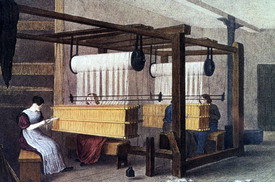
Female and Child Factory Workers Reeding or Drawing in at Loom, England, 1840
Image ID: 8331
Collection: Karen Halttunen
Topic(s): Nineteenth Century, Lowell, Agriculture, Arts and Architecture, British Empire, Business 19th century, Child labor, Class Structure, Cooption of styles, Corporate Image, Early mills and factories, Early National Period, Emerging industrial city, Environmental History, Factory as symbol, Gender-Bending, Imperialism, Industrial Revolution, Institutions and social disorder, Invention, Labor, Labor Organizations and Leaders, Market Economy, National Events, Nineteenth Century Children, Nineteenth Century Furniture, Nineteenth Century Interiors, Strikes and Violence, Success 19th century, Sweatshops, Technology, Urbanization, Victorian Culture, Women and Health, Women in labor movement, Women's organizations, Women's work, Work and Housing, Work and Workers
Region(s): United States, Europe
CA Standard(s): 8.6 - The divergent paths of the American people from 1800 to the mid-1800s...with emphasis on the Northeast. , 5.8 - The colonization, immigration, and settlement patterns of the American people from 1789 to the mid-1800s..., 7.10 - The historical developments of the Scientific Revolution and its lasting effect on religious, political, and cultural institutions, 10.3 - The effects of the Industrial Revolution in England, France, Germany, Japan, and the United States. , 10.4 - Global change in the era of New Imperialism in Africa, Southeast Asia, China, India, Latin America, and the Philippines
National Standard(s): Expansion and Reform (1801-1861)
Card Text: Female and child factory workers reeding or drawing in at large cotton loom, England, 1840. Thread reeding is the process of arranging fabric threads on a loom in the correct order before weaving begins. Reeding allows the same loom to make both very fine and very coarse fabric, and to weave threads at very different densities.
"The Beam full of yarn, after being dressed with size to stiffen and strengthen the threads, is brought to the Drawing-in Frame, and hung up as you see in the picture, the Healds which are made of twisted worsted, or Cotton, are hung under the beam and weighted below. The ends of the warp are then drawn down, and the rods hung up to preserve the lease, or the warp could not be woven. There is a female at each side of the healds; one takes hold of the ends of the warp, and gives them separately to the other, who draws them through the healds. When all the ends are through, the Drawing-in is completed. Next comes the Reeding; a reed consists of a great number of short flat pieces of steel or brass called Dents, fixed at short and equal distances from each other, in long pieces of split cane, and tightly secured with a wax band. Through each space, between the dents, two ends are drawn by a small hook, called a Reed-hook. It is not always necessary to draw the warps in; they can also be twisted in, that is, when the warp is nearly all woven into cloth by the weaver, the yarn is cut off, and the fresh warp twisted to the old one. Drawing-in and Reeding is very tedious work and requires great care, there are not only a great number of threads to draw in and reed, but if they were to miss one dent or one heald, it is probable that the whole or a part of the work would have to be done over again. Since this is the case, the steady, careful look of the girls is not to be wondered at."
"Factory Rules from the Handbook to Lowell, 1848: REGULATIONS TO BE OBSERVED by all persons employed in the factories of the Hamilton Manufacturing Company. The overseers are to be always in their rooms at the starting of the mill, and not absent unnecessarily during working hours. They are to see that all those employed in their rooms, are in their places in due season, and keep a correct account of their time and work. They may grant leave of absence to those employed under them, when they have spare hands to supply their places, and not otherwise, except in cases of absolute necessity. All persons in the employ of the Hamilton Manufacturing Company, are to observe the regulations of the room where they are employed. They are not to be absent from their work without the consent of the over-seer, except in cases of sickness, and then they are to send him word of the cause of their absence. They are to board in one of the houses of the company and give information at the counting room, where they board, when they begin, or, whenever they change their boarding place; and are to observe the regulations of their boarding-house. Those intending to leave the employment of the company are to give at least two weeks' notice thereof to their overseer. All persons entering into the employment of the company, are considered as engaged for twelve months, and those who leave sooner, or do not comply with all these regulations, will not be entitled to a regular discharge. The company will not employ anyone who is habitually absent from public worship on the Sabbath, or known to be guilty of immorality. A physician will attend once in every month at the counting-room, to vaccinate all who may need it, free of expense. Anyone who shall take from the mills or the yard, any yarn, cloth or other article belonging to the company, will be considered guilty of stealing and be liable to prosecution. Payment will be made monthly, including board and wages. The accounts will be made up to the last Saturday but one in every month, and paid in the course of the following week. These regulations are considered part of the contract, with which all persons entering into the employment of the Hamilton Manufacturing Company, engage to comply. JOHN AVERY, Agent."
"… Miss Sarah G. Bagl[e]y said she had worked in the Lowell Mills eight years and a half, six years and a half on the Hamilton Corporation, and two years on the Middlesex. She is a weaver, and works by the piece. She worked in the mills three years before her health began to fail. She is a native of New Hampshire, and went home six weeks during the summer. Last year she was out of the mill a third of the time. She thinks the health of the operatives is not so good as the health of females who do housework or millinery business. The chief evil, so far as health is concerned, is the shortness of time allowed for meals. The next evil is the length of time employed - not giving them time to cultivate their minds. She spoke of the high moral and intellectual character of the girls. That many were engaged as teachers in the Sunday schools. That many attended the lectures of the Lowell Institute; and she thought, if more time was allowed, that more lectures would be given and more girls attend. She thought that the girls generally were favorable to the ten hour system. She had presented a petition...to 132 girls, most of whom said that they would prefer to work but ten hours. In a pecuniary point of view, it would be better, as their health would be improved. They would have more time for sewing. Their intellectual, moral and religious habits would also be benefited by the change."
Citation: J.R. Barfoot, "The Progress of Cotton, 1835-40," #9: "Reeding or Drawing in," in a series of 12 prints. Slater Mill Historic Site, 67 Roosevelt Ave, Pawtucket, RI 02860. First text: Public domain: "The Progress of Cotton No. 9: Reading or Drawing In," 1840. From Barfoot's series of colored lithographs of 1840 depicting the cotton manufacturing process. Original text written to accompany Lithograph No.9. https://www.flickr.com/photos/ manchesterarchiveplus/6503188589/in/album-72157629084961692/. Manchester Archives, Manchester Central Library, Manchester City Council, Town Hall, Albert Square, Manchester M60 2LA, UNITED KINGDOM. Second text: Public domain: "Factory Rules from the Handbook to Lowell, 1848." https: //chnm.gmu.edu/mcpstah/wordpress/wp-content/themes/tah/files/mckee_primary-sources.pdf. Roy Rosenzweig Center for History and New Media, Department of History and Art History, George Mason University, 4400 University Dr, MSN 1E7, Fairfax, VA 22030. Third text: Public domain.
"Report," Massachusetts House Document, no. 50, March, 1845. https://archives.lib.state.ma.us/bitstream/handle/2452/755732/ocm39986872-1845-HB-0050.pdf?sequence=1&isAllowed=y. State Library of Massachusetts, 24 Beacon St, State House Rm 341, Boston, MA 02133. Sept 7, 2023.

Reason, Am I Not a Woman and a Sister?, 1835
Image ID: 8380
Collection: Karen Halttunen
Topic(s): Nineteenth Century, Antebellum Reform, Slavery and Abolition, Abolition, African Americans, British Empire, Business 19th century, Civil War, Class Separation, Colonial America, Cooption of styles, Early American Slavery, Early National Period, Emancipation, Jacksonian Era, Logos, Middle-Class Culture, Moral lessons, Naive Art, National Politics, Nineteenth Century Slavery, Politics & Government, Propaganda, Race, Religion, Social disorder and order to 1865, Social Gospel and Missions, Success 19th century, Symbols, Upper class ante bellum, Victorian Culture, Whites, non planters ante bellum, Women in labor movement, Women's liberation, Women's organizations
Region(s): United States, Europe
CA Standard(s): 8.7 - The divergent paths of the American people in the South from 1800 to the mid-1800s , 5.8 - The colonization, immigration, and settlement patterns of the American people from 1789 to the mid-1800s..., 8.1 - Major events preceding the founding of the nation and the development of American constitutional democracy, 8.2 - The political principles underlying the U.S. Constitution and compare the enumerated and implied powers of the federal government, 8.3 - The foundation of the American political system and the ways in which citizens participate in it, 8.4 - The aspirations and ideals of the people of the new nation, 8.6 - The divergent paths of the American people from 1800 to the mid-1800s...with emphasis on the Northeast. , 11.3 - The role of religion in the founding of America and its lasting moral, social, and political impacts, and issues regarding religious liberty.
National Standard(s): Expansion and Reform (1801-1861)
Card Text: Patrick Reason, "Am I Not a Woman and a Sister?" 1835. African-American women held as slaves were particularly vulnerable to rape and other sexual abuse at the hands of their white owners. This engraving appeared in abolitionist George Bourne’s 1837 "Slavery Illustrated in Its Effects upon Women." It highlighted the connections between the anti-slavery and women's rights movements, as some women abolitionists, such as Sarah and Angelina Grimke, used the anti-slavery cause to address their own plight as women. The connections they drew were controversial and many anti-slavery organizations were split over the issue of women's rights. Many groups fought slavery, but most were led by men while women worked hard in the anti-slavery campaign despite having little voice in politics.
The words "Am I Not a Woman and a Sister?" are imposed above the figure of a black enslaved woman, on one knee, who holds up her chained hands as if in prayer. This powerful symbol was used in the early 19th c. by British and American women fighting for the end of slavery worldwide and for the right to have a voice on the subject. The image was based on the motto "Am I Not a Man and a Brother?," similarly featured beside an image of an enslaved black man on one knee and in chains. This motto and image were originally used by the antislavery Society for the Abolition of the Slave Trade and later by many abolitionist organizations.
There had always been opposition to the slave trade from its 15th century beginnings, but antislavery organizations did not begin to form in Britain until slavery had been outlawed in the country. Though slavery had been ruled illegal, people could still hold enslaved servants or buy and sell them in other countries under British rule at the time. "Abolitionists” wanted to “abolish” every aspect of slavery, and the most famous abolitionists were the Englishmen William Wilberforce and Thomas Clarkson. However, as women also played a major role in the anti-slavery movement, it was a woman, Lady Middleton, who persuaded both Wilberforce and Clarkson to join the abolitionist movement.
Women at the time were prevented from taking any active part in politics, including the abolitionist movement. They were not even allowed to add their names to the mass petitions to end slavery; men felt that the petitions' value would be diminished if women were allowed to sign them. Women were only occasionally allowed to take part in public debates, and at a 1788 debate in London, they could speak only if they covered their faces with veils.
Because of these political restrictions, women had to find other ways to support abolition. Poetry was considered suitable for women at the time, so many of them wrote verses that brought light to the experiences of the enslaved and argued vehemently for abolition. Phillis Wheatley was the first enslaved black woman to have a book of poetry published in Britain. Hannah More's "Slavery, a Poem" was published in 1788 as a large 20-page book.
Women also gave enormous financial support to the abolitionist movement. Many donated money to the Society for the Abolition of the Slave Trade, even though they could not take official roles in the organization. They boycotted slave-produced goods like sugar from the West Indies, shopping instead for sugar grown in the East Indies by free labor, and purchased bracelets, earrings and other items carrying the “Am I Not a Man and a Brother” image.
The British Parliament passed a law in 1807 that abolished the slave trade in the country and other countries under its rule. The anti-slavery campaign continued, however, with the aim of abolishing slavery worldwide. Over the years that followed, women began to form their own anti-slavery societies - to much criticism. Wilberforce expressed a common view: "...For for ladies to meet, to go from house to house stirring up petitions – these appear to me proceedings unsuited to the female character as delineated in Scripture."
In the early 19th century, hundreds of thousands of women signed petitions, participated in the political process, and even questioned the aims of the movement. In 1824, abolitionist Elizabeth Heyrick called for the immediate emancipation of slaves, contradicting the Anti-Slavery Society’s aim of gradual emancipation. Six years later, the influential Birmingham women’s society threatened to withdraw its funding from the Anti-Slavery Society if it did not agree to change its aim to immediate abolition. The change was agreed to. However, women would still face challenges. In 1840 the first World Anti-Slavery Convention was organized in London. Women delegates arrived from all parts of Britain, and from the US who also campaigned for women’s rights. All the women were denied participation in the convention. That decision led not only to a split in the British anti-slavery movement but indirectly to the beginning of the US campaign for women’s right to vote. Several of the British women who were not allowed to participate were among those who, 26 years later, signed the first petition to grant women the right to vote. Engraving.
Citation: Image: George Bourne, "Slavery Illustrated in Its Effects upon Woman," Boston, 1837. Library of Congress, Washington, DC 20540. LC Control No.: 11006909. First text: "History Matters: The US Survey Course on the Web." Last updated: March 22, 2018. https://historymatters.gmu.edu/d/6726/#: ~:text=African%2DAmerican%20women%20 held%20as,upon%20Women%2C%20published%20in%201837. Copyright 1998-2023 American Social History Productions, Inc., Center for History and New Media, Research 1, Ste 450, 4400 University Dr, MSN 3G1, George Mason University, Fairfax, VA 22030. All rights reserved. Second text: Adapted from Elizabeth Crawford, "Am I Not A Woman And A Sister? Women and the Anti-Slavery Campaign," 2019. https://www.gpsd.us/site/handlers/filedownload.ashx?moduleinstanceid=11554&dataid=14749&FileName=commonlit_am-i-not-a-woman-and-a-sister_student.pdf. Common Lit. Copyright Elizabeth Crawford. All rights reserved. Jan 11, 2023.

Durand, Membership Certificate, American Tract Society, 1837
Image ID: 8357
Collection: Karen Halttunen
Topic(s): Nineteenth Century, Antebellum Reform, Abolition, Ads. and Success, Business 19th century, Durand, Early National Period, Eden Imagery, Ensemble, Expansion, Future Progress, Holy Land, Jacksonian Era, Logos, Media, Moral lessons, National Events, Numinous, Propaganda, Reform, Religion, Social Gospel and Missions, Success 19th century, Symbols, Technology, Temp to 1870's, US Destiny, Utopias pre 1860, Women's image
Region(s): United States
CA Standard(s): 8.3 - The foundation of the American political system and the ways in which citizens participate in it, 8.4 - The aspirations and ideals of the people of the new nation, 8.9 - The early and steady attempts to abolish slavery and to realize the ideals of the Declaration of Independence.
National Standard(s): Expansion and Reform (1801-1861), An Age of Revolutions, 1750-1914
Card Text: Asher Durand, Membership certificate for the American Tract Society, a conservative Christian literature printer and distributor, 1837. By the early 19th century post-millennialism had emerged as the dominant form of millennialism among American Protestants who promoted the 1850s reform movements of the Social Gospel and the abolition of slavery. According to millennialism, Christ will establish a 1,000-year reign of the saints on earth before the Last Judgment. Evangelicals seeking to hasten the arrival of the millennium adopted modern advertising methods to carry out Christ's injunction to "Go ye into all the world, and preach the gospel to every creature" (Mark 16:15). The post-millennial view holds that progress is inevitable, that the Church Age will evolve into a “golden age” in which the Church will rule over all the world as all nations become Christianized. (However, when World War I indicated that progress is not inevitable, much post-millennial belief died.) Using stereotypography, steam-powered presses, and new forms of corporate organization from 1829 to 1833, the American Bible Society, the American Tract Society and the American Sunday School Union produced millions of Bibles, tracts, and Sunday School books. Intending to place these publications in every home in the country, The Tract Society wished to help renovate the world, preparing a "multitude which no man can number, to shine in the beauty of holiness and shout the triumphs of grace to everlasting ages."
This faith in the power of print to expand Christian community that transcended physical and social distance is vividly captured in this ATS contribution form. People of various continents, races, and faith traditions are united through the power of the radiant printing press in their midst. The press stands in the center, a place reserved in earlier images for the preaching missionary or even Jesus himself, and signaling divine agency assumed by evangelical believers. This theme of diffusion of Christian truth around the world through literature was a favorite one in ATS publications. Line engraving on paper, 10-1/8 x 8-3/8".
Citation: Asher B. Durand (engraver) after George Miller, American Tract Society certificate, n.d. The New-York Historical Society, 170 Central Park W, New York, NY 10024. Collection No. PR.221.13. "Children, Childhood and Change in America, 1820-1920," fig. 5, in Mary Lynn Stevens Heininger, et al., "A Century of Childhood 1820-1920," 1984. Text: Adapted from Jerome Tharaud, "Apocalyptic Geographies: Religion, Media, and the American Landscape" (2020) p. 50 (Copyright Princeton University Press, 41 William St, Princeton, NJ 08540. All rights reserved.) Feb 7, 2023.

Ad, Merrimack Co. Power Loom Jeans, Lowell, MA, c. 1830
Image ID: 8328
Collection: Karen Halttunen
Topic(s): Nineteenth Century, Lowell, Antebellum Reform, Architecture, Business 19th century, Child labor, Class Structure, Corporate Image, Early mills and factories, Early National Period, Environmental History, Factory as symbol, Family to 1920, Gender-Bending, Industrial Revolution, Invention, Labor, Labor Organizations and Leaders, Market Economy, National Events, Nineteenth Century Children, Parents, Children, Families, Strikes and Violence, Sweatshops, Technology, Urbanization, Women in labor movement, Women's organizations, Women's work
Region(s): United States
CA Standard(s): 8.10 - The multiple causes, key events, and complex consequences of the Civil War, 8.3 - The foundation of the American political system and the ways in which citizens participate in it, 8.4 - The aspirations and ideals of the people of the new nation, 8.6 - The divergent paths of the American people from 1800 to the mid-1800s...with emphasis on the Northeast.
National Standard(s): Expansion and Reform (1801-1861)
Card Text: Ad, Merrimack Manufacturing Co. "Power Loom Jeans," Lowell, MA, c. 1830. Gentlemen in top hats and women carrying parasols stroll in front of a mill. The Merrimack Manufacturing Company (also known as Merrimack Mills) was the first major textile factory to open in Lowell, Massachusetts, beginning operations in 1823. After the death of Francis Cabot Lowell of the Boston Manufacturing Co., his "Boston Associates" began planning a larger operation in East Chelmsford, MA, on the Merrimack River. The Merrimack Manufacturing Co. was modeled after the second Boston Manufacturing Co. mill and built concurrently with the necessary canals, machine shop, dyehouse, and boardinghouses for the workers. The company employed the "Lowell System." Initially capitalized with $600,000, its typical product was calico cloth. Located at the foot of the Merrimack Canal, the original mills received the power of the full 32-foot drop of the river. The Merrimack Co. was the parent company of the later Lowell firms, although they were technically competitors. The Merrimack Co. became very powerful politically in Lowell. However, as US textile production shifted away from New England, the company's fortunes reversed. It survived the Great Depression of the 1930s due to military contracts and awards that revived the surrounding economy, and it was among the last of Lowell's textile giants to close. Shortly after it ceased operations in the late 1950s, nearly the entire complex was demolished for urban renewal in 1960. A few years later, many of the boardinghouses were destroyed as well. Today, the site is occupied by new arterial roads, parking lots, low-rise office buildings, a high-rise housing tower, and the newer buildings of Lowell High School.
"The Voice of industry" appeared during a period of unprecedented, explosive growth in the textile industry. It was the longest-running labor newspaper published during the US Industrial Revolution, and one of the most widely read of the many worker-run journals of the period. It started publication in 1845 in Fitchburg, Mass., under the auspices of the New England Workingmen’s Association. Written and published by the workers themselves, the "Voice" was concerned with the dramatic social changes taking place as corporations began to control economic life. New, large-scale machinery had come to dominate the production of cloth by 1840, and it was being rapidly developed in lockstep with equally new ways of organizing workers for mass production. Together, these mutually reinforcing technological and social changes produced staggering increases: From 1840 to 1860, the number of spindles in use rose from two million to over five million; bales of cotton from 300,000 to nearly a million; and the number of workers from 72,000 to nearly 122,000. This growth translated directly into large profits for the textile corporations. Between 1846 and 1850 the dividends of the “Boston Capitalists,” the group of textile companies that founded Lowell, averaged 14% per year. Most corporations recorded similarly high profits during this period, but workers saw none of these gains. In fact, most workers saw their positions decline sharply during this period as the corporations employed fewer workers and made them tend more machines at faster speeds for reduced wages. Not surprisingly, this trend created considerable discontent. Writing anonymously in the "Voice" as “one of the vast army of sufferers,” an operative protested that while workers now tended “three or four looms, where they used to tend but two” and produced twice as much cloth, “the pay is not increased to them, while the increase to the owners is very great. Is this just?” Nor was the increased danger to workers considered.
In most cases, workers' total earnings stayed the same during this period, and wage cuts took the form of reductions in “piece rates," the amount paid for each piece a worker produced. At this lower rate, their total earnings were maintained by producing more output; which, for the most part, was accomplished by pushing operatives to work harder. Workers were made to tend more machines (a practice referred to as the “stretch-out") at faster speeds (referred to as the “speedup"); they were, in other words, being made to perform more work for less money.
Another worker, writing in 1845, observed that while the profits of 11 Lowell mills had doubled from the year before, the workers were being paid 12.5% less. “This is the natural result of the state of things in New England," she concluded, “the more wealth becomes concentrated in a few hands, and the poorer the great mass becomes.” In the previous decade, the power of the corporations had been limited, as disillusioned workers could leave the factories and return to their nearby rural homes. By the early 1840s, however, many New England farms had been crushed by a severe economic depression, leaving workers with no alternative to harsh factory life. For the first time, a permanent “factory population” arose in Lowell. Measures aimed at increasing worker "discipline" became suddenly more effective. Corporations colluded to increase the workweek and the number of hours in the workday. They maintained "blacklists" that prevented discharged workers - fired, in many cases, for trivial reasons - from finding employment at other mills. A “premium system” was adopted in which supervisors were paid bonuses for pushing operatives to produce more. As a result, by the mid-1840s, workers were spending 12- to 14-hour days each day in factories that were often overheated and poorly ventilated, doing dreary, exhausting work. While they often wrote about being treated by mill owners as “living machines,” the reality was much worse - unlike their inanimate counterparts, workers could be forced to produce more, by way of pressure and intimidation. While workers bitterly condemned this abuse of power, they were even more alarmed by another, overarching feature of the new economic order: The disconnect between the liberating potential of "labor-saving" machinery, and the way these inventions were used instead to increase output. “With such gigantically increased means of production,” asked one reformer, “would it not be supposed that the Laboring Classes would be rendered more comfortable?…Certainly, but directly the reverse is the case.” Machinery, workers argued, should be developed and applied with the aim of freeing people from undesirable work, allowing them more time to cultivate and develop their talents. Instead, they watched with dismay as their work increased, and was fragmented into narrow, routine tasks, which left them physically and mentally debased. “Compared with their employers,” wrote a worker in the Voice, “[workers] are as a class sinking day by day into a still deeper degradation.” Another observed that there was now “machinery enough in New England to do the work of five times its present population performed in the old way,” but that, “the consequence is we are nearer starvation.” These workers were also criticizing the way costs and benefits were understood and tallied in the new, profit-driven, economic system. For the factory owner, the definition of “cost" was restricted to monetary expenses, and “benefit" was defined narrowly to mean physical output. Any other costs associated with production - such as the mental deterioration suffered by workers from performing repetitious, mindless tasks - were considered irrelevant in this calculus of “profitable” work.
While the rise of a permanent factory population increased the power of the corporations, it also allowed for a more lasting, permanent response to that power. In 1845, 12 factory operatives organized the first union of female factory workers in the US, the Lowell Female Labor Reform Association. Six months later, its membership had grown to 500. Under the guidance of the young labor leader Sarah Bagley, and with the "Voice of Industry" as its herald, the Association tirelessly campaigned to convince the public of the need for reform in the mills. It published a series of articles called “Factory Tracts,” which documented the deteriorating conditions in the mills, and provided “a true exposition of the Factory system and its effects upon the health and happiness of the operatives." The association would go on to become a leading organizing force in the Ten-Hour Movement in Lowell.
From 1900 until 1946, the Merrimack Manufacturing Company ran a plant in Huntsville, Alabama, with non-union labor.
Citation: Image and First text: Copyright American Textile History Museum, 491 Dutton St, Lowell, MA 01854. All rights reserved. Second text: Public domain. "The Voice of Industry." https://www.industrialrevolution.org/industrial-revolution--featured-content. Aug. 30, 2023.

Jail Cell Door, Williamsburg, VA
Image ID: 8345
Collection: Karen Halttunen
Topic(s): Antebellum Reform, 18th Century Interiors, Architecture, British Empire, Class Separation, Colonial America, Early cities, Early National Period, Early Virginia, Eighteenth Century, Institutions and social disorder, Moral lessons, Nativism, Nineteenth Century, Nineteenth Century Interiors, Nineteenth Century Slavery, Politics & Government, Prejudice and Discrimination, Slavery, Working, and Living Conditions, Social disorder and order to 1865, Temp to 1870's, Urban poverty, Victorian Culture, Williamsburg, Women's misc.
Region(s): United States
CA Standard(s): 5.4 - Political, religious, social, and economic institutions that evolved in the colonial era. , 5.5 - The causes of the American Revolution, 5.8 - The colonization, immigration, and settlement patterns of the American people from 1789 to the mid-1800s...
National Standard(s): Colonization and Settlement (1585-1763), Revolution and the New Nation (1754-1820s) , Expansion and Reform (1801-1861), Civil War and Reconstruction (1850-1877)
Card Text: Jail cell door, Williamsburg, VA. The haunted Public Gaol of Colonial Williamsburg includes the ghosts of pirates, thieves, corrupt officials, and the enslaved. In this two-story brick prison, the incarcerated didn’t wake up just to austere and depressing cells. With fellow occupants like bloodthirsty pirates and traitors to the country, they were also often greeted by belligerent bunkmates itching for conflict.
When Williamsburg became the capital of the Colony of Virginia in 1699, city officials realized that with economic growth came crime, and with heightened political activity came corruption. Thus they reached out to the best building contractor in the state, Henry Cary, and authorized him to construct “a strong sweet prison” in 1701. Initial specifications for the gaol were simple, as it was not intended to house murderers, thieves, and other dangerous miscreants. At first, the Public Gaol had only three rooms: two for inmates, and one for the gaoler. But officials soon realized that the city’s population of wrongdoers was larger than they’d estimated, and that a 30 x 20-foot building simply could not house all the enslaved runaways, thieves, Tories, and spies who had been sentenced to jail. They added an exercise yard in 1703, a “Debtor’s Prison” in 1711, and a separate brick dwelling for the gaoler in 1722.
The Public Gaol was an inhumane environment and failed to live up to its “strong and sweet” expectations. The food was beyond terrible (soggy peas and overly salted beef, for instance; the cells were freezing (many inmates shivered to death); and the cleaning staff left much to be desired (“Gaol fever,” or typhus, plagued prisoners and jailers alike.)
Arguably, such inhumane incarceration is fair punishment for evil pirates, especially if they served under the infamous Blackbeard. Before Edward Teach earned the name of Blackbeard and a reputation for terrorizing the seas, he was just a humble sailor. However, once he joined Benjamin Hornigold’s Flying Gang of pirates, he quickly learned the ways of the corsair and became one of the most feared pirates to roam colonial coastlines. So when Blackbeard sailed the "Queen Anne’s Revenge" to the Carolinas in 1718, Virginia Governor Alexander Spotswood was ready. He ordered Lt. Robert Maynard to engage and capture Blackbeard and his crew, but the pirate captain was killed during the bloody hand-to-hand conflict that ensued. Some say that the Governor had a pike fixed with Blackbeard’s skull displayed prominently on the banks of the Hampton River to scare off other freebooters and prevent them from landing. As for Blackbeard’s fifteen henchmen who survived the struggle: “Taken to Williamsburg to stand trial, they were held in the 1704 public 'gaol' on Nicholson Street just north of the Capitol. At least some faced an admiralty court on March 12, when one was acquitted, one pardoned and the rest sentenced to hang.”
Another of the gaol’s famous occupants was Governor Henry Hamilton. Hamilton’s ability to forge friendships with Indian chiefs had earned him two nicknames (which he detested): the “Scalptaker” and the “Hair-Buyer General.” There were rumors that Hamilton had bought the scalps of dead settlers from Native American raid parties, and he was arrested in 1779 by Colonel George Rogers Clark to face these allegations. Awaiting trial, the Governor discovered that even political prominence did not exempt him from brutal treatment in the Public Gaol. He was barred from using pen and paper, shackled in a tiny cell with six other criminals, and forced to eat disgusting prison food.
As today, many prisoners belonged in a hospital, not a jail. Before the colonists understood the enormous difference between lawbreakers and “lunaticks,” the mentally ill were forced to bunk with convicts. Not until 1773 did Williamsburg open its first public hospital.
In Virginia there were at least four or five persons incarcerated in the Public Gaol in the 1760s. The jail also had a substantial female population, and the ghosts of two women are still rumored to lurk in the gaoler’s upstairs quarters. “The women’s animated conversations and the thumping of their heavy shoes are heard coming from the deserted room.”
Citation: Karen Halttunen photo. Colonial Williamsburg, Williamsburg, VA. Text: "12. The Public Gaol, Colonial Williamsburg," Aug 15, 2017. https://colonial ghosts.com/public-gaol-and-wythe-house/. US Ghost Adventures. © 2023 Copyright Colonial Ghosts. All rights reserved. Jan 31, 2023.

Jail Cell Window, Williamsburg, VA, 1773
Image ID: 8352
Collection: Karen Halttunen
Topic(s): Antebellum Reform, 18th Century Interiors, Architecture, Class Structure, Colonial America, Early American Slavery, Early cities, Early Virginia, Eighteenth Century, Institutions and social disorder, Moral lessons, Nativism, Nineteenth Century Slavery, Politics & Government, Prejudice and Discrimination, Slavery Misc., Social disorder and order to 1865, Temp to 1870's, Urban poverty, Williamsburg, Women's misc.
Region(s): United States
CA Standard(s): 5.5 - The causes of the American Revolution, 5.4 - Political, religious, social, and economic institutions that evolved in the colonial era. , 8.4 - The aspirations and ideals of the people of the new nation
National Standard(s): Revolution and the New Nation (1754-1820s) , Expansion and Reform (1801-1861)
Card Text: Jail cell window, Williamsburg, VA, 1773. Jail cell door, Williamsburg, VA. The haunted Public Gaol of Colonial Williamsburg includes the ghosts of pirates, thieves, corrupt officials, and the enslaved. In this two-story brick prison, the incarcerated didn’t wake up just to austere and depressing cells. With fellow occupants like bloodthirsty pirates and traitors to the country, they were also often greeted by belligerent bunkmates itching for conflict.
When Williamsburg became the capital of the Colony of Virginia in 1699, city officials realized that with economic growth came crime, and with heightened political activity came corruption. Thus they reached out to the best building contractor in the state, Henry Cary, and authorized him to construct “a strong sweet prison” in 1701. Initial specifications for the gaol were simple, as it was not intended to house murderers, thieves, and other dangerous miscreants. At first, the Public Gaol had only three rooms: two for inmates, and one for the gaoler. But officials soon realized that the city’s population of wrongdoers was larger than they’d estimated, and that a 30 x 20-foot building simply could not house all the enslaved runaways, thieves, Tories, and spies who had been sentenced to jail. They added an exercise yard in 1703, a “Debtor’s Prison” in 1711, and a separate brick dwelling for the gaoler in 1722.
The Public Gaol was an inhumane environment and failed to live up to its “strong and sweet” expectations. The food was beyond terrible (soggy peas and overly salted beef, for instance; the cells were freezing (many inmates shivered to death); and the cleaning staff left much to be desired (“Gaol fever,” or typhus, plagued prisoners and jailers alike.)
Arguably, such inhumane incarceration is fair punishment for evil pirates, especially if they served under the infamous Blackbeard. Before Edward Teach earned the name of Blackbeard and a reputation for terrorizing the seas, he was just a humble sailor. However, once he joined Benjamin Hornigold’s Flying Gang of pirates, he quickly learned the ways of the corsair and became one of the most feared pirates to roam colonial coastlines. So when Blackbeard sailed the "Queen Anne’s Revenge" to the Carolinas in 1718, Virginia Governor Alexander Spotswood was ready. He ordered Lt. Robert Maynard to engage and capture Blackbeard and his crew, but the pirate captain was killed during the bloody hand-to-hand conflict that ensued. Some say that the Governor had a pike fixed with Blackbeard’s skull displayed prominently on the banks of the Hampton River to scare off other freebooters and prevent them from landing. As for Blackbeard’s fifteen henchmen who survived the struggle: “Taken to Williamsburg to stand trial, they were held in the 1704 public 'gaol' on Nicholson Street just north of the Capitol. At least some faced an admiralty court on March 12, when one was acquitted, one pardoned and the rest sentenced to hang.”
Another of the gaol’s famous occupants was Governor Henry Hamilton. Hamilton’s ability to forge friendships with Indian chiefs had earned him two nicknames (which he detested): the “Scalptaker” and the “Hair-Buyer General.” There were rumors that Hamilton had bought the scalps of dead settlers from Native American raid parties, and he was arrested in 1779 by Colonel George Rogers Clark to face these allegations. Awaiting trial, the Governor discovered that even political prominence did not exempt him from brutal treatment in the Public Gaol. He was barred from using pen and paper, shackled in a tiny cell with six other criminals, and forced to eat disgusting prison food.
As today, many prisoners belonged in a hospital, not a jail. Before the colonists understood the enormous difference between lawbreakers and “lunaticks,” the mentally ill were forced to bunk with convicts. Not until 1773 did Williamsburg open its first public hospital.
In Virginia there were at least four or five persons incarcerated in the Public Gaol in the 1760s. The jail also had a substantial female population, and the ghosts of two women are still rumored to lurk in the gaoler’s upstairs quarters. “The women’s animated conversations and the thumping of their heavy shoes are heard coming from the deserted room.”
Citation: Karen Halttunen photo. Colonial Williamsburg, Williamsburg, VA. Text: "12. The Public Gaol, Colonial Williamsburg," Aug 15, 2017. https://colonial ghosts.com/public-gaol-and-wythe-house/. U.S. Ghost Adventures. © 2023 Copyright Colonial Ghosts. All rights reserved. Jan 31, 2023.