
Oneida Community, Oneida, NY, 19th c.
Image ID: 8378
Collection: Karen Halttunen
Topic(s): Nineteenth Century, Antebellum Reform, Agrarian Reform, Arts and Architecture, Business 19th century, Children, Civil Rights, Class Separation, Domesticity, Early National Period, Eden Imagery, Environmental History, Family to 1920, Future Progress, Gender-Bending, Immigrants, Individualism, Technology, Industrial Revolution, Institutions and social disorder, Labor Organizations and Leaders, Masculinity, Middle-Class Culture, Moral lessons, National Events, Nature and Civilization, Politics & Government, Prejudice and Discrimination, Pro feminist and suffrage, Pullman and Model Towns, Religion, Shakers, Socialism, Success, Utopias, Women's liberation
Region(s): United States
CA Standard(s): 8.6 - The divergent paths of the American people from 1800 to the mid-1800s...with emphasis on the Northeast. , 5.8 - The colonization, immigration, and settlement patterns of the American people from 1789 to the mid-1800s..., 8.1 - Major events preceding the founding of the nation and the development of American constitutional democracy, 8.4 - The aspirations and ideals of the people of the new nation, 8.9 - The early and steady attempts to abolish slavery and to realize the ideals of the Declaration of Independence.
National Standard(s): Expansion and Reform (1801-1861), Civil War and Reconstruction (1850-1877) , The Development of the Industrial United States (1870-1900)
Card Text: Oneida Community at pea-shelling bee, Oneida, NY, 19th c. The Oneida Community was founded in 1848 as a polyamorous communist Christian utopia. In operation for over three decades, the Community was revolutionary for its time, paving the way for advances in women’s and workers’ rights. At the commune, headquartered on the Oneida River in upstate New York, women cut their hair short, ditched the corset, and did the same work as the men. Everyone worked four to six hours a day, and no one accumulated material possessions—not furniture, not fine clothing, and certainly not silverware. Commune members engaged in a system of “complex marriage,” believing that loving, open sexual relationships could bring them closer to God. They believed that the liquid electricity of Jesus Christ’s spirit flowed through words and touch, and that a chain of sexual intercourse would create a spiritual battery so charged with God’s energy that the community would transcend into immortality, creating heaven on earth.
Oneida’s early enterprises included canning fruits and vegetables and manufacturing animal traps, chain link, and silk sewing thread. In 1877 they started making spoons. The original religious commune broke up in 1880 and reorganized into a corporation. In the 1890s, the Oneida Community, Limited, began to focus on the cutlery market. For roughly 100 years, the silverware corporation—eventually renamed Oneida Limited—thrived under the leadership of the Community’s descendants. However, the 21st century has not been kind to Oneida; its executives had to file for bankruptcy in 2006 and sell the brand, now owned by a houseware conglomerate. The company had touted its patriotism and contributions to American capitalism, as well as its devotion to social equality and the golden rule.
Oneida began as most utopias do with the vision of one charismatic leader, in this case, a preacher named John Humphrey Noyes. Born in 1811 to a well-off family in Putney, Vermont, Noyes, an awkward and introverted redhead, grew up lamenting his feelings of sexual frustration. When his religiously devout mother sent him to a tent revival in 1831, the 20-year-old virgin discovered he could channel all his erotic energy into Christianity. At the time, the growing industrialization in the US was threatening to upset Americans’ agrarian lives. Before 1800, most Americans believed they’d left the ugly, inequitable English factory system. While the South had its large slave plantations, New Englanders thought freedom meant living in small villages where artisans and farmers owned their own land and thrived on subsistence agriculture. White men were the only Americans with full legal rights in the early 19th century, including the rights to own land and slaves, and they essentially owned their wives and children. The dog-eat-dog system of free-market capitalism was not yet a part of the American dream. Wage labor was seen as near-slavery, and the notion of an individual pursuing his own wealth and self-interest above that of the community was an appalling, grievous sin.
Amid this growing social and economic uncertainty, Christian sects sprang up, attracting legions of converts through traveling tent revivals in a movement that became known as the Second Great Awakening. Many of these new denominations, such as Methodists and Baptists, rejected the Puritan belief that only God’s chosen people could go to heaven. They believed that by choosing to follow Christ through their human free will, anyone could receive God’s grace and be redeemed from their sinful natures. So-called "Perfectionists" took that a step further, saying that accepting God’s grace made true believers “perfect” and free from sin.
It was a volatile time in American history. The Industrial Revolution was beginning in tandem with the market and transportation revolutions. The familiar ways of living in small, tight-knit communities in a seemingly classless society were beginning to break apart. People felt vulnerable and did not know how to identify themselves. Today, the dominant economic narrative holds that Americans were always ardent capitalists, gung-ho about the free market and individualism. But when the market economy began, the idea of competition, of struggle against the neighbor to make a living, horrified Americans. They refused this new, self-centered model for the economy, a concept that haunted people. That is one reason John Humphrey Noyes attracted followers.
In that moment of upheaval, many of the tent-revival pastors spreading Baptist, Methodist, or Perfectionist ideology asserted the imminence of Christ’s return. They adopted a literal reading of the Book of Revelation(s), which says that Jesus will return and rule the earth for 1,000 years. To prepare for his impending arrival, “reform Christians” sought to improve conditions on Earth, eliminating slavery (abolitionism), providing voting rights for women (the suffrage movement), and preventing women from suffering abuse at the hands of alcoholic husbands (the temperance movement). Satan would be bound in chains, but after 1,000 years, he would break out and the Last Judgment would lead to the final reconciliation of heaven and earth. Many 19th-century reform movements were based in religion. With the social and economic instability of the 19th century, many Americans felt their world was ending and that the Millennium was just around the corner. Noyes’ commune was one of many sects that predicted how that would happen. The idea was that Christ is coming back, and they'd better get their house in order.
Traveling tabernacle sermons allowed proper middle-class Americans—who normally kept their emotions hidden, according to 19th-century mores—to sob, yell, tremble, moan, and dance. The experience was similar to sexual release, and the free expression was so novel and liberating that documents show it often led charged-up worshippers to have sex after the revival. While Noyes did not, he did feel called to join the ministry, and attended seminary at Andover in Newton, Massachusetts, for a year and then at Yale, where he took the concepts of Perfectionism even further: In February 1834, he claimed he had achieved complete holiness on Earth, and therefore nothing he did would ever be a sin. He also felt liberated from obedience to governmental laws. For his heresy, Yale kicked him out and stripped him of his right to preach. As his friends in New Haven, Connecticut, fell away, Noyes managed to convert one young woman, Abigail Merwin, to his concept of perfect holiness, and she stood by him in the face of public disgrace. Ostracized, Noyes left Merwin in New Haven in May of 1834 for a crime- and disease-ridden neighborhood in Manhattan, where, after hallucinating a passionate encounter with God’s spirit, he imagined he was besieged by the devil. For three weeks, dirty and deprived of sleep and food, he roamed the streets desperately warning of Christ’s impending judgment. Although Noyes believed he emerged triumphant from his trial with the devil, his family and friends thought he’d lost his mind. After this brief, wild stint in New York City, he bounced around New England, publishing Perfectionist newsletters and trying to repair the sect’s reputation for sexual impropriety. In 1835, Noyes was devastated to learn that Merwin, whom he saw as his partner in his crusade, was engaged to another man. To comfort himself, he embraced the popular 19th-c. concept of “spiritual spouses,” that couples married for earthly reasons such as financial stability, but a man or woman’s true soulmate could be someone else, who would be their husband or wife in heaven, where they would engage in “angel sex.” Noyes wrote Merwin a letter to explain her status as his spiritual wife. Then he followed the couple to Ithaca, New York, where he tried to persuade her to rejoin his movement. She wouldn’t talk to him.
In 1837, Noyes wrote to a friend, explaining his shift from believing in spiritual wives to spiritual polyamory, which would be enacted on earth once Jesus arrived: “When the will of God is down on earth as it is in heaven there will be no marriage. Exclusiveness, jealousy, quarreling have no place at the marriage supper of the Lamb. I call a certain woman my wife. She is yours, she is Christ’s, and in him she is the bride of all saints. She is now in the hands of a stranger, and according to my promise to her I rejoice...” This "Christian free love" letter was published and prompted all Noyes' subscribers to cancel, leaving him in debt.
That same Fall, a Vermont convert, a wealthy young woman named Harriet Holton, sent Noyes’ $80 to pay off his creditors, and the two began corresponding. In 1838, Noyes asked Holton to marry him, on the condition that they wouldn’t be exclusive “in the free fellowship of God’s universal family.” He moved with Holton back to Putney, where he recruited several family members to his cause. Two more of Noyes’ converts, George and Mary Cragin, joined his family in 1841. With the help of the Noyes’ inheritance from their father, the group established The Society of Inquiry, investing $38,000 in the community, or $1 million in today’s dollars. Noyes further developed his idea of “Bible Communism,” in which converts shared everything they possibly could. By 1843, the Society had 35 recruits.
The transition from Noyes’ theoretical polyamory to actual extramarital sex took place in 1846, with two couples agreeing to the Society’s first “complex marriage” engagement, to be acted on when the kingdom of Christ arrived. However, Noyes decided that God’s kingdom had already arrived, and it was the Society’s job to create and spread paradise on earth. Three other couples joined the marriage that year, and the ten agreed that “all individual proprietorship either of persons or things is surrendered” and “John H. Noyes is the father and overseer whom the Holy Ghost has set over the family thus constituted.” John and Harriet Noyes moved into the Cragins’ home, while Noyes’ sisters welcomed another couple into their home nearby. The 25 other members of the Society were kept in the dark about this new marital arrangement but it would not remain a secret for long. Noyes, who had started practicing faith healings (one that worked, and another that failed), confided in a new friend about his multiple relationships. In 1847, that friend betrayed him and took the news of Noyes’ extramarital affairs to a Vermont attorney. Noyes was arrested on charges of adultery but released on bail. The Putney villagers’ outcry about the group’s amoral behavior caused them to flee to a Perfectionist’s farm on Oneida Creek in New York, part of the former Oneida Native American reservation, in early 1848.
At Oneida, Noyes decided that in order to abolish “egotism and exclusiveness” the members of the group, now called the Community, whose ranks had swelled to 84, should live under one roof. The Community had attracted a large number of craftsmen who helped to construct a three-story dwelling called the Mansion House. Not satisfied to contain the kingdom of heaven in this little rural outpost, Noyes set up branches in Brooklyn (1849-55) and Wallingford, CT (1851-80). In Brooklyn, Noyes launched a weekly newspaper, “The Free Church Circular,” to promote his theology of Bible Communism.
Most religions have a mystical branch that wants to dissolve the separate, individual selves into some larger whole that some call heaven. To create heaven on earth, Noyes expected his followers to dissolve their egos into the greater whole through full communal living. Noyes’ communist philosophy goes back to the Bible. He quotes the Acts of the Apostles, which says that on the day of Pentecost, "all the believers were together and had everything in common. They sold property and possessions to give to anyone who had need." (Acts 2:44-45).
The first tenet of Noyes’ Bible Communism was to let go of emotional attachment to other people, be they spouses or even children, in exchange for a communal spirit fed by God’s love. Married couples who joined the commune were told to give up their “marriage spirit” of sexual possessiveness and jealousy. Mothers and children or pairs of lovers who showed too much attachment or “sticky love” were punished with periods of separation.
The Supreme Court's decision to outlaw polygamy in Utah in 1879 was the death knell for non-monogamy. Until then it had been up in the air whether polygamy would be tolerated in the United States.
Citation: Copyright The Oneida Community Mansion House, 170 Kenwood Ave, Oneida, NY 13421. All rights reserved. Text: Adapted from Lisa Hix, "The Polyamorous Christian Socialist Utopia That Made Silverware for Proper Americans." https://www.collectorsweekly.com/articles/the-polyamorous-christian-socialist-utopia-that-made-silverware-for-proper-americans/. Collectors Weekly. © 2007–2023 Auctions Online USA Ltd. All rights reserved. Jan 9, 2023.

Welby, Place of Worship and Burial Ground at Ligonier Town, PA, 1821
Image ID: 8355
Collection: Karen Halttunen
Topic(s): Antebellum Reform, Religion, Beaches and Parks, Business 19th century, Class and Status, Drummers, Early National Period, Exhibition, Family to 1920, Frontier, Gender-Bending, Holy Land, Institutions and social disorder, Media, Moral lessons, National Events, Nineteenth and Twentieth Century, Numinous, Outdoor Life, Parents, Children, Families, Popular recreation to 1865, Prejudice and Discrimination, Shakers, Social Gospel and Missions, Southern Society, Success 19th century, Symbols of mass society, Temperance and Prohibition, Utopias pre 1860, Women's liberation
Region(s): United States
CA Standard(s): 8.1 - Major events preceding the founding of the nation and the development of American constitutional democracy, 8.4 - The aspirations and ideals of the people of the new nation, 5.8 - The colonization, immigration, and settlement patterns of the American people from 1789 to the mid-1800s..., 8.7 - The divergent paths of the American people in the South from 1800 to the mid-1800s , 8.8 - The divergent paths of the American people in the West from 1800 to the mid-1800s , 11.3 - The role of religion in the founding of America and its lasting moral, social, and political impacts, and issues regarding religious liberty.
National Standard(s): Expansion and Reform (1801-1861)
Card Text: Adlard Welby, "Place of Worship and Burial Ground" at Ligonier Town, PA, 1821. This camp-meeting ground north of Redstone, PA, was typical of those used by many frontier ministers for revivals and regular religious services. Between 1799 and 1805, the backcountry settlements of the early American frontier blazed with religious excitement. From western Pennsylvania to northern Georgia, middle Tennessee to the Carolina piedmont—but especially in the Bluegrass Country of Ohio—tens of thousands of frontier settlers gathered for multi-day, open-air religious meetings in which teams of Baptist, Methodist, and Presbyterian ministers preached from morning until late at night. The ministers claimed to have converted thousands at these camp meetings during the early 19th century. From innovations in theology and hymnody to church organization and denominational growth, this "Great Revival" shaped the development of early American evangelicalism and the southern Bible Belt.
The revivals also stimulated new religious practices known as the “bodily exercises,” in which some worshippers in the throes of conversion collapsed to the ground, then rose up, and began dancing. Others lay insensate for hours, enraptured with dramatic visions of heaven and hell. Camp meeting participants barked liked dogs, scampered up trees, engaged in trance walking, ran headlong through the woods, faced off in mock boxing matches, and burst into uncontrolled peals of "holy laughter." Observers heard worshippers speaking in unknown tongues and heard music issuing miraculously from the chests of young converts.
Of the various physical religious exercises that spread across the trans-Appalachian frontier and southern backcountry during the Great Revival, none drew more astonishment or opposition than “the jerks,” involuntary convulsions in which the worshippers’ heads lashed violently backward and forward. More than fifty years before the contemptuous phrase "holy roller" was coined to describe the ecstatic worship practices of Holiness and Pentecostal evangelicals in Appalachia, the subjects of these extraordinary bodily fits were known as “Jerkers.”
Although religious revivalism recurred periodically in 18th-century America, the Great Revival was unusual. First, its scale was unprecedented; the most famous of these open air religious meetings—the 1801 sacrament at the Cane Ridge meetinghouse near Paris, Kentucky—drew crowds estimated at 12,000. Observers learned to gauge the intensity of revival gatherings by the purported number of conversions and by the number of wagons and tents visible. Second, the frontier revivals were ecumenical affairs that attracted mixed audiences of Baptists, Methodists, and Presbyterians and blended their rituals, preaching styles, and singing traditions into unique “Union Meetings.” Most important, the camp meetings of the Great Revival transformed religious experience in the west. At first, ministers expressed joy at the conversion experiences of their audiences, but increasingly those experiences were physically dramatic as large numbers of converts were “struck down” to the ground while listening to powerful sermons. Soon the “falling exercise” included uncontrollable weeping, shaking, holy laughter, ecstatic dancing, and trance phenomena. For many participants, the worshippers' movements signaled the descent of God’s Holy Spirit upon the bodies of the faithful. But others struggled to account for these increasingly extravagant “bodily exercises” that seemed destructive of order in worship. "The jerks" sometimes manifested as spasmodic “shuddering” gesticulations of neck and head, and other accounts described jerkers as bouncing from “place to place like a foot-ball” or thrashing like a “fish, when thrown out of the water.” "The jerks" purportedly struck riders on horseback, men plowing in the fields, boys at their school desks, young girls drinking tea, families at supper, people in bed, musicians at play, and nursing mothers. They erupted without warning and without regard to age, class, gender, or physical constitution. Pious saints and notorious sinners were “taken,” “seized,” or “attacked” by the jerks, which often traveled from person to person like a “sympathetic contagion.” Witnesses even recounted stories of the jerkers’ preternatural strength, of diminutive women hurling 200-pound men to the ground and of floundering men leaving imprints of their knuckles on the massive timber walls of pioneer log churches.
The jerks incited vigorous debates in newspapers, magazines, religious tracts, medical dissertations, and tavern conversations. This astonishing "nervous affection” of “violent twitching and jerking” was “awful to behold,” “dreaded and hated, and even cursed by some,” and “altogether without precedent in Christian lands.” Eventually, most ministers and lay people decried the “corporeal agitation” of revival gatherings as the “inspirations of fanaticism” or, worse, signs of madness, witchcraft, or demonic possession. Yet for some, the jerks remained a “judgment sent from God…to bring sinners to repentance.”
Within a decade of the first outbreak of the jerks in east Tennessee, ministers of all persuasions began distancing themselves from what one Methodist clergyman later called a "very strange as well as disgusting exercise." Bodily exercises, recalled one pastor in 1833, “were of unspeakable injury to the church.” Even as Presbyterian, Baptist, and Methodist ministers turned against the jerks, however, migrating settlers were importing the distinctive bodily practice to new settlements on the prairies of the Midwest. Itinerant preachers occasionally encountered jerkers as far south as the Mississippi Territory. Abraham Lincoln undoubtedly witnessed them near his law office in New Salem, Illinois.
By the mid-19th century, the chaotic bodily exercises of the Great Revival were rapidly receding into folklore, at least among "respectable" Protestant writers. Their autobiographies featured "jerker tales" of two distinct genres: humorous accounts of dancing masters, drunkards, and other notorious sinners, or outspoken revival critics who boasted they would never be taken by the jerks only to be seized by them almost instantly; and lurid stories of jerkers experiencing physical violence and even death. While ministers, physicians, and skeptical laypeople belittled the jerks as a nervous disorder, others saw the convulsions as a form of spirit possession in which the Holy Spirit violently wrenched reluctant sinners into the new birth. Not only did the jerks fuel the explosive growth of the earliest Shaker communities in the west, they also guided the growth of the distinctive religious culture of the Appalachian mountain region. Rooted in a deep tradition of Scots-Irish popular piety, jerking and snake handling have been dynamic innovations in worship by a people long thought to be conservative and backward. Today the “involuntary movements” of the Great Revival remain central to the religious experiences of many Appalachian mountain Protestants, just as they have for more than a century and a half. These serpent-handling descendants of the early jerkers are often still derided as "holy rollers," but evangelical Christian revivals have persisted and grown in the early 21st century. Drawing.
Citation: Adlard Welby, Esq, "A Visit to North America and the English Settlements in Illinois with a Winter Residence at Philadelphia: solely to ascertain the actual prospects of the emigrating agriculturist, mechanic, and commercial speculator," South Rauceby, Lincolnshire (London, 1821; reprinted [Cleveland, OH: Arthur H. Clark Co., 1905]). Library of Congress Rare Book and Special Collections Division, Washington, DC 20540. LC Control No.: 01028364. Text: Adapted from Douglas L. Winiarski, Religious Studies Department, University of Richmond, "A History of the Jerks: Bodily Exercises and the Great Revival: A digital archive of first-person accounts from the turn of the 19th century chronicling an unusual display of religious ecstasy." Copyright © 2019 Omohundro Institute of Early American History and Culture. This article first appeared in The William and Mary Quarterly 76:1 (2019): 111-150. All rights reserved. April 9, 2018

Lecherous Bishop of Canterbury Whips Beautiful Young Woman, c. 1234?
Image ID: 8356
Collection: Karen Halttunen
Topic(s): Anti feminist and suffrage, Arts and Architecture, Catholicism, Founding Myths, Masculinity, Medieval, Moral lessons, Mythology, Naive Art, Nature and Civilization, Prejudice and Discrimination, Religion, Utopias pre 1860, Women, Gender-Bending, Institutions and social disorder, Numinous, Personalization, Salem Witch Trials, Women's image
Region(s): Canada, Europe, North America, South America
CA Standard(s): 7.6 - The geographic, political, economic, religious, and social structures of the civilizations of Medieval Europe, 10.1 - The relationship of moral and ethical principles in ancient Greek and Roman philosophy, Judaism and Christianity to the development of Western political thought, 11.3 - The role of religion in the founding of America and its lasting moral, social, and political impacts, and issues regarding religious liberty.
National Standard(s): Three Worlds Meet (Beginnings to 1620) , Intensified Hemispheric Interactions 1000-1500 CE
Card Text: "ST. EDMUND, Bishop of Canterbury, while studying at Paris, was tormented by a very beautiful young woman: summoning her to his study, he administered such a Flagellation that her body was covered with weals," c. 1234? A tonsured monk looks with fury at a young woman, who is stepping out of an overskirt, with a curtained bed in the back. The ascetic monk, a future bishop and Catholic saint, holds a short whip behind his back, preparing to hit her repeatedly for tempting him sexually.
"In Paris, Edmund once played the part of Joseph to a fair siren, and behaved with less than his usual chivalry. A certain young girl, who had taken a shine to him, invited the Abingdonian [Edmund] to a private assignation, but Edmund invited the University authorities, who proceeded to lay bare the back of the frail maiden and the offending Eve was whipped out of her!" The young woman, "the Offending Eve," is blamed and punished for threatening the monk’s control of his sexual desire, which he projects onto her. Thus women have been seen for millennia: as "inherently lustful beings," and condemned as evil in its spiritual combat against good: in this case, monks who fight for God.
A cleric was seen to be truly chaste if he not only renounced all sexual partners and eschewed all forms of sexual activity, including masturbation and impure thoughts. It was possible both to lose one’s virginity without having sexual relations of any kind, and to regain spiritual virginity even after having sexual relations. The problematic nature of clerical sexuality and clerical virginity is illustrated by the case of a young monk who had been physically attacked by a demon. Whenever this monk prostrated himself in prayer, "an evil spirit approaches him, places its hands on his genital organs, and does not stop rubbing his body with its own until he is so agitated that he is polluted by an emission of semen." The young monk was otherwise of good behavior. Yet Bishop Hildegard of Le Mans (1096-1125) ruled that the monk could no longer be considered a virgin, since he had been "polluted…through masturbation" and tempted by the devil into a "shameful act of fornication."
These conceptual and linguistic complications have delayed modern understandings of medieval sexualities, and in particular have resulted in the significance of male virginity being downplayed by students of medieval holy men. Yet the extent to which this phenomenon has been underestimated is suggested by the example of the medieval English episcopate. By using a case study of this culturally significant group of religious men, we can begin to explore the significance of virginity to later medieval holy men- and also to deepen our understanding of episcopal sexuality in a crucial phase for the formation of clerical identities.
Between the late 11th and early 14th centuries, episcopal sainthood experienced a golden age across western Europe, especially in England. The country produced over half of the bishops officially canonized (sainted) during this period, and nine of the fourteen canonizations held in the country between 1198 and 1431 related to former members of the English episcopate. As a 12-year-old boy, Edmund of Abingdon (later archbishop of Canterbury, 1233-40) "vowed to give his virginity to Mary, the chaste mother of God, and promised to preserve it all the days of his life" - a vow which he was reputed to have kept. Of course, not all bishops discovered their religious vocation at such a young age. Thomas Becket spent many years as a royal servant, exposed to the many temptations of the world, before becoming archbishop of Canterbury (1162-70), but he too was celebrated as a life-long virgin. Indeed, his sexual purity was a key component in the case for his sanctity, demonstrating that he was possessed of a life-long commitment to God that went far beyond conventional piety.
Virginity was not an absolute requirement for a male saint, but it was seen in a very positive light. Consequently, hagiographers (biographers of saints) were usually very keen to demonstrate that their subject possessed this virtue, and did so by deploying one or more of a small set of literary motifs. Bishops of the 12th and 13th centuries were obliged to administer the sacraments to both men and women. As women bore the blame for male sexual temptation, numerous bishops avoided contact with them. William de Wycombe wrote of Robert de Béthune, bishop of Hereford (1131-48):
"Concerning the preservation and proof of his chastity, as far as we know, he was wont never to fix his eyes on a woman. For he had read that he who so fixes his eyes is the abomination of the Lord. He nowhere presumed to sit or speak alone with a woman except in the presence of appointed companions, not even in confession or any secret matter....as far as I know, he died an old man still a virgin." Like his predecessor at Hereford, Thomas Cantilupe sought to avoid the company of women. From his youth he would draw his hood over his face when a woman passed, and as bishop he scorned the company of the female sex, including his own sisters. Contact with women was dangerous for two reasons: firstly (and most obviously) because the bishop might fall prey to lust, but also because medieval optical theory suggested that gazing on an object would cause the onlooker to absorb some of the properties of that object - in this case the sexual corruption they believed inherent in all women. However, a few bishops deliberately sought out the company of women to show that they could resist temptation. Edmund of Abingdon seems to have been one such man, but such a strategy was not without its problems, since his visits to holy women prompted scandalous rumors. Virginity was a quality highly valued in bishops, both by prelates themselves and by those who wrote about them. These virgin-bishops were center-stage in English ecclesiastical and political life. Bishops needed to be more than merely good men. They were to be model men, living their lives in emulation of the saints and providing their flocks with an example of Christian living. It might even be claimed that he was the perfect man: a virgin. Black and white engraving
Citation: William M. Cooper (James Glass Bertram), "Flagellation and The Flagellants: A History of the Rod in All Countries..." (London, 1877) pl. 9, opp. p. 134. The Huntington Library, Art Collections, and Botanical Gardens, 1151 Oxford Rd, San Marino, CA 91108. In "The American Historical Review," April 1995, p. 317. Text: Adapted from Dr. Katherine Harvey, "Episcopal Virginity in Medieval England," 2017. https://www.ncbi.nlm.nih.gov/pmc/articles/PMC5405854/. Copyright National Library of Medicine, 8600 Rockville Pike #2E-17B, Bethesda, MD 20894. J Hist Sex. 2017 May; 26(2):273-293. doi: 10.7560/JHS26205. PMID: 28458500; PMCID: PMC5405854. All rights reserved. Feb 7, 2023.

Cell Window, Hospital for the Insane, Williamsburg, VA, 1773
Image ID: 8344
Collection: Karen Halttunen
Topic(s): Antebellum Reform, 18th Century Interiors, Architecture, British Empire, Civil Rights, Civil War, Class Separation, Colonial America, Early American Slavery, Early National Period, Early Virginia, Eighteenth Century, Institutions and social disorder, Invention, Moral lessons, National Events, Nature and Civilization, Nineteenth Century, Nineteenth Century Slavery, Politics & Government, Pre-Industrial Work - Misc., Prejudice and Discrimination, Slavery, Working, and Living Conditions, Urban poverty, Victorian Culture, Williamsburg, Women and Health
Region(s): United States
CA Standard(s): 5.4 - Political, religious, social, and economic institutions that evolved in the colonial era. , 5.8 - The colonization, immigration, and settlement patterns of the American people from 1789 to the mid-1800s..., 8.4 - The aspirations and ideals of the people of the new nation
National Standard(s): Revolution and the New Nation (1754-1820s) , Expansion and Reform (1801-1861), Civil War and Reconstruction (1850-1877)
Card Text: Cell window, Hospital for the Insane, Williamsburg, VA, 1773. The Public Hospital for Persons of Insane and Disordered Minds, as the Eastern State Hospital was first known, was the first US public mental health facility. Its aim was noble, but its practices were brutal by modern standards. Bleeding, bullying, blistering salves, and electrocution were all standard treatments. This "care" was changed under the supervision of Dr. John Galt (1841- 62), who believed the mentally ill were entitled to dignity and could be reintegrated into society. Galt knew that just because the patients were insane didn’t mean they weren’t witty. It is said that when hospital sponsor John D. Rockefeller strolled through the grounds and introduced himself to an inmate, the inmate replied, “Oh, sure. And I’m Napoleon Bonaparte.” Thanks to a donation from Rockefeller, the hospital was moved three miles west to Dunbar Farms to accommodate its large patient population. As many as 45 enslaved workers were held by the asylum. Galt claimed to treat patients “without regard to race,” but he published no records of the patients' races. In 1846, he successfully submitted a bill to admit enslaved people as patients.
Eastern State Hospital was constructed solely for the care and treatment of the mentally ill. In the summer of 1770, Colonial legislators met in Williamsburg, the capital of the Virginia colony, and passed a bill to construct such a hospital. It was built on an eight-acre site near the College of William and Mary, and the first patients were admitted in 1773. The hospital provided treatment during both the Revolutionary War and the Civil War. In 1841 the hospital, called Eastern Lunatic Asylum and housing 125 "inmates," came under the supervision of Dr. Galt, a brilliant physician who brought "Moral Management" treatment to Williamsburg. As Dr. Galt put it, three successive revolutions in psychiatry occurred there. The first revolution was the hospital's founding as a publicly-supported facility exclusively for the care of the mentally ill. The second was the introduction of "Moral Management" therapy. This concept taught, as Dr. Galt said, that the mentally ill "differ from us in degree, but not in kind" and are entitled to human dignity. He introduced therapeutic activities and talk therapy. He was probably the only contemporary asylum superintendent to advocate that the psychiatric hospital undertake in-house research, and he claimed to treat African-American patients equally with whites. Dr. Galt used restraint sparingly (in one year restraining no one) and sought a calming medication to replace restraint. He dispensed opium liberally to patients in a foreshadowing of our 21st century neuroleptics; and he replaced the bare cell with the more humane "apartment." Galt's third revolution in psychiatry began in 1857, when he was the first to advocate de-institutionalization and community-based mental health care. His was a lone voice, over a century ahead of its time--there were no echoes of agreement beyond his office, and the hospital's directors stopped his plans three times. His disappointment and consequent depression probably contributed to his suicide five years later. Yet it was at Eastern State Hospital that all the components of the modern psychiatric hospital may have first been put into practice--human dignity for the mentally ill, therapeutic activities, talk therapy, calming medication, in-house research, deinstitutionalization, and community-based mental health care.
The 19th century was a dysfunctional age in the US, characterized by a lack of civil rights for most people. African-Americans were enslaved, women and children were oppressed, and the mentally ill bore a tremendous stigma. Eastern State Hospital's 1850 list of "servants" is actually a list of its 45 enslaved workers, who took a large share in the work to be done. Dr. Galt trained them and white "officers" (nursing aides) to provide talk therapy for the patients. Chaining and other forms of long-term restraint of the mentally ill had been common at Eastern Lunatic Asylum until the late 1830s, when Dr. Galt's Moral Management thinking introduced the ideals of human dignity and least restraint. However, patients who escaped were sometimes cruelly treated by the surrounding community. A letter of September 4, 1843, is a bill for the castration of an Eastern State patient who was captured near Lynchburg, Virginia. Dr. Galt did not send payment.
The Civil War devastated Eastern State, destroying the advanced therapeutic community Dr. Galt had nourished. The hospital found itself on one side, then another, of the battle lines. It was captured by Union troops on May 6, 1862, and Dr. Galt died soon afterward. He had probably suffered from depression for many years, and either accidentally or purposely overdosed on laudanum, which he liberally dispensed to his patients as a neuropletic (antipsychotic) substitute.
Citation: Karen Halttunen photo. First text: "Eastern State Hospital, Williamsburg, Virginia: America's First Public Mental Health Facility." www.atlasobscura.com/ places/eastern-state-hospital. © 2023 Atlas Obscura. All rights reserved. Second text: "Eastern State Hospital," Eastern State Hospital, 4601 Ironbound Rd, Williamsburg, VA 23188-2652; Department of Health, Commonwealth of Virginia, 109 Governor St, Richmond, VA 23219. Copyright Commonwealth of Virginia. All rights reserved. Feb 5, 2023.

Jail Cell Door, Williamsburg, VA
Image ID: 8345
Collection: Karen Halttunen
Topic(s): Antebellum Reform, 18th Century Interiors, Architecture, British Empire, Class Separation, Colonial America, Early cities, Early National Period, Early Virginia, Eighteenth Century, Institutions and social disorder, Moral lessons, Nativism, Nineteenth Century, Nineteenth Century Interiors, Nineteenth Century Slavery, Politics & Government, Prejudice and Discrimination, Slavery, Working, and Living Conditions, Social disorder and order to 1865, Temp to 1870's, Urban poverty, Victorian Culture, Williamsburg, Women's misc.
Region(s): United States
CA Standard(s): 5.4 - Political, religious, social, and economic institutions that evolved in the colonial era. , 5.5 - The causes of the American Revolution, 5.8 - The colonization, immigration, and settlement patterns of the American people from 1789 to the mid-1800s...
National Standard(s): Colonization and Settlement (1585-1763), Revolution and the New Nation (1754-1820s) , Expansion and Reform (1801-1861), Civil War and Reconstruction (1850-1877)
Card Text: Jail cell door, Williamsburg, VA. The haunted Public Gaol of Colonial Williamsburg includes the ghosts of pirates, thieves, corrupt officials, and the enslaved. In this two-story brick prison, the incarcerated didn’t wake up just to austere and depressing cells. With fellow occupants like bloodthirsty pirates and traitors to the country, they were also often greeted by belligerent bunkmates itching for conflict.
When Williamsburg became the capital of the Colony of Virginia in 1699, city officials realized that with economic growth came crime, and with heightened political activity came corruption. Thus they reached out to the best building contractor in the state, Henry Cary, and authorized him to construct “a strong sweet prison” in 1701. Initial specifications for the gaol were simple, as it was not intended to house murderers, thieves, and other dangerous miscreants. At first, the Public Gaol had only three rooms: two for inmates, and one for the gaoler. But officials soon realized that the city’s population of wrongdoers was larger than they’d estimated, and that a 30 x 20-foot building simply could not house all the enslaved runaways, thieves, Tories, and spies who had been sentenced to jail. They added an exercise yard in 1703, a “Debtor’s Prison” in 1711, and a separate brick dwelling for the gaoler in 1722.
The Public Gaol was an inhumane environment and failed to live up to its “strong and sweet” expectations. The food was beyond terrible (soggy peas and overly salted beef, for instance; the cells were freezing (many inmates shivered to death); and the cleaning staff left much to be desired (“Gaol fever,” or typhus, plagued prisoners and jailers alike.)
Arguably, such inhumane incarceration is fair punishment for evil pirates, especially if they served under the infamous Blackbeard. Before Edward Teach earned the name of Blackbeard and a reputation for terrorizing the seas, he was just a humble sailor. However, once he joined Benjamin Hornigold’s Flying Gang of pirates, he quickly learned the ways of the corsair and became one of the most feared pirates to roam colonial coastlines. So when Blackbeard sailed the "Queen Anne’s Revenge" to the Carolinas in 1718, Virginia Governor Alexander Spotswood was ready. He ordered Lt. Robert Maynard to engage and capture Blackbeard and his crew, but the pirate captain was killed during the bloody hand-to-hand conflict that ensued. Some say that the Governor had a pike fixed with Blackbeard’s skull displayed prominently on the banks of the Hampton River to scare off other freebooters and prevent them from landing. As for Blackbeard’s fifteen henchmen who survived the struggle: “Taken to Williamsburg to stand trial, they were held in the 1704 public 'gaol' on Nicholson Street just north of the Capitol. At least some faced an admiralty court on March 12, when one was acquitted, one pardoned and the rest sentenced to hang.”
Another of the gaol’s famous occupants was Governor Henry Hamilton. Hamilton’s ability to forge friendships with Indian chiefs had earned him two nicknames (which he detested): the “Scalptaker” and the “Hair-Buyer General.” There were rumors that Hamilton had bought the scalps of dead settlers from Native American raid parties, and he was arrested in 1779 by Colonel George Rogers Clark to face these allegations. Awaiting trial, the Governor discovered that even political prominence did not exempt him from brutal treatment in the Public Gaol. He was barred from using pen and paper, shackled in a tiny cell with six other criminals, and forced to eat disgusting prison food.
As today, many prisoners belonged in a hospital, not a jail. Before the colonists understood the enormous difference between lawbreakers and “lunaticks,” the mentally ill were forced to bunk with convicts. Not until 1773 did Williamsburg open its first public hospital.
In Virginia there were at least four or five persons incarcerated in the Public Gaol in the 1760s. The jail also had a substantial female population, and the ghosts of two women are still rumored to lurk in the gaoler’s upstairs quarters. “The women’s animated conversations and the thumping of their heavy shoes are heard coming from the deserted room.”
Citation: Karen Halttunen photo. Colonial Williamsburg, Williamsburg, VA. Text: "12. The Public Gaol, Colonial Williamsburg," Aug 15, 2017. https://colonial ghosts.com/public-gaol-and-wythe-house/. US Ghost Adventures. © 2023 Copyright Colonial Ghosts. All rights reserved. Jan 31, 2023.

Jail Cell Window, Williamsburg, VA, 1773
Image ID: 8352
Collection: Karen Halttunen
Topic(s): Antebellum Reform, 18th Century Interiors, Architecture, Class Structure, Colonial America, Early American Slavery, Early cities, Early Virginia, Eighteenth Century, Institutions and social disorder, Moral lessons, Nativism, Nineteenth Century Slavery, Politics & Government, Prejudice and Discrimination, Slavery Misc., Social disorder and order to 1865, Temp to 1870's, Urban poverty, Williamsburg, Women's misc.
Region(s): United States
CA Standard(s): 5.5 - The causes of the American Revolution, 5.4 - Political, religious, social, and economic institutions that evolved in the colonial era. , 8.4 - The aspirations and ideals of the people of the new nation
National Standard(s): Revolution and the New Nation (1754-1820s) , Expansion and Reform (1801-1861)
Card Text: Jail cell window, Williamsburg, VA, 1773. Jail cell door, Williamsburg, VA. The haunted Public Gaol of Colonial Williamsburg includes the ghosts of pirates, thieves, corrupt officials, and the enslaved. In this two-story brick prison, the incarcerated didn’t wake up just to austere and depressing cells. With fellow occupants like bloodthirsty pirates and traitors to the country, they were also often greeted by belligerent bunkmates itching for conflict.
When Williamsburg became the capital of the Colony of Virginia in 1699, city officials realized that with economic growth came crime, and with heightened political activity came corruption. Thus they reached out to the best building contractor in the state, Henry Cary, and authorized him to construct “a strong sweet prison” in 1701. Initial specifications for the gaol were simple, as it was not intended to house murderers, thieves, and other dangerous miscreants. At first, the Public Gaol had only three rooms: two for inmates, and one for the gaoler. But officials soon realized that the city’s population of wrongdoers was larger than they’d estimated, and that a 30 x 20-foot building simply could not house all the enslaved runaways, thieves, Tories, and spies who had been sentenced to jail. They added an exercise yard in 1703, a “Debtor’s Prison” in 1711, and a separate brick dwelling for the gaoler in 1722.
The Public Gaol was an inhumane environment and failed to live up to its “strong and sweet” expectations. The food was beyond terrible (soggy peas and overly salted beef, for instance; the cells were freezing (many inmates shivered to death); and the cleaning staff left much to be desired (“Gaol fever,” or typhus, plagued prisoners and jailers alike.)
Arguably, such inhumane incarceration is fair punishment for evil pirates, especially if they served under the infamous Blackbeard. Before Edward Teach earned the name of Blackbeard and a reputation for terrorizing the seas, he was just a humble sailor. However, once he joined Benjamin Hornigold’s Flying Gang of pirates, he quickly learned the ways of the corsair and became one of the most feared pirates to roam colonial coastlines. So when Blackbeard sailed the "Queen Anne’s Revenge" to the Carolinas in 1718, Virginia Governor Alexander Spotswood was ready. He ordered Lt. Robert Maynard to engage and capture Blackbeard and his crew, but the pirate captain was killed during the bloody hand-to-hand conflict that ensued. Some say that the Governor had a pike fixed with Blackbeard’s skull displayed prominently on the banks of the Hampton River to scare off other freebooters and prevent them from landing. As for Blackbeard’s fifteen henchmen who survived the struggle: “Taken to Williamsburg to stand trial, they were held in the 1704 public 'gaol' on Nicholson Street just north of the Capitol. At least some faced an admiralty court on March 12, when one was acquitted, one pardoned and the rest sentenced to hang.”
Another of the gaol’s famous occupants was Governor Henry Hamilton. Hamilton’s ability to forge friendships with Indian chiefs had earned him two nicknames (which he detested): the “Scalptaker” and the “Hair-Buyer General.” There were rumors that Hamilton had bought the scalps of dead settlers from Native American raid parties, and he was arrested in 1779 by Colonel George Rogers Clark to face these allegations. Awaiting trial, the Governor discovered that even political prominence did not exempt him from brutal treatment in the Public Gaol. He was barred from using pen and paper, shackled in a tiny cell with six other criminals, and forced to eat disgusting prison food.
As today, many prisoners belonged in a hospital, not a jail. Before the colonists understood the enormous difference between lawbreakers and “lunaticks,” the mentally ill were forced to bunk with convicts. Not until 1773 did Williamsburg open its first public hospital.
In Virginia there were at least four or five persons incarcerated in the Public Gaol in the 1760s. The jail also had a substantial female population, and the ghosts of two women are still rumored to lurk in the gaoler’s upstairs quarters. “The women’s animated conversations and the thumping of their heavy shoes are heard coming from the deserted room.”
Citation: Karen Halttunen photo. Colonial Williamsburg, Williamsburg, VA. Text: "12. The Public Gaol, Colonial Williamsburg," Aug 15, 2017. https://colonial ghosts.com/public-gaol-and-wythe-house/. U.S. Ghost Adventures. © 2023 Copyright Colonial Ghosts. All rights reserved. Jan 31, 2023.

Durand, Membership Certificate, American Tract Society, 1837
Image ID: 8357
Collection: Karen Halttunen
Topic(s): Nineteenth Century, Antebellum Reform, Abolition, Ads. and Success, Business 19th century, Durand, Early National Period, Eden Imagery, Ensemble, Expansion, Future Progress, Holy Land, Jacksonian Era, Logos, Media, Moral lessons, National Events, Numinous, Propaganda, Reform, Religion, Social Gospel and Missions, Success 19th century, Symbols, Technology, Temp to 1870's, US Destiny, Utopias pre 1860, Women's image
Region(s): United States
CA Standard(s): 8.3 - The foundation of the American political system and the ways in which citizens participate in it, 8.4 - The aspirations and ideals of the people of the new nation, 8.9 - The early and steady attempts to abolish slavery and to realize the ideals of the Declaration of Independence.
National Standard(s): Expansion and Reform (1801-1861), An Age of Revolutions, 1750-1914
Card Text: Asher Durand, Membership certificate for the American Tract Society, a conservative Christian literature printer and distributor, 1837. By the early 19th century post-millennialism had emerged as the dominant form of millennialism among American Protestants who promoted the 1850s reform movements of the Social Gospel and the abolition of slavery. According to millennialism, Christ will establish a 1,000-year reign of the saints on earth before the Last Judgment. Evangelicals seeking to hasten the arrival of the millennium adopted modern advertising methods to carry out Christ's injunction to "Go ye into all the world, and preach the gospel to every creature" (Mark 16:15). The post-millennial view holds that progress is inevitable, that the Church Age will evolve into a “golden age” in which the Church will rule over all the world as all nations become Christianized. (However, when World War I indicated that progress is not inevitable, much post-millennial belief died.) Using stereotypography, steam-powered presses, and new forms of corporate organization from 1829 to 1833, the American Bible Society, the American Tract Society and the American Sunday School Union produced millions of Bibles, tracts, and Sunday School books. Intending to place these publications in every home in the country, The Tract Society wished to help renovate the world, preparing a "multitude which no man can number, to shine in the beauty of holiness and shout the triumphs of grace to everlasting ages."
This faith in the power of print to expand Christian community that transcended physical and social distance is vividly captured in this ATS contribution form. People of various continents, races, and faith traditions are united through the power of the radiant printing press in their midst. The press stands in the center, a place reserved in earlier images for the preaching missionary or even Jesus himself, and signaling divine agency assumed by evangelical believers. This theme of diffusion of Christian truth around the world through literature was a favorite one in ATS publications. Line engraving on paper, 10-1/8 x 8-3/8".
Citation: Asher B. Durand (engraver) after George Miller, American Tract Society certificate, n.d. The New-York Historical Society, 170 Central Park W, New York, NY 10024. Collection No. PR.221.13. "Children, Childhood and Change in America, 1820-1920," fig. 5, in Mary Lynn Stevens Heininger, et al., "A Century of Childhood 1820-1920," 1984. Text: Adapted from Jerome Tharaud, "Apocalyptic Geographies: Religion, Media, and the American Landscape" (2020) p. 50 (Copyright Princeton University Press, 41 William St, Princeton, NJ 08540. All rights reserved.) Feb 7, 2023.
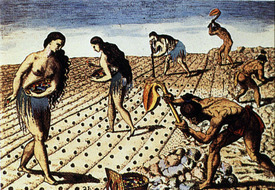
Timucuan Women, FL, 1560s
Image ID: 6839
Collection: Karen Halttunen
Topic(s): Seventeenth Century, Native Americans, Agriculture, Discovery and Conquest, Indian Civilization, Indian-White Relations Before Revolution
Region(s): United States, North America
CA Standard(s): 5.1 - The major pre-Columbian settlements…, 5.2 - Routes of early explorers and early explorations of the Americas, 5.3 - The cooperation and conflict among the American Indians and between the Indian nations and the new settlers
National Standard(s): Three Worlds Meet (Beginnings to 1620) , Colonization and Settlement (1585-1763), Revolution and the New Nation (1754-1820s) , Intensified Hemispheric Interactions 1000-1500 CE, The Emergence of the First Global Age, 1450-1770
Card Text: Jacques LeMoyne, "Timucuan Women," Florida, 1560s, working in agriculture with men. Men plowed and women planted beans and maize. "They be all naked and of goodly stature, mighty, faire and as well shapen…as any people in all the worlde, very gentill, curtious and of good nature… the men be of tawny color, hawke nosed and of a pleasant countenance…the women be well favored and modest…" French explorer Jean Ribault was impressed by these first Native peoples he encountered in Florida. The Timucuans under Chief Saturiwa, who met the French at the mouth of the River of May (later called the St. Johns River) in 1562, were one of a number of Timucua-speaking tribes who inhabited central and northern Florida and southeastern Georgia. Their way of life had remained essentially unchanged for more than 1000 years. Attacks, slavery and disease reduced their numbers. During the Spanish mission period (1595 - 1700) the Timucua population collapsed, from 50,000 people to 1,000, a loss of 98 percent. When the British took over Florida from the Spaniards in 1763, only one Timucua was reported to have survived.
Citation: Library of Congress Rare Book and Special Collections Division, Washington, DC 20540. LC-USZC4-4821. Text: "Timucua," Timucuan Ecological & Historic Preserve Florida, National Park Service, 12713 Fort Caroline Rd, Jacksonville, FL 32225. https://www.nps.gov/timu/learn/historyculture/ timucua.htm. Nov 28, 2017.

Rider, Camp-Meeting, c. 1829
Image ID: 8342
Collection: Karen Halttunen
Topic(s): Antebellum Reform, Blacks in Rural South, Class and Status, Early National Period, Environmental History, Exhibition, Family, Frontier, Jacksonian Era, Landscape, anti-urban, Middle-Class Culture, Moral lessons, Nineteenth and Twentieth Century, Outdoor Life, Popular recreation to 1865, Populism, Post Antebellum south, Religion, Revivalism since 1880, Sharecroppers and rural US, Slavery Misc., Social disorder and order to 1865, Social Gospel and Missions, Success 19th century, Symbols of mass society, Temp to 1870's, Women's liberation, Working Class Culture
Region(s): Europe, United States
CA Standard(s): 5.8 - The colonization, immigration, and settlement patterns of the American people from 1789 to the mid-1800s..., 8.4 - The aspirations and ideals of the people of the new nation, 11.2 - The the relationship among the rise of industrialization, large-scale rural-to-urban migration, and massive immigration from Southern and Eastern Europe, 11.3 - The role of religion in the founding of America and its lasting moral, social, and political impacts, and issues regarding religious liberty.
National Standard(s): Revolution and the New Nation (1754-1820s) , Expansion and Reform (1801-1861), Civil War and Reconstruction (1850-1877)
Card Text: Alexander Rider, "Camp-Meeting," c. 1829. A large revival meeting, with tents in the background and a large wooden pulpit in the foreground. A large crowd worships enthusiastically: Some sit on benches as others kneel, stand, or dance while listening to an itinerant preacher. These camp meetings were a popular form of Protestant worship throughout the 19th century and continue into the 21st. Early in the 19th century, Virginia Methodists perfected the camp meeting, a relatively new revival setting begun in Kentucky and Tennessee, to which people, both white and black, would come from the surrounding region to camp on church grounds for several days at a time. These open-air events have often involved ecstatic communal prayer in which believers, many of them women, respond to an evangelical preacher with trances, dreams, visions, and bodily movement. Hundreds and even thousands of congregants have come from miles around for preaching, worshipping, and enjoying the festival-like atmosphere.
A recent participant speaks: "Each summer I do something odd by most American standards: I spend one week with my extended family, we sleep in a crowded cabin with no air conditioner, and we go to worship services three times per day—alongside of hundreds of others—in an open air structure with a sawdust floor. The songs we sing were written long before I was born and the sermons last much longer than fifteen to eighteen minutes. Camp meetings are uniquely American institutions developed during the Second Great Awakening, of the early 19th century. At the time, they were a new method for evangelism and revival that sprang up all across the country. Camp meetings often provided a place for those who lived in unsettled areas to worship and gather as a community for a short period of time—typically during the late summer. They began with very temporary arrangements such as tents, wagons, and brush arbors to worship under. Over time, these gatherings established more permanent structures and began to draw people from all over the surrounding communities. Francis Asbury [a founder of US Methodism] once called camp meetings 'a battle ax and weapon of war' that broke down walls of wickedness throughout America. He believed they were a great means of grace. And in 1811, he estimated that these spirit-filled gatherings brought together one-third of the total American population. More than 200 years later, thousands of people continue to make the pilgrimage each summer to camp meetings that have withstood the test of time. Here are five reasons why I think we still need them today:
"1. They provide an opportunity for true Sabbath rest. You’ll rarely see a laptop, television, or gaming console. You’ll often see porch swings, laughter, and lounging. Many who attend take the week of camp meeting as vacation from work, not worrying about being productive or efficient. Eugene Peterson describes the Sabbath as 'uncluttered time and space to distance ourselves from the frenzy of our own activities so we can see what God has been and is doing.'
"2. They aid in the slow work of cultivating true community. In five to ten years, great relationships can be built, but like cast iron skillets, the best relationships are formed slowly over time. This summer will mark my 26th camp meeting. I’ve shared the crying years of infancy, the awkward years of middle school, and the growing years of being a young adult with an intergenerational community that hasn’t gone anywhere. Each year in this community babies are celebrated, deaths are mourned, people with cancer are cared for, and wayward children who once attended are lifted up in prayer. Although I sleep in a cabin at camp meeting each night that holds three generations of my family, generations of others have helped them raise me and shape who I am. And they’re not all from the same church. As they were in the beginning, camp meetings continue to be a place where Methodists, Baptists, Presbyterians, and others truly come together for the gospel.
"3. They are a foundation that helps with recalibration. Questions like 'who am I?,' 'where am I headed?,' and 'what’s the purpose of all of this?' aren’t new. Yet in a VUCA world—one that is volatile, uncertain, complex, and ambiguous—these questions are more challenging than ever and it’s easy to lose one’s bearings. Camp meetings are the antithesis of VUCA. Many of them are now 100+ years old and they exude steadiness, embody regular life-shaping rituals, and offer simplicity. The altar calls, Sabbath time, and community that surround camp meetings provide just the kinds of opportunities through which one can easily explore the deep questions of life and experience the Holy Spirit move in a powerful way. They also come with the advantage that you can count on them every year.
"4. They serve as a reminder that we don’t have to make faith up as we go. As Christians we’ve been called 'to contend for the faith that was once and for all entrusted to the saints.' Yet as contemporary Americans, we often act as if we can make Christianity up as we go along. Camp meetings remind us that we’re part of something that started well before us. And the fact that camp meetings survive in our world today also serves as a testimony to the unstoppable nature of the gospel.
"5. They form Christians in a deep way. Spiritual formation is the process, empowered by the Holy Spirit, in which we adopt the narratives of Jesus as the narratives of our lives, adopt the practices of Jesus as the daily rhythms of our lives, and spend time with others doing the same. At camp meetings these three things happen in an intentional way for one week each year. Every day preaching, teaching, and conversation take place which help replace false narratives adopted from the world with the true narratives about God that Jesus regularly taught. Throughout the week, countless opportunities arise to spend time alone in prayer, care for broken and hurting people within the community, and encourage others with love. Every moment is spent with other people who have chosen to dedicate their lives to these same tasks."
The artist Alexander Rider was a German- or Swiss-born colorist and engraver who arrived in the US in the early 1800s. He worked for the next two decades in Philadelphia as a book illustrator, miniature and portrait artist, and painter of historical themes. By 1830 he had begun making lithographic prints and continued in the 1840s, producing plates for an important book on American natural history. Colored lithograph.
Citation: Library of Congress Prints and Photographs Division, Washington, DC 20540. LC-USZC4-4554. First text: Adapted from "Camp-Meeting" by Hugh Bridport and Kennedy & Lucas after a painting by Alexander Rider. https://www.si.edu/object/nmah_325242. National Museum of American History, Harry T. Peters "America on Stone" Lithography Collection. Copyright NMAH, 1300 Constitution Ave, NW, Washington, DC 20560. All rights reserved. Second text: Adapted from Jonathan Andersen, "Five Reasons We Need Camp Meetings Now More Than Ever," June 19, 2014. https://seedbed.com/5-reasons-need-camp-meetings-now-ever/. Copyright Seedbed, Inc., 415 Bridge St, Franklin, TN 37064. All rights reserved. Feb 2, 2023.

Alden, The Last Judgment, Barre, MA, c. 1830
Image ID: 8353
Collection: Karen Halttunen
Topic(s): Nineteenth Century, Antebellum Reform, Religion, Arches, Arts and Architecture, Early National Period, Eden Imagery, Institutions and social disorder, Moral lessons, Naive Art, Numinous, Social disorder and order to 1865, Social Gospel and Missions, Symbols, Temp to 1870's, Victorian Culture, Victorian Death
Region(s): United States
CA Standard(s): 8.4 - The aspirations and ideals of the people of the new nation, 5.4 - Political, religious, social, and economic institutions that evolved in the colonial era. , 5.8 - The colonization, immigration, and settlement patterns of the American people from 1789 to the mid-1800s...
National Standard(s): Expansion and Reform (1801-1861), An Age of Revolutions, 1750-1914
Card Text: Albert Alden, "The Last Judgment," Barre, MA, c. 1840. The Apocalypse: God dances joyfully in the clouds above a pair of trumpeting archangels as the dead rise from their graves to be led off to heaven or hell. At upper left, angels in long white gowns take only a few souls to heaven, an orderly, regimented open space surrounded by clouds, while at lower right black demons with pitchforks push and drag thousands of naked sinners through an arch of fire into a flaming pit below. Hell is separated from heaven and the world by huge, billowing black clouds.
A descendant of the Pilgrim immigrant John Alden, Albert Alden (1812-83) published the "Barre Gazette," Worcester County’s oldest newspaper, and a number of prints and children’s books. He worked as a wood engraver in Barre, MA, from the 1830s to the 1850s, producing two large scrapbooks of his cuts, scientific illustrations, images for periodicals and almanacs, and advertisements. Etching. (30 x 38 cm)
Citation: Image and text: Copyright American Antiquarian Society, 185 Salisbury St, Worcester, MA 01609-1634. Text: Miscellaneous Matrix Collection, American Antiquarian Society, BIB 509501. https://www.americanantiquarian.org/Inventories/Miscellaneous%20Matrix%20Collection%20509501.pdf. All rights reserved. Feb 1, 2023.

Public Hospital and Dewitt Wallace Gallery, Williamsburg, VA
Image ID: 8338
Collection: Karen Halttunen
Topic(s): Nineteenth Century, Antebellum Reform, Civil Rights, Class and Status, Early National Period, Institutions and social disorder, Moral lessons, National Events, Nineteenth and Twentieth Century, Nineteenth Century Slavery, Prejudice and Discrimination, Race, Reform, Slavery, Working, and Living Conditions, Social disorder and order to 1865, Success 19th century, Williamsburg
Region(s): United States
CA Standard(s): 8.1 - Major events preceding the founding of the nation and the development of American constitutional democracy, 11.10 - The development of federal civil rights and voting rights
National Standard(s): Expansion and Reform (1801-1861), Civil War and Reconstruction (1850-1877)
Card Text: Public hospital and Dewitt Wallace Gallery, Williamsburg, VA. Eastern State Hospital was the first public facility in the United States constructed solely for the care and treatment of the mentally ill. In 1770, Colonial legislators met in Williamsburg, the capital of the Virginia colony, and passed a bill authorizing the construction of a hospital for this purpose. The building was erected on an eight-acre site near the College of William and Mary, and the first patients were admitted on October 12, 1773.
The Hospital provided treatment during the turbulent crises of both the Revolutionary War and the Civil War. In 1841 the Hospital, called Eastern Lunatic Asylum and housing 125 “inmates,” came under the supervision of Dr. John Galt, a brilliant physician who brought "Moral Management" treatment to the mentally ill. As Dr. Galt put it, three successive revolutions in psychiatry occurred at the Hospital. The “First Revolution” was the Hospital’s founding as a publicly-supported facility exclusively for the care of the mentally ill. The “Second Revolution” was the introduction of Moral Management therapy. This taught, as Dr. Galt said, that the mentally ill “differ from us in degree, but not in kind” and are entitled to human dignity. Dr. Galt introduced therapeutic activities and talk therapy. He was probably the only asylum superintendent at the time to advocate that the psychiatric hospital undertake in-house research, and he claimed to treat African-American patients equally with whites. Dr. Galt rarely used restraint, physical control of the patients, and sought a calming medication to replace restraint. He dispensed opium liberally to patients in a foreshadowing of our 20th century neuroleptics (antipsychotic medications that block dopamine and sometimes serotonin receptors in the brain) to reduce symptoms of psychosis, the loss of contact with reality. The “Third Revolution" in psychiatry became clear in 1857, when Dr. Galt was the first to advocate de-institutionalization and community-based mental health care. He wrote, “A large number of insane, instead of rusting out their lives in the confines of some vast asylum, should be placed… in the neighboring community….Were any other class of persons than the insane collected together in such large numbers as is the case in some asylums,... the greatest disorder would be likely to ensue.” Dr. Galt’s was a lone voice, over a century ahead of its time. There was no support from the Hospital’s Court of Directors, which three times prevented his accomplishing these plans. His disappointment and consequent depression probably contributed to his suicide five years later.
Most Americans in the 19th century lacked civil rights. African-Americans were enslaved, women and children oppressed, and the mentally ill tremendously stigmatized and punished. The servants at Eastern State Hospital around 1850 were actually slaves owned by the hospital; as many as 45 enslaved at the asylum did much of the work. Dr. Galt trained them, as well as white “officers” (nursing aides, now called "care workers"), to provide talk therapy for the patients. Eastern State had been an integrated hospital since its beginning in 1773, and in 1846 Dr. Galt successfully submitted a bill to admit slaves as patients. Dr. Galt claimed to treat patients equally “without regard to race,” although he published no records of the races of his patients.
The mentally ill had been chained and suffered other forms of long-term restraint at Eastern Lunatic Asylum until the late 1830s, when Moral Management thinking introduced the ideals of human dignity and least restraint. After Dr. Galt arrived in 1841, he used no restraints at all in some years. Patients who escaped were sometimes cruelly treated by the surrounding community. In 1843 Dr. Galt received a bill for the castration of an Eastern State patient captured near Lynchburg, Virginia. Dr. Galt’s reaction is not known, but he did not send payment.
The Civil War devastated Eastern State, destroying the advanced therapeutic community Dr. Galt had built. The Hospital found itself on one side, then another, of the battle lines, and the war disrupted lives. The Hospital was finally captured by Union troops on May 6, 1862, and Dr. Galt died soon after, on May 17 or 18. He had probably suffered from depression for many years, and either accidentally or purposely overdosed on laudanum, which he liberally dispensed to his patients as a neuroleptic substitute.
By the mid-1930s, Eastern State Hospital had expanded significantly from its early beginnings. Because of the embellishment of Colonial Williamsburg by the Rockefeller family, the Hospital was moved about three miles from its downtown site to more spacious surroundings at Dunbar Farms. This move was accomplished gradually and completed in 1970.
Home to the world's largest collection of Southern furniture and a large collections of British ceramics, the DeWitt Wallace Decorative Arts Museum displays useful and beautiful objects. Its exhibitions illuminate life in Virginia and America before, during, and after the Revolution.
Citation: Image and Last text: Copyright Colonial Williamsburg Foundation, PO Box 1776, Williamsburg, VA 23187-1776. All rights reserved. First text: "ESH History: Eastern State Hospital, Williamsburg, VA." https://dbhds.virginia.gov/facilities/esh/esh-history/. Department of Behavioral Health and Developmental Services, PO Box 1797, Richmond, VA 23218-1797. Copyright © 2023 ESH | DBHDS. All rights reserved. Sept 10, 2023.