
Private Railroad Car, c. 1890
Image ID: 8242
Collection: Karen Halttunen
Topic(s): Nineteenth Century, Transportation, Arts and Architecture, Business 19th century, Class Separation, Coal, Cooption of styles, Domesticity, Exhibition, Gilded Age, Industrial Revolution, Invention, Luxury, Nature and Civilization, Nineteenth Century Interiors, Popular recreation 1870-1920, Popular recreation since 1920, Pullman and Model Towns, Railroad and steamboat, Recreation - upper class, Symbols, Technology, The West, Twentieth Century Misc., Victorian Culture
Region(s): United States
CA Standard(s): 8.6 - The divergent paths of the American people from 1800 to the mid-1800s...with emphasis on the Northeast. , 8.11 - The character and lasting consequences of Reconstruction, 8.12 - The transformation of the American economy and the changing social and political conditions…in response to the Industrial Revolution, 8.4 - The aspirations and ideals of the people of the new nation, 8.8 - The divergent paths of the American people in the West from 1800 to the mid-1800s , 11.2 - The the relationship among the rise of industrialization, large-scale rural-to-urban migration, and massive immigration from Southern and Eastern Europe, 11.4 - The rise of the United States to its role as a world power in the twentieth century, 11.5 - Major political, social, economic, technological, and cultural developments of the 1920s.
National Standard(s): Revolution and the New Nation (1754-1820s) , Civil War and Reconstruction (1850-1877) , The Development of the Industrial United States (1870-1900) , The Emergence of Modern America (1890-1930), The Great Depression and World War II (1929-1945)
Card Text: Private railroad car with mahogany paneling, built by Wagner Palace Car Co., c. 1890. Early rail travel was uncomfortable. From the 1830s through the '50s, long-distance train travel allowed passengers little sleep if the train didn't stop at a village or city for an overnight accommodation. Webster Wagner (1817-82) was a New York Central Railroad freight agent in Palatine Bridge, NY, who saw the need for better comfort. He came up with the idea of building sleeping cars. With the assistance of other enterprising men, Wagner constructed four such cars at a cost of $3,200 each. Berths were provided for the sleepers, along with a pair of cheap blankets and pillows. Wagner invented and put into operation his first drawing-room or palace car, "the first ever seen in America," in 1867. This car and its comforts of home became so popular with tourists that it made Wagner a fortune. The company became the second largest builder of sleeping cars in the United States.
The Wagner Company began as the New York Central Sleeping Car Company, founded in 1858 in New York City by Wagner in cooperation with Commodore Cornelius Vanderbilt, whose New York Central used the four original coaches. About 1870 Wagner negotiated a deal with Pullman to use its berths in the Wagner cars, with the understanding that Wagner would limit its operations to the New York Central. But in 1875, Pullman sued, and settled out-of-court. Wagner died in 1882 aboard one of his own sleeping cars in a rear-end collision. The company nevertheless continued doing business, and in 1888 was in court again against Pullman, this time for having allegedly infringed upon Pullman’s vestibule patents. This time Pullman won. The battles between the Pullman and Wagner companies continued until Vanderbilt’s death, when the Wagner directors sold the company to Pullman on January 1, 1900.
The Wagner Palace Car Company was one of the largest employers in Buffalo, NY, in 1890, and its works occupied 35.7 acres. In addition to brass finishers, the company employed blacksmiths, car builders, carpenters, carvers, marble finishers, steamfitters and even a storekeeper. Most of these workers lived on the east side of Buffalo, and likely walked, rode a bicycle or took a horse-drawn streetcar to work. The former Wagner Palace Car complex is one of the last Reconstruction-era industrial sites in Buffalo, the construction site of some of the luxurious railcars of the “Golden Age” of American railroading.
Citation: Image: Copyright Shelburne Museum, PO Box 10, Shelburne, VT 05482. All rights reserved. First text: "Wagner Palace Car Company," April 2006. https:// www.midcontinent.org/rollingstock/builders/wagner.htm. Copyright Mid-Continent Railway Museum, PO Box 358, E8948 Museum Rd, North Freedom, WI 53951. All rights reserved. Second text: "Wagner Palace Car Complex (Pullman) - East Buffalo." www.forgottenbuffalo.com/forgottenbflofeatures/pullman wagnercomplex.html. © 2020 by Forgotten Buffalo. All rights reserved. Oct 24, 2022.

Exterior, Private Railroad Car, c. 1890
Image ID: 8243
Collection: Karen Halttunen
Topic(s): Nineteenth Century, Transportation, Arts and Architecture, Business 19th century, Business 20th century, Class Separation, Coal, Cooption of styles, Domesticity, Environmental History, Exhibition, Gilded Age, Industrial Revolution, Invention, Luxury, Middle-Class Culture, Nature and Civilization, Popular recreation 1870-1920, Popular recreation since 1920, Pullman and Model Towns, Railroad and steamboat, Railroads, Recreation - upper class, Symbols, Technology, The West, Twentieth Century Misc., Victorian Culture
Region(s): United States
CA Standard(s): 8.6 - The divergent paths of the American people from 1800 to the mid-1800s...with emphasis on the Northeast. , 8.12 - The transformation of the American economy and the changing social and political conditions…in response to the Industrial Revolution, 11.2 - The the relationship among the rise of industrialization, large-scale rural-to-urban migration, and massive immigration from Southern and Eastern Europe, 11.4 - The rise of the United States to its role as a world power in the twentieth century, 11.5 - Major political, social, economic, technological, and cultural developments of the 1920s.
National Standard(s): The Development of the Industrial United States (1870-1900) , The Emergence of Modern America (1890-1930), The Great Depression and World War II (1929-1945), Postwar United States (1945 to early 1970s)
Card Text: Exterior view, private railroad car built by Wagner Palace Car Co., c. 1890. Early rail travel was uncomfortable. From the 1830s through the '50s, long-distance train travel allowed passengers little sleep if the train didn't stop at a village or city for an overnight accommodation. Webster Wagner (1817-82) was a New York Central Railroad freight agent in Palatine Bridge, NY, who saw the need for better comfort. He came up with the idea of building sleeping cars. With the assistance of other enterprising men, Wagner constructed four such cars at a cost of $3,200 each. Berths were provided for the sleepers, along with a pair of cheap blankets and pillows. Wagner invented and put into operation his first drawing-room or palace car, "the first ever seen in America," in 1867. This car and its comforts of home became so popular with tourists that it made Wagner a fortune. The company became the second largest builder of sleeping cars in the United States.
The Wagner Company began as the New York Central Sleeping Car Company, founded in 1858 in New York City by Wagner in cooperation with Commodore Cornelius Vanderbilt, whose New York Central used the four original coaches. About 1870 Wagner negotiated a deal with Pullman to use its berths in the Wagner cars, with the understanding that Wagner would limit its operations to the New York Central. But in 1875, Pullman sued, and settled out-of-court. Wagner died in 1882 aboard one of his own sleeping cars in a rear-end collision. The company nevertheless continued doing business, and in 1888 was in court again against Pullman, this time for having allegedly infringed upon Pullman’s vestibule patents. This time Pullman won. The battles between the Pullman and Wagner companies continued until Vanderbilt’s death, when the Wagner directors sold the company to Pullman on January 1, 1900.
The Wagner Palace Car Company was one of the largest employers in Buffalo, NY, in 1890, and its works occupied 35.7 acres. In addition to brass finishers, the company employed blacksmiths, car builders, carpenters, carvers, marble finishers, steamfitters and even a storekeeper. Most of these workers lived on the east side of Buffalo, and likely walked, rode a bicycle or took a horse-drawn streetcar to work. The former Wagner Palace Car complex is one of the last Reconstruction-era industrial sites in Buffalo, the construction site of some of the luxurious railcars of the “Golden Age” of American railroading.
Citation: Image: Copyright Shelburne Museum, PO Box 10, Shelburne, VT 05482. All rights reserved. First text: "Wagner Palace Car Company," April 2006. https://www.midcontinent.org/rollingstock/builders/wagner.htm. Copyright Mid-Continent Railway Museum, PO Box 358, E8948 Museum Rd, North Freedom, WI 53951. All rights reserved. Second text: "Wagner Palace Car Complex (Pullman) - East Buffalo." www.forgottenbuffalo.com/forgotten bflofeatures/pullmanwagnercomplex.html. © 2020 by Forgotten Buffalo. All rights reserved. Oct 24, 2022.

Interior, Private Railroad Car, c. 1890
Image ID: 8245
Collection: Karen Halttunen
Topic(s): Nineteenth Century, Transportation, Arts and Architecture, Business 19th century, Business 20th century, Class Separation, Coal, Cooption of styles, Domesticity, Exhibition, Gilded Age, Industrial Revolution, Invention, Luxury, Nature and Civilization, Nineteenth Century Interiors, Popular recreation 1870-1920, Popular recreation since 1920, Pullman and Model Towns, Railroad and steamboat, Railroads, Recreation - upper class, Symbols, Technology, Twentieth Century Misc., Victorian Culture
Region(s): United States
CA Standard(s): 8.6 - The divergent paths of the American people from 1800 to the mid-1800s...with emphasis on the Northeast. , 8.12 - The transformation of the American economy and the changing social and political conditions…in response to the Industrial Revolution, 11.2 - The the relationship among the rise of industrialization, large-scale rural-to-urban migration, and massive immigration from Southern and Eastern Europe, 11.4 - The rise of the United States to its role as a world power in the twentieth century, 11.5 - Major political, social, economic, technological, and cultural developments of the 1920s.
National Standard(s): The Emergence of Modern America (1890-1930), The Great Depression and World War II (1929-1945), Postwar United States (1945 to early 1970s)
Card Text: Private railroad car with mahogany paneling, built by Wagner Palace Car Co., c. 1890. Early rail travel was uncomfortable. From the 1830s through the '50s, long-distance train travel allowed passengers little sleep if the train didn't stop at a village or city for an overnight accommodation. Webster Wagner (1817-82) was a New York Central Railroad freight agent in Palatine Bridge, NY, who saw the need for better comfort. He came up with the idea of building sleeping cars. With the assistance of other enterprising men, Wagner constructed four such cars at a cost of $3,200 each. Berths were provided for the sleepers, along with a pair of cheap blankets and pillows. Wagner invented and put into operation his first drawing-room or palace car, "the first ever seen in America," in 1867. This car and its comforts of home became so popular with tourists that it made Wagner a fortune. The company became the second largest builder of sleeping cars in the United States.
The Wagner Company began as the New York Central Sleeping Car Company, founded in 1858 in New York City by Wagner in cooperation with Commodore Cornelius Vanderbilt, whose New York Central used the four original coaches. About 1870 Wagner negotiated a deal with Pullman to use its berths in the Wagner cars, with the understanding that Wagner would limit its operations to the New York Central. But in 1875, Pullman sued, and settled out-of-court. Wagner died in 1882 aboard one of his own sleeping cars in a rear-end collision. The company nevertheless continued doing business, and in 1888 was in court again against Pullman, this time for having allegedly infringed upon Pullman’s vestibule patents. This time Pullman won. The battles between the Pullman and Wagner companies continued until Vanderbilt’s death, when the Wagner directors sold the company to Pullman on January 1, 1900.
The Wagner Palace Car Company was one of the largest employers in Buffalo, NY, in 1890, and its works occupied 35.7 acres. In addition to brass finishers, the company employed blacksmiths, car builders, carpenters, carvers, marble finishers, steamfitters and even a storekeeper. Most of these workers lived on the east side of Buffalo, and likely walked, rode a bicycle or took a horse-drawn streetcar to work. The former Wagner Palace Car complex is one of the last Reconstruction-era industrial sites in Buffalo, the construction site of some of the luxurious railcars of the “Golden Age” of American railroading.
Citation: Image: Copyright Shelburne Museum, PO Box 10, Shelburne, VT 05482. All rights reserved. First text: "Wagner Palace Car Company," April 2006. https://www.midcontinent.org/rollingstock/builders/wagner.htm. Copyright Mid-Continent Railway Museum, PO Box 358, E8948 Museum Rd, North Freedom, WI 53951. All rights reserved. Second text: "Wagner Palace Car Complex (Pullman) - East Buffalo." www.forgottenbuffalo.com/forgotten bflofeatures/pullmanwagnercomplex.html. © 2020 by Forgotten Buffalo. All rights reserved. Oct 24, 2022.

Woodwork, S.S. Ticonderoga, Lake Champlain, 1906-53
Image ID: 8222
Collection: Karen Halttunen
Topic(s): Nineteenth Century, Transportation, Arts and Architecture, Business 20th century, Coal, Conservation, Environmental History, Fifties, Gilded Age, Industrial Revolution, Labor, Luxury, Middle-Class Culture, Nature and Civilization, Popular recreation 1870-1920, Popular recreation since 1920, Railroad and steamboat, Recreation - upper class, Symbols, Technology, Victorian Culture
Region(s): United States
CA Standard(s): 8.6 - The divergent paths of the American people from 1800 to the mid-1800s...with emphasis on the Northeast. , 8.12 - The transformation of the American economy and the changing social and political conditions…in response to the Industrial Revolution, 11.4 - The rise of the United States to its role as a world power in the twentieth century, 11.8 - The economic boom and social transformation of post-World War II America
National Standard(s): The Emergence of Modern America (1890-1930), The Great Depression and World War II (1929-1945), Postwar United States (1945 to early 1970s)
Card Text: Woodwork in S.S. Ticonderoga, side-paddle-wheeler, Lake Champlain, 1906-53. The Ticonderoga is one of two remaining side-paddle-wheel passenger steamers with a vertical beam engine of the type that provided freight and passenger service on America's bays, lakes and rivers from the early 19th to the mid-20th centuries. Ticonderoga was built in 1906 at the Shelburne Shipyard in Shelburne, Vermont on Lake Champlain. The ship is 220 feet in length and 59 feet in beam, with a displacement of 892 tons. Its steam engine, handmade by the Fletcher Engine Company of Hoboken, NJ, was powered by two coal-fired boilers and could reach a speed of 17 miles per hour (27 km/h) (14.77 knots). The ship's crew numbered 28, including the captain, pilots, mate, deckhands, engineers, and firemen. The purser, stewardess, freight clerk, bartender, hall boys, cook, waiters, and scullion and mess boys attended to passengers and freight arrangements. Initially, Ticonderoga served a north-south route on Lake Champlain, docking daily at Westport, NY, where it met the New York City evening train. The next morning it carried travelers and freight north to St. Albans, VT. In addition to passengers, Ticonderoga regularly transported local farm produce, livestock, and dry goods, and during both world wars ferried US troops between Plattsburgh, NY, and Burlington, VT. Over the years it also operated on the east-west run from Burlington to Port Kent, NY, and briefly served as a floating casino. When modern ferries made it obsolete, Ticonderoga persisted in operation for several years as an excursion boat, but by 1950 the decline in business threatened its future. Ralph Nading Hill saved Ticonderoga from the scrap heap when he persuaded Electra Havemeyer Webb to buy it for her growing museum in Shelburne. However, the steamboat era had passed, making it difficult to find qualified personnel to operate and maintain the aging vessel. In 1954 the Shelburne Museum moved Ticonderoga overland to the museum grounds. At the end of the summer season the boat paddled into a newly dug water-filled basin off Shelburne Bay and floated over a railroad carriage resting on specially laid tracks. The water was pumped out of the basin and Ticonderoga settled onto the railroad carriage. In 1955 Ticonderoga was hauled across highways, over a swamp, through woods and fields, and across the tracks of the Rutland Railway to reach its permanent mooring on the Shelburne Museum grounds. Much of its interior was restored to its original grandeur: The dining room and stateroom halls retain their butternut and cherry paneling, and ceilings their gold stenciling. The barbershop, captain's quarters, dining room, and promenade deck contain furniture and accessories used in Ticonderoga and other Lake Champlain steamboats.
Today, Ticonderoga portrays life on board in 1923. The ship’s carved and varnished woodwork, gilded ceilings, staterooms, grand staircase, and dining room evoke the elegance of steamboat travel. The many visitors freely explore the ship’s four decks, massive engine, pilot house, galley, and crew’s quarters. Ticonderoga was declared a National Historic Landmark in 1964.
Citation: Image and text: "Steamboat Ticonderoga." Copyright Shelburne Museum, PO Box 10, Shelburne, VT 05482. https://shelburnemuseum.org/collection/ steamboat-ticonderoga/. All rights reserved. Aug 14, 2022.

Quaker Meeting, 18th c.
Image ID: 8364
Collection: Karen Halttunen
Topic(s): Nineteenth Century, Antebellum Reform, 17th Century Interiors, 18th Century Interiors, Americanization and Political Activity, Arts and Architecture, British Empire, Civil Rights, Colonial America, Early American Slavery
Region(s):
CA Standard(s): 8.9 - The early and steady attempts to abolish slavery and to realize the ideals of the Declaration of Independence.
National Standard(s):
Card Text: Unidentified British artist, "Quaker Meeting," 18th c. or first quarter 19th c., illustrating the prominent place of women in Quaker gatherings. The Religious Society of Friends (Quakers) is a movement that began in 17th-century England. George Fox was frustrated by the Christian institutions of his day. He spent years wandering the English countryside, seeking spiritual solace, sometimes consulting with ministers and other religious leaders—but, as he later wrote, “there was none among them all that could speak to my condition.” “And when all my hopes in them and in all men were gone, so that I had nothing outwardly to help me, nor could tell what to do, then, oh, then, I heard a voice which said, ‘There is one, [namely] Christ Jesus, that can speak to thy condition’; and when I heard it my heart did leap for joy.” Fox continued to roam the land, but now he began sharing the insights he gained from this and other spiritual experiences. In 1652, he met Margaret Fell, who became an active member of the growing Religious Society, and would spend several years in prison for her faith. It was there that she wrote the pamphlet “Women’s Speaking Justified,” which articulated the Quaker belief that men and women were equally capable of receiving and sharing prophetic visions from God. In 1669, having been widowed for more than a decade, she married Fox, although between missionary work and imprisonment they were often apart. The early Friends sought to revive “primitive Christianity” by going back to Christian roots in Jesus’ teachings about nonviolence, simple living, God’s concern for the marginalized, and the immediate and equal access to God’s Spirit. They refused to pay tithes to the Church of England, though this was a required tax at the time. They also refused to take oaths by swearing on the Bible, insisting that Jesus’s mandate to “let your communication be, Yea, yea; Nay, nay” (Matthew 5:37) was sufficient. They rejected all priestly authority and the pomp of church sacrament, choosing instead to gather in “expectant silence,” where they waited for the Spirit present among them to share whatever messages it had, choosing whoever among them it deemed fit. While Quakerism started in England and soon spread to the American colonies, today’s Religious Society of Friends is a global faith community with diversity in its members’ theological principles and religious practices. Many Quakers still worship in silence, with no clergy presiding over the service, while other Quakers have pastors who lead their meetings in song and prayer (though silent prayer is still frequently a component of their worship). Some Friends maintain a strong connection to the Society’s Christian roots, while others incorporate other religious traditions into their understanding of the divine—or even abandon belief in any divine power while remaining committed to a life of ethical conduct: "We all share four things in common: our belief in the possibility of receiving direct communications from God, a commitment to nurturing our spiritual life through worship, a commitment to practicing spiritual discernment together as a community, and a commitment to making our lives a testimony to our faith."
The last English colony to be established in the 17th century was Pennsylvania. The proprietor, William Penn, envisioned it as a place where those facing religious persecution in Europe could enjoy spiritual freedom, and colonists and Native peoples would coexist in harmony. Penn’s late father had been a supporter and creditor of Charles II. To cancel his debt to the Penn family and bolster the English presence in North America, the king in 1681 granted Penn a vast tract of land south and west of New York, as well as the old Swedish-Dutch colony that became Delaware. A devout member of the Society of Friends, Penn was particularly concerned with establishing a refuge for his coreligionists, who faced increasing persecution in England. He had already assisted a group of English Quakers in purchasing half of what became the colony of New Jersey from Lord John Berkeley, who had received a land grant from the Duke of York. Penn was largely responsible for the government structure announced in 1677, the West Jersey Concessions, one of the most liberal of the era. Based on Quaker ideals, it created an elected assembly with a broad suffrage and established religious liberty. Penn hoped that West Jersey would become a society of small farmers, not large. Like the Puritans, Penn considered his colony a “holy experiment,” but of a different kind—“a free colony for all mankind that should go hither.” He hoped that Pennsylvania could be governed according to Quaker principles, among them the equality of all persons (including women, blacks, immigrants and Indians) before God and the primacy of the individual conscience. To Quakers, liberty was a universal entitlement, not the possession of any single people—a position that would eventually make them the first group of whites to repudiate slavery. Penn also treated indigenous people with a consideration almost unique in the colonial experience, arranging to purchase land before reselling it to colonists and offering refuge to tribes driven out of other colonies by warfare. Sometimes, he even purchased the same land twice, when more than one Native tribe claimed it. Since Quakers were pacifists who came to America unarmed and did not even organize a militia until the 1740s, peace with the Native population was essential. Penn’s Chain of Friendship appealed to the local Indians, promising protection from rival tribes who claimed power over them. Religious freedom was Penn’s most fundamental principle. He condemned attempts to enforce “religious Uniformity” for depriving thousands of “free inhabitants” of England of the right to worship as they desired. His Charter of Liberty, approved by the assembly in 1682, offered “Christian liberty” to all who affirmed a belief in God and did not use their freedom to promote “licentiousness.” There was no established church in Pennsylvania, and attendance at religious services was entirely voluntary, although Jews were barred from office by a required oath affirming belief in the divinity of Jesus Christ. At the same time, the Quakers upheld a strict code of personal morality. Penn’s Frame of Government prohibited swearing, drunkenness, and adultery, as well as popular entertainments of the era such as “revels, bull-baiting, and cock-fighting.” Private religious belief may not have been enforced by the government, but moral public behavior certainly was. Not religious uniformity but a virtuous citizenry would be the foundation of Penn’s social order.
Given the power to determine the colony’s form of government, Penn established an appointed council to originate legislation and an assembly elected by male taxpayers and “freemen” (owners of 100 acres of land for free immigrants and 50 acres for former indentured servants). These rules made a majority of the male population eligible to vote. Penn owned all the colony’s land and sold it to settlers at low prices rather than granting it outright. Like other proprietors, he expected to turn a profit, and like most of them, he never really did. But if Penn did not prosper, Pennsylvania did. A majority of the early settlers were Quakers from the British Isles. But Pennsylvania’s religious toleration, healthy climate, and inexpensive land, along with Penn’s aggressive efforts to publicize the colony’s advantages, soon attracted immigrants from all over western Europe. Ironically, the freedoms Pennsylvania offered to European immigrants contributed to the deterioration of freedom for others. The colony’s successful efforts to attract settlers would eventually come into conflict with Penn’s benevolent Indian policy. And the opening of Pennsylvania led to an immediate decline in the number of indentured servants choosing to sail for Virginia and Maryland, a development that did much to shift those colonies toward reliance on slave labor. Oil on canvas. 64.1 x 76.2 cm (25-1/4 x 30".)
Citation: Copyright Museum of Fine Arts, 465 Huntington Ave, Boston, MA 02115-5523. Bequest of Maxim Karolik, 1964. Acc. No: 64.456. https://collections.mfa. org/objects/33823. All rights reserved. First text: Adapted from "Quaker History: An Introduction." https://quaker.org/quaker-history-introduction/. © 2023 Friends Publishing Corporation, 1501 Cherry St, Philadelphia, PA 19102. All rights reserved. Second text: Eric Foner, "Give Me Liberty: An American History" (2019) pp. 90-92. Erenow © 2015-2023. https://erenow.net/modern/give-me-liberty-american-history/90.php. Copyright © W.W. Norton & Co., Inc., 500 Fifth Ave, New York, NY 10110. All rights reserved. Feb 11, 2023.

Rider, Camp-Meeting, c. 1829
Image ID: 8342
Collection: Karen Halttunen
Topic(s): Antebellum Reform, Blacks in Rural South, Class and Status, Early National Period, Environmental History, Exhibition, Family, Frontier, Jacksonian Era, Landscape, anti-urban, Middle-Class Culture, Moral lessons, Nineteenth and Twentieth Century, Outdoor Life, Popular recreation to 1865, Populism, Post Antebellum south, Religion, Revivalism since 1880, Sharecroppers and rural US, Slavery Misc., Social disorder and order to 1865, Social Gospel and Missions, Success 19th century, Symbols of mass society, Temp to 1870's, Women's liberation, Working Class Culture
Region(s): Europe, United States
CA Standard(s): 5.8 - The colonization, immigration, and settlement patterns of the American people from 1789 to the mid-1800s..., 8.4 - The aspirations and ideals of the people of the new nation, 11.2 - The the relationship among the rise of industrialization, large-scale rural-to-urban migration, and massive immigration from Southern and Eastern Europe, 11.3 - The role of religion in the founding of America and its lasting moral, social, and political impacts, and issues regarding religious liberty.
National Standard(s): Revolution and the New Nation (1754-1820s) , Expansion and Reform (1801-1861), Civil War and Reconstruction (1850-1877)
Card Text: Alexander Rider, "Camp-Meeting," c. 1829. A large revival meeting, with tents in the background and a large wooden pulpit in the foreground. A large crowd worships enthusiastically: Some sit on benches as others kneel, stand, or dance while listening to an itinerant preacher. These camp meetings were a popular form of Protestant worship throughout the 19th century and continue into the 21st. Early in the 19th century, Virginia Methodists perfected the camp meeting, a relatively new revival setting begun in Kentucky and Tennessee, to which people, both white and black, would come from the surrounding region to camp on church grounds for several days at a time. These open-air events have often involved ecstatic communal prayer in which believers, many of them women, respond to an evangelical preacher with trances, dreams, visions, and bodily movement. Hundreds and even thousands of congregants have come from miles around for preaching, worshipping, and enjoying the festival-like atmosphere.
A recent participant speaks: "Each summer I do something odd by most American standards: I spend one week with my extended family, we sleep in a crowded cabin with no air conditioner, and we go to worship services three times per day—alongside of hundreds of others—in an open air structure with a sawdust floor. The songs we sing were written long before I was born and the sermons last much longer than fifteen to eighteen minutes. Camp meetings are uniquely American institutions developed during the Second Great Awakening, of the early 19th century. At the time, they were a new method for evangelism and revival that sprang up all across the country. Camp meetings often provided a place for those who lived in unsettled areas to worship and gather as a community for a short period of time—typically during the late summer. They began with very temporary arrangements such as tents, wagons, and brush arbors to worship under. Over time, these gatherings established more permanent structures and began to draw people from all over the surrounding communities. Francis Asbury [a founder of US Methodism] once called camp meetings 'a battle ax and weapon of war' that broke down walls of wickedness throughout America. He believed they were a great means of grace. And in 1811, he estimated that these spirit-filled gatherings brought together one-third of the total American population. More than 200 years later, thousands of people continue to make the pilgrimage each summer to camp meetings that have withstood the test of time. Here are five reasons why I think we still need them today:
"1. They provide an opportunity for true Sabbath rest. You’ll rarely see a laptop, television, or gaming console. You’ll often see porch swings, laughter, and lounging. Many who attend take the week of camp meeting as vacation from work, not worrying about being productive or efficient. Eugene Peterson describes the Sabbath as 'uncluttered time and space to distance ourselves from the frenzy of our own activities so we can see what God has been and is doing.'
"2. They aid in the slow work of cultivating true community. In five to ten years, great relationships can be built, but like cast iron skillets, the best relationships are formed slowly over time. This summer will mark my 26th camp meeting. I’ve shared the crying years of infancy, the awkward years of middle school, and the growing years of being a young adult with an intergenerational community that hasn’t gone anywhere. Each year in this community babies are celebrated, deaths are mourned, people with cancer are cared for, and wayward children who once attended are lifted up in prayer. Although I sleep in a cabin at camp meeting each night that holds three generations of my family, generations of others have helped them raise me and shape who I am. And they’re not all from the same church. As they were in the beginning, camp meetings continue to be a place where Methodists, Baptists, Presbyterians, and others truly come together for the gospel.
"3. They are a foundation that helps with recalibration. Questions like 'who am I?,' 'where am I headed?,' and 'what’s the purpose of all of this?' aren’t new. Yet in a VUCA world—one that is volatile, uncertain, complex, and ambiguous—these questions are more challenging than ever and it’s easy to lose one’s bearings. Camp meetings are the antithesis of VUCA. Many of them are now 100+ years old and they exude steadiness, embody regular life-shaping rituals, and offer simplicity. The altar calls, Sabbath time, and community that surround camp meetings provide just the kinds of opportunities through which one can easily explore the deep questions of life and experience the Holy Spirit move in a powerful way. They also come with the advantage that you can count on them every year.
"4. They serve as a reminder that we don’t have to make faith up as we go. As Christians we’ve been called 'to contend for the faith that was once and for all entrusted to the saints.' Yet as contemporary Americans, we often act as if we can make Christianity up as we go along. Camp meetings remind us that we’re part of something that started well before us. And the fact that camp meetings survive in our world today also serves as a testimony to the unstoppable nature of the gospel.
"5. They form Christians in a deep way. Spiritual formation is the process, empowered by the Holy Spirit, in which we adopt the narratives of Jesus as the narratives of our lives, adopt the practices of Jesus as the daily rhythms of our lives, and spend time with others doing the same. At camp meetings these three things happen in an intentional way for one week each year. Every day preaching, teaching, and conversation take place which help replace false narratives adopted from the world with the true narratives about God that Jesus regularly taught. Throughout the week, countless opportunities arise to spend time alone in prayer, care for broken and hurting people within the community, and encourage others with love. Every moment is spent with other people who have chosen to dedicate their lives to these same tasks."
The artist Alexander Rider was a German- or Swiss-born colorist and engraver who arrived in the US in the early 1800s. He worked for the next two decades in Philadelphia as a book illustrator, miniature and portrait artist, and painter of historical themes. By 1830 he had begun making lithographic prints and continued in the 1840s, producing plates for an important book on American natural history. Colored lithograph.
Citation: Library of Congress Prints and Photographs Division, Washington, DC 20540. LC-USZC4-4554. First text: Adapted from "Camp-Meeting" by Hugh Bridport and Kennedy & Lucas after a painting by Alexander Rider. https://www.si.edu/object/nmah_325242. National Museum of American History, Harry T. Peters "America on Stone" Lithography Collection. Copyright NMAH, 1300 Constitution Ave, NW, Washington, DC 20560. All rights reserved. Second text: Adapted from Jonathan Andersen, "Five Reasons We Need Camp Meetings Now More Than Ever," June 19, 2014. https://seedbed.com/5-reasons-need-camp-meetings-now-ever/. Copyright Seedbed, Inc., 415 Bridge St, Franklin, TN 37064. All rights reserved. Feb 2, 2023.

Sully, Mother and Son, 1840, detail
Image ID: 8477
Collection: Karen Halttunen
Topic(s): Nineteenth Century, Domesticity
Region(s):
CA Standard(s): 8.6 - The divergent paths of the American people from 1800 to the mid-1800s...with emphasis on the Northeast.
National Standard(s):
Card Text: Thomas Sully, "Mother and Son," 1840. This grand, allegorically rich portrait of Sully's daughter Jane Cooper Sully Darley (1807-77) and her son Francis Thomas Sully Darley (d.1914) has provoked many interpretations, the most ambitious of which equates mother and son with the mythological figure of Penelope, the ideal wife of Odysseus, and Telemachus, her perfect son. Sully filled the composition with attributes of blithe family life: the spray of ivy clinging to the wall is the emblem of a faithful wife; the scene on the urn - Hermes bringing the infant Dionysus to be nurtured by the nymphs - alludes to the duties of motherhood; the boy's foot lightly resting on his dog connotes fidelity and loyalty.
Jane Sully married William Henry W. Darley, a prominent music teacher in Philadelphia and older brother of the illustrator F.O.C. Darley. She became active as a portrait painter and exhibited pictures in Philadelphia and other art societies between 1825 and 1869. Her son became a well-known organist in Philadelphia. Although this portrait is dated "1840. Jan.," according to a register kept by Sully it was begun on April 13, 1839, and finished on December 31. The register also records the painting of a smaller replica in 1866. The composition may be linked to Sir Thomas Lawrence's Countess Grey and Her Daughters (private collection). It makes use of a full range of iconographic elements, such as the rendition of the Salpion Krater. As used here, its scene of Dionysos brought by Hermes to be nurtured by the nymphs serves to emphasize the tender closeness of mother and son. Similarly, the dog and clinging ivy are traditional symbols of loyalty. Oil on canvas. 57 x 45-3/8". (144.8 x 115.3 cm)
Citation: Image and First text: Copyright Metropolitan Museum of Art, 1000 Fifth Ave, New York, NY 10028-0198. Bequest of Francis T. S. Darley, 1914 (14.126.5). https://www.metmuseum.org/art/collection/search/12693. All rights reserved. Second text: Thomas Sully, "Mother and Son," Wiki Art Visual Art Encyclopedia. https://www.wikiart.org/en/thomas-sully/mother-and-son-1840.

Newbury, VT, c. 1850
Image ID: 8311
Collection: Karen Halttunen
Topic(s): Nineteenth Century, Business 19th century, Civil War, Class Structure, Early mills and factories, Early National Period, Emerging industrial city, Gender-Bending, Industrial Revolution, Labor, Market Economy, Mills Factories Post Civil War, National Events, Parents, Children, Families, Success 19th century, Technology, Trade, Urbanization, Whites, non planters ante bellum, Women in labor movement, Women's work
Region(s): United States
CA Standard(s): 8.12 - The transformation of the American economy and the changing social and political conditions…in response to the Industrial Revolution, 5.8 - The colonization, immigration, and settlement patterns of the American people from 1789 to the mid-1800s..., 8.4 - The aspirations and ideals of the people of the new nation, 8.6 - The divergent paths of the American people from 1800 to the mid-1800s...with emphasis on the Northeast.
National Standard(s): Expansion and Reform (1801-1861), Civil War and Reconstruction (1850-1877)
Card Text: Newbury, VT, c. 1850. Newbury was once a thriving, affluent 19th-century mill village on the major Connecticut River corridor with a commanding view of the White Mountains to the east.
Between 1820 and 1860, tens of thousands of single women left rural New England to work in the factory towns of the region. After a few years, many returned to the farm, moved west, or settled in the growing towns and cities. They were the first generation of American women employed for wages outside their homes. Women's work in factories and towns often supplemented the family income and surprisingly often earned a dowry for the worker. Women working outside the home in the 19th-c. New England clothing factories had few choices available to them. Many did manage to form communities at work despite the difficult work demanded of them. They were expected to do hard labor even as the Civil War started, when cotton became scarce and factories began to shut down. Those that continued to operate were able to cut women's wages because so many women needed the work.
Citation: Copyright Shelburne Museum, PO Box 10, Shelburne, VT 05482. All rights reserved. Text: Thomas Dublin, ed., "Farm to Factory: Women’s Letters, 1830–1860" (1993) p. 76. https://doi.org/10.7312/dubl91106. Copyright Columbia University Press, 61 W 62 St, New York, NY 10023. All rights reserved. May 30, 2023.

Jackson Mfg. Co., Nashua, NH, 1846
Image ID: 8321
Collection: Karen Halttunen
Topic(s): Nineteenth Century, Lowell, Architecture, Business 19th century, Child labor, Class Structure, Corporate Image, Early mills and factories, Early National Period, Emerging industrial city, Environmental History, Factory as symbol, Industrial Revolution, Invention, Labor, National Events, Propaganda, Strikes and Violence, Success 19th century, Sweatshops, Symbols of mass society, Technology, Urbanization, Women in labor movement, Women's work, Work and Workers
Region(s): United States
CA Standard(s): 8.10 - The multiple causes, key events, and complex consequences of the Civil War, 5.8 - The colonization, immigration, and settlement patterns of the American people from 1789 to the mid-1800s..., 8.6 - The divergent paths of the American people from 1800 to the mid-1800s...with emphasis on the Northeast.
National Standard(s): Expansion and Reform (1801-1861), Civil War and Reconstruction (1850-1877)
Card Text: Jackson Mfg. Co., Nashua, NH, with genteel folk strolling below its bell tower, 1846. The Jackson Manufacturing Company, next to the Jackson Falls dam, was incorporated in 1824. Nashua is an industrial town located at the juncture of the Nashua and Merrimack Rivers in southern New Hampshire. Two large textile mills on the Nashua River, the Nashua Manufacturing Co. and the Jackson Manufacturing Co., were cotton textile manufacturers and the largest employers in the city. Nashua was one of several cities that blossomed along the Merrimack River to take advantage of its water power in the early days of the Industrial Revolution. This gentle representation of a "good-neighbor" factory of human scale belies its dirt, noise, dangerous working conditions, long working hours, and exploitation of child labor.
Citation: Courtesy of Columbia University Press, 61 W 62nd St, New York, NY 10023. In Thomas Dublin, ed., "Farm to Factory: Women's Letters 1830-1860" (1981) p. 91. Our thanks to Columbia University Press. Text: "Nashua, N.H.: 1875." https://collections.leventhalmap.org/search/commonwealth:x633fc84m.
Copyright Norman B. Leventhal Map & Education Center, Boston Public Library, 700 Boylston St, Copley Square, Boston, MA 02116. All rights reserved. Sept 12, 2023.
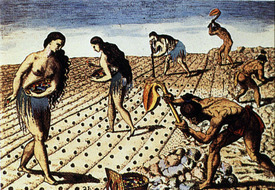
Timucuan Women, FL, 1560s
Image ID: 6839
Collection: Karen Halttunen
Topic(s): Seventeenth Century, Native Americans, Agriculture, Discovery and Conquest, Indian Civilization, Indian-White Relations Before Revolution
Region(s): United States, North America
CA Standard(s): 5.1 - The major pre-Columbian settlements…, 5.2 - Routes of early explorers and early explorations of the Americas, 5.3 - The cooperation and conflict among the American Indians and between the Indian nations and the new settlers
National Standard(s): Three Worlds Meet (Beginnings to 1620) , Colonization and Settlement (1585-1763), Revolution and the New Nation (1754-1820s) , Intensified Hemispheric Interactions 1000-1500 CE, The Emergence of the First Global Age, 1450-1770
Card Text: Jacques LeMoyne, "Timucuan Women," Florida, 1560s, working in agriculture with men. Men plowed and women planted beans and maize. "They be all naked and of goodly stature, mighty, faire and as well shapen…as any people in all the worlde, very gentill, curtious and of good nature… the men be of tawny color, hawke nosed and of a pleasant countenance…the women be well favored and modest…" French explorer Jean Ribault was impressed by these first Native peoples he encountered in Florida. The Timucuans under Chief Saturiwa, who met the French at the mouth of the River of May (later called the St. Johns River) in 1562, were one of a number of Timucua-speaking tribes who inhabited central and northern Florida and southeastern Georgia. Their way of life had remained essentially unchanged for more than 1000 years. Attacks, slavery and disease reduced their numbers. During the Spanish mission period (1595 - 1700) the Timucua population collapsed, from 50,000 people to 1,000, a loss of 98 percent. When the British took over Florida from the Spaniards in 1763, only one Timucua was reported to have survived.
Citation: Library of Congress Rare Book and Special Collections Division, Washington, DC 20540. LC-USZC4-4821. Text: "Timucua," Timucuan Ecological & Historic Preserve Florida, National Park Service, 12713 Fort Caroline Rd, Jacksonville, FL 32225. https://www.nps.gov/timu/learn/historyculture/ timucua.htm. Nov 28, 2017.

Trussell Farm, c. 1860
Image ID: 8316
Collection: Karen Halttunen
Topic(s): Nineteenth Century, Lowell, Agriculture, Architecture, Business 19th century, Child labor, Class and Status, Early mills and factories, Early National Period, Emigration and Passage, Environmental History, Family to 1920, Gender-Bending, Immigrants, Industrial Revolution, Labor, Labor Organizations and Leaders, Plantation Exterior, Pro feminist and suffrage, Strikes and Violence, Success 19th century, Sweatshops, Temp to 1870's, Urbanization, Victorian Culture, Women in labor movement, Women's work, Work and Housing, Working Class Culture, Working Conditions
Region(s): United States
CA Standard(s): 8.12 - The transformation of the American economy and the changing social and political conditions…in response to the Industrial Revolution, 5.8 - The colonization, immigration, and settlement patterns of the American people from 1789 to the mid-1800s..., 8.4 - The aspirations and ideals of the people of the new nation, 8.6 - The divergent paths of the American people from 1800 to the mid-1800s...with emphasis on the Northeast.
National Standard(s): Expansion and Reform (1801-1861), An Age of Revolutions, 1750-1914
Card Text: Sarah Trussell, "Trussell Farm," c. 1860; the artist was a Lowell worker. Between 1820 and 1860, tens of thousands of single women left rural New England to work in the factory towns of the region. After a few years, they returned to the farm, moved west, or settled in the growing urban centers. They were the the first generation of American women employed for wages outside their own homes. This is the farm home Sarah Trussell left for work in the Lowell, Massachusetts, mills. Painting.
Citation: Copyright holder unknown. Mildred Tunis. In Thomas Dublin, "Farm to Factory: Women's Letters, 1830-1860," Columbia University Press, New York, N.Y., ©1993. All rights reserved. Front cover. Sept 30, 2023.