
Rail Truck, 19th c.
Image ID: 8231
Collection: Karen Halttunen
Topic(s): Nineteenth Century, Transportation, British Empire, Business 19th century, Class Separation, Coal, Developing Nations, Early mills and factories, Early National Period, Emerging industrial city, Environmental History, Expansion, Future Progress, Imperialism, Industrial Revolution, Invention, Labor, Luxury, Market Economy, Middle-Class Culture, National Events, Nationhood, Nature and Civilization, Popular recreation 1870-1920, Railroad and steamboat, Railroads, Social Disorder, Success 19th century, Symbols of mass society, Technology, Trade, Urbanization, Victorian Culture, Victorian Death, Working Conditions
Region(s): Europe, United States
CA Standard(s): 8.6 - The divergent paths of the American people from 1800 to the mid-1800s...with emphasis on the Northeast. , 5.8 - The colonization, immigration, and settlement patterns of the American people from 1789 to the mid-1800s..., 8.10 - The multiple causes, key events, and complex consequences of the Civil War, 8.11 - The character and lasting consequences of Reconstruction, 8.12 - The transformation of the American economy and the changing social and political conditions…in response to the Industrial Revolution, 10.10 - Nation-building in the contemporary world in the Middle East, Africa, Mexico and other parts of Latin America, and China, 10.11 - The integration of countries into the world economy and the information, technological, and communications revolutions , 10.3 - The effects of the Industrial Revolution in England, France, Germany, Japan, and the United States. , 10.4 - Global change in the era of New Imperialism in Africa, Southeast Asia, China, India, Latin America, and the Philippines, 10.5 - The causes and course of the First World War, 11.2 - The the relationship among the rise of industrialization, large-scale rural-to-urban migration, and massive immigration from Southern and Eastern Europe, 11.4 - The rise of the United States to its role as a world power in the twentieth century
National Standard(s): Expansion and Reform (1801-1861), Civil War and Reconstruction (1850-1877) , The Development of the Industrial United States (1870-1900) , The Emergence of Modern America (1890-1930), An Age of Revolutions, 1750-1914
Card Text: Rail trucks are swiveling carriages with four or six wheels beneath the front part of a locomotive or one end of a railway car. They allow rail cars to turn tight curves. In 1864 more than 10,000 miles of railway track stretched across Britain, linking great cities, suburbs, and remote countryside towns. Trailing smoke and steam in its wake, the train had compressed the time it once took to journey in a horse-drawn coach from hours into minutes. It had broadened the horizons of every class of British citizen, redefining labor and the transport of goods, becoming vital to both business and recreation. Since the days of railway madness in the late 1830s and mid-1840s, a wave of speculation and construction had caused a vast network of steel to transform the landscape. Tracks ran over rivers, spanned busy streets and shady lanes, cut swaths through fertile pastures, curved through lonely moorland and even crossed wide stretches of water by means of floating jetties or the iron span bridges constructed by the age's great engineers. Steam power dazzled, and mid-Victorians wondered and enthused at its vigor, energy and spirit. Emblematic of technocratic success, of enterprise, endurance, adventure and civilization, trains delivered cotton to boats heading for China and India, they brought wool to Yorkshire and coal to the factories fueling the industrial revolution. They took the post, delivered the exotic goods arriving in British docks from all over the world to shops in towns and villages, and enabled businesses to find new markets for their products. They spread the news of national and international events to the very edges of the country and they allowed Victorians to pursue their lives more quickly than ever had been imagined possible, encouraging leisure excursions among people who had hitherto rarely left the safety of their county boundaries.
Railroad timetables forced the standardization of time across the nation, enshrining speed as the new principle of public life; vast clocks adorned the facades of stations and it became commonplace to assert that train journeys had "annihilated time." To a society caught between conservatism and progress, the railways fostered ambiguous reactions. In the whistle and shriek of every approaching engine was evidence of rapid social and technological change. The stations, viaducts and embankments turned modest towns into sprawling cities and created startling new wealth. They were liberating, but they also devoured rural communities and displayed a perilous carelessness for human life - wheels ran off tracks, axles broke, boilers burst and there were countless collisions.
Woven into the excitement of railway travel, a corresponding nervousness developed about the loss of individual control. The sense of being trapped in a box-like compartment, whirled along at speed and treated like just one in a stream of disposable, moveable goods was disorienting and even threatening. Deafening noise confounded the ears, speed taxed the eyes and vibrations had an adverse effect on both the brain and the skeleton. By the 1860s novelists had been exploring the public's deepening apprehensions about the relentlessness of progress, technology and modernity for two decades. Collapsing time with such ease, they questioned whether the railways might annihilate the human spirit with equal success.
Citation: Copyright Shelburne Museum, PO Box 10, Shelburne, VT 05482. All rights reserved. Text: Adapted from Kate Colquhoun, "Murder in The First-Class Carriage" 2011, pp. 9-11 (Overlook Press, 141 Wooster St, New York, NY 10012). Copyright Kate Colquhoun. All rights reserved. Nov 5, 2023.
Business 19th centuryClass SeparationEarly National PeriodEmigration and PassageEnvironmental HistoryExpansionFrontierFuture ProgressImmigrationIndustrial RevolutionInventionLaborLuxuryMiddle-Class CultureNational EventsNationhoodNature and CivilizationNineteenth CenturyRailroad and steamboatRailroadsTechnologyThe WestTradeTransportationWhites, non planters ante bellum

The Wickedest Man in New York, 1868
Image ID: 8280
Collection: Karen Halttunen
Topic(s): Nineteenth Century, Industrial Revolution, Industrialization, Arts and Architecture, Business 19th century, Class Structure, Early National Period, Emerging industrial city, Exhibition, Games 19th century, Institutions and social disorder, Labor, Liquor, Market Economy, Moral lessons, Nineteenth Century Interiors, Popular recreation to 1865, Prostitution, Reform, Religion, Satire and Comedy, Success 19th century, Symbols of mass society, Trade, Urban gangs, Urban poverty, Victorian Culture, Women and Theater, Women's work
Region(s): United States
CA Standard(s): 8.12 - The transformation of the American economy and the changing social and political conditions…in response to the Industrial Revolution, 8.4 - The aspirations and ideals of the people of the new nation, 8.6 - The divergent paths of the American people from 1800 to the mid-1800s...with emphasis on the Northeast.
National Standard(s): The Development of the Industrial United States (1870-1900) , Expansion and Reform (1801-1861), Civil War and Reconstruction (1850-1877)
Card Text: "The Wickedest Man in New York," Scene at John Allen's Dance House, 304 Water St, New York City, 1868. John Allen was born in 1823 in New York to Rev. Jesse B. Allen (1810-71) and Hannah Louise Cole (1812-84). His parents were prominent, well-to-do and religious, living in upstate New York near Syracuse. They had 10 children, 7 surviving childhood. John became a saloon keeper and underworld figure in New York City during the early- to mid-19th century. A former student of religion, John was a notorious criminal in the city and known as the "Wickedest Man in New York." A public crusade against him, headed by lawyer and journalist Oliver Dyer, resulted in a reform movement called the "Water Street Revival." This campaign, in which Allen and other notorious underworld figures were "reformed" by religious leaders, was eventually revealed to be a fraud through exposés published by The New York Times and The New York World, and Allen was forced to leave the city.
Two of John's brothers became Presbyterian preachers and a third a Baptist minister. The rest of his brothers, however, became "professional burglars and footpads [robbers]" in New York City; Theodore Allen became one of the city's earliest underworld figures. John was attending Union Theological Seminary when, around 1850, he left to join his brothers in New York. They tutored him in burglary but eventually cast him out after he confessed to being a police informant.
During this time he married a "lush worker" known as Little Susie and they moved to the waterfront district of the infamous Fourth Ward in 1855. While Susie continued her trade of "rolling drunks," John lured sailors and other passersby into the dance hall, where they were drugged and "shanghaied," kidnapped and forced to work as crew on outgoing vessels. Allen himself suffered a similar fate two years later when, while drinking with his employer one night, he was drugged and robbed, waking up hours later "in the forecastle of a ship bound for South America." He made his way back to New York six months later, and his former employer was soon found "beaten to death with an iron belaying-pin." No evidence connected Allen to the murder, but he was considered a suspect by police and decided to seek different means of employment.
He and Susie moved to the district that would become the "Tenderloin" and began working for procuress Hester Jane Haskins. The husband and wife team were among the "respectable-looking young men and women" hired by Haskins to travel through New England luring young women to New York with the promises of work. Once arrived in the city the women were abducted and trafficked, forced to work in brothels as prostitutes. When Haskins began kidnapping young girls from prominent families, John and Susie decided to leave her organization. Haskins was arrested only a year later.
Returning to the waterfront in 1868, the Allens opened the dance hall on Water Street. It operated as a brothel, one of the most licentious establishments in New York City. John dressed his 20 or so “dance girls” in long black bodices of satin, scarlet skirts and red-topped boots, with sleigh-bells circling their ankles. One of the women who worked at Allen's business was supposedly the daughter of a lieutenant-governor in New England. She had come to New York to find her fortune but fell into the hands of procurers who forced her into prostitution. All types of vice and sexual "obscenities" were performed in private rooms, and sometimes out in the open - so much so that journalist Dyer wrote in Packard’s Monthly that John Allen was “The Wickedest Man in New York City.” Allen was so proud of his new moniker that he made up business cards. The dance hall was so prosperous that in just ten years, Allen banked more than $100,000, making him the richest pimp in New York City.
In time, Allen's resort became a principal hangout for the gangsters and other criminals of the Fourth Ward. As one of the earliest dance halls, it was the model for many of the city's most infamous dive bars and saloons of the late 19th century: The Haymarket, McGurk's Suicide Hall, Paresis Hall and Billy McGlory's Armory Hall. It was reported that, every evening, "several hundred partake of the rude fun, among them are boys and girls below twelve years of age. The atmosphere reeks with blasphemy. The women are driven to their work by imprecation [curses], and often by blows, from their task master."
Although involved in theft, sex trafficking and possibly murder, Allen remained a devoutly religious man. He gathered his employees, including prostitutes, bartenders and musicians, for a prayer meeting three days a week at noon in a barroom. In each cubicle where Allen's women brought men, a Bible and other religious literature were available. On gala nights, these were often given away as souvenirs by Allen himself. He subscribed to almost every religious magazine published in the US at the time as well as his favorite newspapers, the New York Observer and The Independent. He scattered these about his dance hall and barroom while every table and bench held "The Little Wanderers' Friend," a popular hymnbook. In this spirit Allen led his employees and patrons in a hymn sing-along, most often in "There is Rest for the Weary."
Citation: Frank Leslie's Illustrated Newspaper, Aug. 8, 1868. Library of Congress Prints and Photographs Division, Washington, DC 20540. LC-USZ62-2162. August 14, 2020

Homer, The Dance After the Husking, 1858
Image ID: 8307
Collection: Karen Halttunen
Topic(s): Nineteenth Century, Industrialization, Agriculture, 19th century Genre painting, Arts and Architecture, Domesticity, Early National Period, Environmental History, Family to 1920, Games 19th century, Labor, Market Economy, Middle-Class Culture, Naive Art, Nineteenth Century Interiors, Parents, Children, Families, Plantation Interior, Popular recreation to 1865, Pre-Industrial Work - Misc., Success 19th century, Victorian Culture, Women's work, Work and Workers
Region(s): United States
CA Standard(s): 8.12 - The transformation of the American economy and the changing social and political conditions…in response to the Industrial Revolution, 8.4 - The aspirations and ideals of the people of the new nation, 5.8 - The colonization, immigration, and settlement patterns of the American people from 1789 to the mid-1800s..., 11.2 - The the relationship among the rise of industrialization, large-scale rural-to-urban migration, and massive immigration from Southern and Eastern Europe
National Standard(s): Expansion and Reform (1801-1861)
Card Text: Winslow Homer (American, 1836–1910), "The Dance After the Husking," 1858. Many couples dance in a Victorian home. In the back right corner of the room a band is playing while other couples sit along the edges watching the dancers. Near a fireplace on the right side an older couple and young girl stand watching. This stereotypically nostalgic vision shows hard work and its rewards in rural America. "When the Indian corn has been gathered into the corn-house, or the barn, the neighbors are all invited to the husking. This consists simply of stripping the leaves or husks from the full ripened ears, which is done by hand. The ears are thrown into a heap and the husks gathered in a corner. The scene is one of great merriment, and usually winds up with a banquet and social games.
Although Halloween was not celebrated in New England until the late 19th century, the locals did have festivities called “husking parties” and “frolics.” Husking parties were an important activity meant to prepare food for the winter. After the annual harvest, farmers needed to ready their corn for storage by removing the silky husk that trapped moisture and caused rotting. This “husking” ensured the families' survival through a harsh winter. Families spent weeks preparing for a husking frolic: The house was cleaned, food prepared, and the cider barrel "hossed up" in the dooryard beside a bountiful pile of "eating apples.” In 1828, John Neil of Concord, MA, described “A Husking As It Is”: “When one of our thrifty New England farmers intends to have a husking, he picks his corn from the hill, or cuts it up by the roots and hauls it too, and piles it up in one end of his barn for two or three days previous to the appointed night; the day preceding the husking he sends a boy round within the circumference of a mile perhaps, with particular and general invitations… The boy who bares the invitation sometimes carries the empty jugs about with him, as a sort of bait, or to let them know that white-eye [New Rum] will be there.” “Huskings” or “frolics” provided an opportunity for neighbors to gather and for the young to begin romantic courtships. On the day of the husking, “when company gets collected, and the ‘how d’ye do” is over, they sit down and apply themselves to business…” Another participant recalled, “the evening began with steady work, which was mainly performed by the younger and more nimble of the party.” During the tedious but absent-minded process of husking, the company often found joyous ways to entertain themselves; “… they sing many songs, which are vulgar and obscene, but then the old grandfathers tell many cleaver stories of by-gone days, and some moral ones too—it is not [infrequent] to hear now and then a good, perhaps very good song, or set piece, when a hardy choir of songsters happen to get together…” In some areas local tradition held that finding a red ear of corn was good luck, deserving of a prize. Red ears of corn were an infrequent discovery, caused by an imbalance of sugar in the plant. The rarity of these red ears inspired local folklore. Some early accounts of husking frolics held that the individual who found a red ear received a kiss as a reward. For the young romantics in a husking party, finding the red ear became a highly coveted tradition. In later accounts, finding the ear caused the entire party to chase the finder until the ear was forfeited via capture.
Traditionally, after husking a large supper was set, and “…they all repair to the house, or the refreshment is brought out to them, where a motherly quantity of lusty pumpkin and coalpit or two-story apple platter pies are provided, with a fresh new skimm’d milk cheese (green) and hot biscuit. Oh what a luxury! Every one eats his fill, and washes down with good old orchard, or hop beer…” .
After dinner festivities carried on long into the night as the young people were left “…to engage in games, and the elders, grouped about the sitting room fire, talked of olden times…” In many instances, dark stories of witchcraft and the devil’s minions enthralled participants. Fortune telling was another popular tradition of frolics and husking parties. When young romantic sentiments took hold, fortune telling promised to reveal future lovers. Practices ranged from roasting nuts over a fire, looking down wells to see the face of a future spouse, and throwing balls of yarn in hopes their soul mate would follow it. Other games included “Button—roll the plate—chase the lady,” “wrestle, scuffle, jump, heels overhead, pull sticks, throw corn, &c, &c.” When on their own the younger romantics danced, sang, and frolicked together in ways that future generations referred to as “scenes of vile lewdness.” John Neil in Concord warned of the many “romping plays,” where “they kiss,” and sometimes, “sit on each others knees, or lap.” After hours of music, games, food, and drinking the festivities came to an end. “Rain or shine,” participants headed home, likely thinking over the spooky tales of haunting devils lurking in the dark, or their romantic interests left by the fireside.
For generations, husking parties and autumn frolics remained a staple of New England tradition. In the early 19h century, an era of socially conservative values, the grandchildren of the revolutionary period shifted towards temperance, modesty, and proper etiquette. By 1828, John Neil recorded that “it is no more the fashion for females to go a husking in the country…though it undoubtedly has been in days of yore.” Fortunately, these restrictive conditions did not last and by the mid-19th century frolics and husking emerged again as a tradition for all.
Over time, those practices mingled with the cultural rituals flowing into America via waves of immigration. When Scottish and Irish immigrants brought holidays such as All Hollow’s Eve, they mixed with other forms of traditional folklore to create a uniquely American experience. Today, many aspects of husking parties are still present within our own Halloween traditions.
A New England corn-husking: 'The days grow short; but though the falling sun To the glad swain proclaims his day's work done, Night's pleasing shades his various task prolong, and yield new subject to my various song. For now, the corn-house filled, the harvest-home, the invited neighbors to the husking come; A frolic scene, where work, and mirth, and play Unite their charms to chase the hours away. Where the huge heap lies centred in the hall, The lamp suspended from the cheerful wall, Brown corn-fed nymphs, and strong hard-handed beaux, Alternate ranged, extend in circling rows, Assume their seats, the solid mass attack, The dry husks rustle, and the corn-cobs crack, The song, the laugh, alternate notes resound, and the sweet cider trips in silence round....Various the sport as are the wit and brains Of well-pleased lasses, and contending swains; Till the vast mound of corn is swept away, And he that gets the last ear wins the day. Meanwhile the housewife plies her evening care The well-earned feast to hasten and prepare....When to the board the thronging huskers pour And take their seats as at the corn before."
Winslow Homer is regarded by many as the greatest American painter of the 19th century. Born in Boston and raised in rural Cambridge, he began his career as a commercial printmaker in Boston and then in New York, where he settled in 1859. He briefly studied oil painting in the spring of 1861. Wood engraving. 5-7/8 x 9-1/4" (14.9 x 23.5 cm)
Citation: Homer, Winslow. "The dance after the husking." Print. November 13, 1858. Digital Commonwealth, https://ark.digitalcommonwealth.org/ark:/50959/r494vn453 (accessed October 09, 2020). Public domain. Image and First text: "A Corn-Husking in New England," Harper's Weekly Magazine, Nov. 13, 1858, vol. 2, no. 98, pp. 728-29. Second text: H. Barbara Weinberg, “Winslow Homer (1836–1910).” In Heilbrunn Timeline of Art History. New York: The Metropolitan Museum of Art, 2000–. http://www. metmuseum.org/toah/hd/homr/hd_homr.htm (Oct 2004). © 2000–22 The Metropolitan Museum of Art, 1000 Fifth Ave, New York, NY 10028. All rights reserved. Nov 25, 2022.

Hill, The Last Spike, 1881
Image ID: 8238
Collection: Karen Halttunen
Topic(s): Nineteenth Century, Transportation, Railroads, Anti Catholic Nativism, Anti-Immigration, Arts and Architecture, Chinese, Class Structure, Corporate Image, Developing Nations, Environmental History, Exhibition, Expansion, Frontier, Gilded Age, Immigrants, Industrial Revolution, Invention, Irish, Labor, Liquor, Masculinity, Mythology, National Events, Nationhood, Personalization, Prejudice and Discrimination, Propaganda, Prostitution, Reconstruction, Religion, Success 19th century, Symbols of mass society, Taxes, Technology, The West, Upper Class since 1865, US Nationalism, Women's image, Women's work, Working Conditions
Region(s): United States
CA Standard(s): 8.6 - The divergent paths of the American people from 1800 to the mid-1800s...with emphasis on the Northeast. , 5.8 - The colonization, immigration, and settlement patterns of the American people from 1789 to the mid-1800s..., 8.4 - The aspirations and ideals of the people of the new nation, 8.8 - The divergent paths of the American people in the West from 1800 to the mid-1800s , 11.2 - The the relationship among the rise of industrialization, large-scale rural-to-urban migration, and massive immigration from Southern and Eastern Europe, 11.4 - The rise of the United States to its role as a world power in the twentieth century
National Standard(s): Expansion and Reform (1801-1861), Civil War and Reconstruction (1850-1877) , The Development of the Industrial United States (1870-1900)
Card Text: Thomas Hill, "The Last Spike," c. 1881. The completion of the transcontinental railroad. Leland Stanford, the Civil War governor of California and one of the founders of the Central Pacific Railroad, commissioned California painter Thomas Hill to paint a monumental portrait of the ceremony at Promontory Point, Utah. Popular lithographs of this painting gave the event mythological status, mingling fact and fiction. Stanford decided who would be included among the portraits and he included people who were not present at the 1869 ceremony. Meanwhile, the Chinese and Irish workers who laid the last rails to Promontory Point were erased. The painting is an imagined recreation of the ceremony held May 10, 1869 to celebrate the completion of the railroad, when the Central Pacific and Union Pacific railroad tracks were joined. Hill began the painting in 1877 at the request of Stanford, who later refused to pay for the commission.
Hill's famous painting depicts the driving of the "Last Spike" at Promontory Summit, but is a largely fictional vision. Historians agreed that the most dramatic and most significant single date in the record of the American West was May 10, 1869, when the rails were joined at this desolate spot in the Utah desert about forty miles northwest of Ogden. Here in a single day and hour, the American people achieved a continental dimension, Manifest Destiny was realized, and the Old West reached its apotheosis. The conquest of the American continent by white men was recapitulated in the driving of the spike of California gold in a ceremonial tie of laurel, along with a tie of Nevada silver from the Comstock Lode and another from Arizona of silver, gold, and iron in equal parts.
This shining moment of the achievement of empire was also a scene of low comedy and lamentable moral tone. First, the Union Pacific train from the East was delayed by heavy rains and washouts in Weber Canyon and was a day late. The ceremonies were postponed from May 9, but no word of the change in plans reached San Francisco in time, with the result that the entire city closed up shop a day before the event it was celebrating and stayed at a fine pitch of patriotic alcoholism for three whole days. The weather at Promontory was inclement. Low clouds and rain and a chill wind off the Great Salt Lake made for discomfort. Collis Huntington, one of the Central’s “Big Four,” was in New York, while Charlie Crocker and Mark Hopkins, others of the four, had been unable to leave Sacramento and San Francisco, respectively. Brigham Young, president of the Latter-day Saints, sent his excuses and stayed away in a huff because the railroad right-of-way had avoided the Mormon capital at Salt Lake City. William Henry Jackson, greatest of western photographers, got mixed up in his dates and arrived a week after the excitement was over, but his place was taken by Colonel Charles Savage, who immortalized the event on wet plates in his enormous view camera, capturing the scene at a moment when the sun emerged briefly from behind the dull gray clouds.
A considerable number of celebrants arrived to maintain the low, joyous moral tone that had characterized the progress of the Union Pacific all the way from Omaha and constituted the “Hell on Wheels” that accompanied the track-laying gangs across Nebraska, Colorado, Wyoming, and part of Utah. A generous contingent of prostitutes arrived from Corrine, a construction camp a few miles down the track. “They contributed a quota of furbelows,” delicately recorded Edwin Sabin, the Union Pacific’s official historian, but their presence earned hard looks from the Reverend John Todd of Pittsfield, Massachusetts, who had been imported to lend piety to the event.
Then, too, the construction workers themselves displayed a lamentable lack of restraint. Bottles passed freely from hand to hand amidst uncouth salutations, to show up prominently in Colonel Savage’s official photograph of the great moment.
At the ceremony itself, minor squabbles gathered and multiplied. Everyone had to wait on the Western Union telegrapher, who was testing the circuits that would instantly convey to Washington, New York, Boston, Philadelphia, and other great eastern cities the news that the spike had been driven. When the gold spike itself was inserted into the hole prepared for it, President Leland Stanford of the Central Pacific took a mighty swipe at it with the official silver spike maul and missed by a generous margin. There was rude laughter among the numerous experts present. Vice President Thomas C. Durant likewise missed. A professional, General Jack Casement, head of U.P. construction, finally smote the spike home amidst ironical cheers from the Paddies.
Col. Savage's photograph of the event was not inspiring enough for the railroad executives. When his historic wet plate was developed, it was unsatisfactory to Stanford; it was vulgar in its general tone, uncouth, and, for a perpetual candidate for public honors, a bit boozy. Three champagne bottles showed in the center of the picture, and the presence of others was strongly suggested. Stanford himself didn’t show up in the group and neither did the imported man of God. From Stanford’s viewpoint it was all most unfortunate. Stanford therefore commissioned Thomas Hill, a portrait painter, to clean up the history a little, and Hill included the likenesses of 70 upright citizens. It was also one of the most monumental historical fakes. The official painting is full of dignity and decorum lamentably absent in the actual photograph. No ladies from Corrine appeared in the finished masterpiece. There were no bottles. A look of appropriate solemnity was on every bearded face. Included were at least four persons who hadn’t actually been present—Stanford’s three associates, Crocker, Hopkins, and Huntington, and Theodore Judah, original engineer of the Central Pacific, who had been dead for years. Conspicuous in the foreground were the Reverend Todd and, of course, the well-composed features of Leland Stanford.
Even though Hill’s painting had been tailored to his explicit directions, when he saw the finished work, Stanford wanted no part of it any more than he had of Colonel Savage’s photograph. Several people who he felt might be useful to him politically did not appear prominently. The Chinese and Irish builders of the railroad were entirely omitted. The painting hangs today in the California capitol in Sacramento, a bogus re-creation of a dramatic and perhaps hilarious moment in American history, an object for mirth, pity, or cynicism.
Citation: Copyright holder unknown. California State Railroad Museum, 125 I St, Sacramento, CA 95814. Engraving in E. McD. Johnstone, "Pacific Coast Souvenir" (Oakland, CA; E.S. Denison: 1888). Text: Adapted from Lucius Beebe, "Pandemonium At Promontory," (American Heritage, Feb 1958, Vol 9, Issue 2). https://www.americanheritage.com/pandemonium-promontory. © Copyright 1949-2022 American Heritage Publishing Co., PO Box 1488,
Rockville, MD 20849. All rights reserved. Oct 28, 2022.
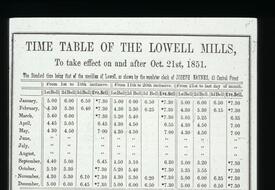
Time Table of the Lowell Mills, 1851
Image ID: 8332
Collection: Karen Halttunen
Topic(s): Nineteenth Century, Lowell, Industrialization
Region(s):
CA Standard(s): 8.12 - The transformation of the American economy and the changing social and political conditions…in response to the Industrial Revolution
National Standard(s):
Card Text: "Time Table of the Lowell Mills" showing hours of labor, Lowell, MA, 1851, “to take effect on and after Oct. 21st, 1851." This timetable does not list all of the bells that the women might have heard throughout the day. The struggle for the ten-hour day, more than any other issue, was the focal point for many workers' organizations in the 1840s. By 1845, factory workers in Lowell were spending an average of 12.5 hours per day performing dreary, exhausting work in onerous conditions. When the time spent going to and from the mills was factored in, the days approached 14.5 hours.
The long hours worsened the already physically- and mentally-debasing factory life. Operatives (workers) wrote that the hours of work were “sufficient to impair health, induce disease, premature old age, and death...to say nothing of the intellectual degeneracy which must necessarily result from the want of mental recreation.” Many were so worn out by their work that they were unable to take advantage of the wealth of educational opportunities offered in Lowell.
The system of long hours was embodied in the factory bells, gates and public clocks that the mills used to regiment the workday. The system of bells established new, industrial work rhythms that synchronized Lowell’s workforce. The bells woke the operatives up, and called them into the mills; they rang at breakfast, called them back into the mills, again at lunch, at closing time, and finally at curfew.
In order to succeed, ten-hour workday initiatives required legislative action, making government and the political process part of reform discussions for the first time. Workers organized several petition campaigns demanding laws that limited the workday. In Lowell, women led these efforts. Although earlier petition efforts found little traction, in 1845 the "Voice of Industry," a workers' newspaper, spearheaded a vigorous campaign that collected over 2,000 signatures (mostly from women). This effort led to the creation of a House of Representatives committee to investigate factory conditions, the first such committee in the United States. The committee was led by William Schouler, an appointment that dismayed many of the activists who had run the campaign. As the editor of a factory-friendly newspaper called the “Lowell Courier,” Schouler was perceived as being biased in favor of the corporations; his newspaper was often described by the Voice as a “political organ of the corporations.”
The committee heard testimony from a number of women who spoke about the dreary work and long hours in the mills. Despite this, it opted not to intervene. Indeed, the committee’s report amounted to a full exoneration of the corporations. A law restricting the workday, the committee wrote, would negatively affect the competitiveness of the mills. It would also affect “the question of wages,” which the committee held should be set by the market, as negotiated between labor and capital. In Lowell, the committee said, “labor is on an equality with capital, and indeed controls it…Labor is intelligent enough to make its own bargains, and look out for its own interests without any interference from us.” The committee concluded by expressing confidence that any abuses in the mills would remedy themselves, through “the progressive improvement in art and science, in a higher appreciation of man's destiny.”
"The Voice" reacted sharply to the report, charging that the political process had been hijacked by the corporations, and accused the committee of distorting the workers’ testimony. When Schouler sought re-election following the release of the report, the Female Labor Reform Association vigorously campaigned against him, likely contributing to his defeat a year later.
Workers in New England had varying attitudes towards the ten hour campaigns. Some believed that they were the first step in a broader reform movement. For others, it was an attempt to simply ease the negative effects of the new economic system, the basic premise of which had already been reluctantly accepted. Still other workers, fearing that a ten-hour system would put a limit on their earnings, refused to lend their support to the movement
Citation: Image: Baker Library, Harvard Business School, Soldiers' Field, Boston, MA 02163. "The Ten Hour Movement." Copyright The Voice of Industry. https:// www.industrialrevolution.org/10-hours-movement. All rights reserved. Sept 7, 2023.

Durrie, Winter in the Country, 1857
Image ID: 8206
Collection: Karen Halttunen
Topic(s): Nineteenth Century, Transportation, 19th century Genre painting, Agrarianism, Architecture, Business 19th century, Class Structure, Domesticity, Founding Myths, Industrialization, Labor, Landscape, anti-urban, Market Economy, Middle-Class Culture, Nature and Civilization, Plantation Exterior, Success 19th century, Symbols
Region(s): United States
CA Standard(s): 8.6 - The divergent paths of the American people from 1800 to the mid-1800s...with emphasis on the Northeast. , 5.8 - The colonization, immigration, and settlement patterns of the American people from 1789 to the mid-1800s..., 8.10 - The multiple causes, key events, and complex consequences of the Civil War, 8.4 - The aspirations and ideals of the people of the new nation
National Standard(s): Expansion and Reform (1801-1861), Civil War and Reconstruction (1850-1877)
Card Text: George Henry Durrie (1820-63), "Winter in the Country (Winter Time at Jones Inn)," New England, 1857. Durrie's painting evokes the New England landscape near his New Haven, CT, home. The house at right is a colonial-era saltbox, characterized by a roof steeply pitched in the front but descending gradually toward the back. This image documents the economic progress of the original settlers, who built a single-story home and added a three-story hotel to capitalize on the needs of travelers and tourists. Painted just before the Civil War, this prosperous scene celebrates the virtues of Northern free labor, which was often contrasted with the inequalities and evil of Southern slave labor. Durrie's paintings were popularized by the firm of Currier & Ives, who published ten prints of his paintings, mostly of his winter scenes, from 1861 to 1867. These idealized depictions of New England farms resonated with Northerners nostalgic for the rural life being transformed - and damaged - by industrialization. Oil on canvas. 18 x 24" (45.7 x 61 cm).
Citation: Image: Copyright Fine Arts Museums of San Francisco, De Young Museum, Golden Gate Park, 50 Hagiwara Tea Garden Dr, San Francisco, CA 94118. Museum purchase, Roscoe and Margaret Oakes Income Fund. 1985.47. All rights reserved. Text: "Winter in the Country." https://artsandculture.google. com/asset/winter-in-the-country/ZwGmZN60gIldWg?hl=en. May 31, 2022.

Haying-Time. The First Load, 1868
Image ID: 8304
Collection: Karen Halttunen
Topic(s): Nineteenth Century, Industrial Revolution, Agriculture, Agrarianism, Art Style, Business 19th century, Children, Civil War, Class Structure, Corporate Image, Domesticity, Eden Imagery, Environmental History, Family to 1920, Labor, Landscape, anti-urban, Middle-Class Culture, Naive Art, Nationhood, Nature and Civilization, Nineteenth Century Misc, Outdoor Life, Parents, Children, Families, Pre-Industrial Work - Misc., Reconstruction, Success 19th century, Symbols of mass society, Utopias, Victorian Culture, Women's image, Work and Workers
Region(s): United States
CA Standard(s): 8.12 - The transformation of the American economy and the changing social and political conditions…in response to the Industrial Revolution, 5.8 - The colonization, immigration, and settlement patterns of the American people from 1789 to the mid-1800s..., 8.10 - The multiple causes, key events, and complex consequences of the Civil War, 8.4 - The aspirations and ideals of the people of the new nation
National Standard(s): Expansion and Reform (1801-1861), An Age of Revolutions, 1750-1914
Card Text: Frances F. Palmer and John Cameron, "Haying-Time. The First Load," Currier and Ives, 1868. In this rural scene a young man leads an ox-drawn cart carrying a smiling family of a man, a woman and two cherubic children into a field where workers harvest hay. A dog leaps up towards the cart at left. In the background are trees and a hilly landscape. This quaint picture gives insight into how most 19th-century Americans perceived and idealized themselves. Currier & Ives prints painted an indelible cultural record of the latter part of the 19th century, with happy, glistening country scenes in an idealized rural America that even then was beginning to fade away.
When "Fanny" Flora Bond Palmer (1812-76) moved to New York from England with her husband in 1844, she was 32 and an accomplished artist and printmaker. Nathaniel Currier recognized her talent and began to buy her drawings to use as print designs. After Currier & Ives was established in 1857 she became a staff artist. Palmer produced more than 200 prints for the firm and today is regarded as a leading lithographer of the period. She was the first woman in the United States to work as a professional artist and to make a living at it. She produced more Currier and Ives’ prints than any other artist, and the only female in a business dominated by men. Palmer’s work has appeared in millions of books, calendars and greeting cards, depicting idyllic scenes of American life, but she has been largely ignored by historians. During her lifetime painting was not considered a suitable occupation for a woman, and some of this prejudice may remain.
Currier & Ives was a powerhouse of 19th-c. publishing and immeasurably influenced American visual culture. Founded in New York in 1834 by Nathaniel Currier, the company expanded to include a new partner, James Merritt Ives, after 1857. Currier & Ives produced millions of cheaply priced copies of over 7000 original lithographs, living up to its self-appointed title as “the Grand Central Depot for Cheap and Popular Prints.” The firm took advantage of New York City’s booming arts culture in the late 19th c., but its output was not seen as fine art by critics, nor was it intended as such. Its prints were first and foremost commodities, and the choice of subjects was often determined by popularity and sales figures. Currier & Ives perpetuated Victorian ideals in these depictions of family, history, politics, and urban and suburban life, yet these prints also serve as important records of a nation in the midst of an extraordinary transformation from a rural, agricultural landscape to an industrialized, urbanized global power.
The company is best known today for its lush, hand-colored lithographs that nostalgically depicted an idyllic republic of pioneer homesteads, sporting camps, and bucolic pastimes, but these sentimental images comprised only one aspect of Currier & Ives’ production. The company’s inexpensive and popular prints just as frequently touched on pressing social and political issues. Addressing economic development, western expansion, the Civil War, and controversies of racial and class politics, Currier & Ives portrayed scenes of urbanization, nation building, naval battles, catastrophic disasters, and current events that were far from idyllic. They offer a complex and conflicted vision of America that embraced the possibilities of an emerging urban and industrial society while nostalgically celebrating the social stability of a rural ideal. Hand-colored lithograph with some gum arabic. 15-11/16 × 23-3/4" (39.8 × 60.3 cm).
Citation: Courtesy of The Museum of the City of New York, 1220 Fifth Ave, New York, NY 10029. https://collections.mcny.org/CS.aspx?VP3=DamView&VBID=24 UP1GQCHKYW3&SMLS=1&RW=1920&RH=963. Our thanks to the Museum of the City of New York for its generosity. First text: "Haying Time – The First Load." https://www.metmuseum.org/art/collection/search/416176. Copyright Metropolitan Museum of Art, 1000 Fifth Ave, New York, NY 10028. All rights reserved. Second text: Adapted from "Revisiting America: The Prints of Currier & Ives," Jun 2 - Sept 5, 2021. https://shelburnemuseum.org/ exhibition/revisiting-america-the-prints-of-currier-ives/?gclid=CjwKCAiA0syqBhBxEiwAeNx9N11IW-Gor5V5jDwVe E2oAPS_at_26forKTAD2zmndR4F P3tSm21O1RoCHzIQAvD_BwE. Copyright Shelburne Museum, 6000 Shelburne Rd, PO Box 10, Shelburne, VT 05482. All rights reserved. Nov 14, 2023.

The Household as Factory, England, 18th c.
Image ID: 8261
Collection: Karen Halttunen
Topic(s): 18th Century Cities, 18th Century Families, 18th Century Interiors, Arts and Architecture, British Empire, Business 19th century, Child labor, Class Separation, Colonial America, Domesticity, Early mills and factories, Early National Period, Emerging industrial city, Environmental History, Family to 1920, Individualism, Technology, Labor, Market Economy, Nineteenth Century Children, Parents, Children, Families, Pre-Industrial Work - Misc., Sweatshops, Technology, Urban poverty, Women's work, Working Class Culture
Region(s): Europe, North America, United States
CA Standard(s): 8.6 - The divergent paths of the American people from 1800 to the mid-1800s...with emphasis on the Northeast. , 5.8 - The colonization, immigration, and settlement patterns of the American people from 1789 to the mid-1800s...
National Standard(s): An Age of Revolutions, 1750-1914, Colonization and Settlement (1585-1763), Revolution and the New Nation (1754-1820s) , Expansion and Reform (1801-1861)
Card Text: "The Household as Factory," an 18th-century English family making textiles. Before the Industrial Revolution, many products were manufactured in homes or small workshops. All types of goods were hand-made by the piece, including nails, lace, stockings, shoes and textiles. Historians today commonly call this home-based labor process the "Domestic System." It was extremely popular in England, where woolen cloth was made. Merchant-employers “put out” materials like raw wool to rural producers, called "outworkers," to turn into cloth. Family members typically worked together side by side and their pets often stayed in the room with them. As shown above, the woman of the family spins the wool that her husband and children then weave into textiles. Most cloth was made from wool and cotton, but silk and flax were used as well.
The three main stages of cloth-making were carding, spinning and weaving. Generally, the children of the family washed the wool and carded (combed) it for their mothers to spin into yarn. The women passed it on their husbands, who wove the yarn into cloth with a hand-powered loom. This work was usually combined with farming, as many families had access to a small plot of land for growing vegetables and raising hens, goats and cows. Working days under the domestic system were extremely long, and making money was difficult. However, some families could tailor their working hours to their needs, unlike workers in the first factories. This household-as-factory system was not as efficient as industrial factories, but it was less stressful for the workers and their quality of life was far superior. The system failed, however, due to growing populations and factory owners' demands for quantity rather than quality of goods. When the factory system was introduced, domestic textile production became too expensive. Factories could operate more cheaply and the business inevitably fell on the shoulders of the factory owners, who often made large profits. It is ironic that much 21st-century industry has now gone full circle with large corporations allowing flexible working hours and laborers to work from home. Some companies also allow work performed "virtually" from workers' homes, reducing overhead and often improving productivity. Woodcut.
Citation: The New York Public Library, 188 Madison Ave, New York, NY 10016. Text: "The Domestic System." https://industrialrevolution.org.uk/domestic-system/. Copyright © 2010 - 22 CB Media: Industrial Revolution. All rights reserved. Sept. 6, 2022.

Andrews, The Children of Nathan Starr, 1835
Image ID: 8389
Collection: Karen Halttunen
Topic(s): Nineteenth Century, Domesticity, Arts and Architecture, Business 19th century, Children, Class and Status, Early National Period, Family to 1920, Games 19th century, Industrial Revolution, Luxury, Middle-Class Culture, Nineteenth Century Children, Nineteenth Century Furniture, Nineteenth Century Interiors, Numinous, Popular recreation to 1865, Recreation - upper class, Sports and Recreation, Success 19th century, Symbols, Upper Class to 1865, Victorian Culture, Victorian Death
Region(s): United States
CA Standard(s): 5.8 - The colonization, immigration, and settlement patterns of the American people from 1789 to the mid-1800s..., 8.4 - The aspirations and ideals of the people of the new nation, 8.6 - The divergent paths of the American people from 1800 to the mid-1800s...with emphasis on the Northeast.
National Standard(s): Expansion and Reform (1801-1861), An Age of Revolutions, 1750-1914
Card Text: Ambrose Andrews (1801-c.77), "The Children of Nathan Starr," 1835, the year of the death of the youngest, three-year-old Edward. The subjects of this portrait as a "conversation piece" are the five youngest children of Nathan Starr (1784-1852) and Grace Townsend Starr (1789-1856) of Middletown, CT. From about 1813 to 1845, Starr worked with his father in manufacturing arms, mainly for the federal government. Besides the children portrayed here, the couple had three elder children - Elihu William Nathan (1812-91), Mary Elizabeth (1815-98), and Ebenezer Townsend (1816-99) - as well as three others who died in infancy.
The children are posed in a Greek Revival parlor whose doors open onto a sweeping view of the Connecticut River. The children are bathed in a soft light and an inner glow. The door frame holds pots of calla lilies, the lilies of Easter, suggesting beauty, innocence and rebirth. Three of the five children play at “battledore and shuttlecock,” an early form of badminton. The game may have been symbolic of the children's mutual affection. Toddler Edward, at center, shows his full face and holds not a racquet but a hoop and stick. The circular hoop hints at eternity, and the stick, held heavenward, points to a flock of white birds in flight. Perhaps Edward's soul is about to follow. This painting is probably a posthumous portrait of this child. The lesser quality of his portrait compared with his siblings' could indicate that his likeness was not taken from life. Left to right, the children are: Henry Ward (1826-92), aged 9; Frederick Barnard (1829-65), aged 6; Edward Pomeroy (1832-35), aged 3; Emily Helen (1820-98), aged 15; and Grace Ann (1823-93), aged 12.
Complex emotions informed the decision to commission a portrait of a loved one who had died. Such portraits reinforced a sense of grief, a visceral and ongoing acknowledgment of loss, but they also provided comfort to the bereaved family.
Andrews was a Massachusetts itinerant portrait, miniature, and landscape painter. He attended the National Academy of Design in 1824 and had a geographically wide-ranging career in New York, Connecticut, Texas, Louisiana, St. Louis, Vermont, and Canada. Oil on canvas. 28-3/8 x 36-1/2" (72.1 x 92.7 cm).
Citation: Copyright Metropolitan Museum of Art, 1000 Fifth Ave, New York, NY 10028-0198. Gift of Nina Howell Starr in memory of Nathan Comfort Starr (1896–1981), 1987 (1987.404). https://www.metmuseum.org/art/collection/search/10077. All rights reserved. Text: Copyright Stephen O'Donnell, "Gods and Foolish Grandeur: 'The Children of Nathan Starr,' by Ambrose Andrews, 1835," Oct 5, 2018. http://godsandfoolishgrandeur.blogspot.com/2018/10/the-children-of-nathan-starr-by-ambrose.html. All rights reserved. Mar 5, 2023.

Thompson, The Belated Party on Mansfield Mountain, 1858
Image ID: 8275
Collection: Karen Halttunen
Topic(s): Nineteenth Century, Industrial Revolution, 19th century Genre painting, Class Structure, Eden Imagery, Landscape, Middle-Class Culture, Nationhood, Nature and Civilization, Popular recreation to 1865, Sports and Recreation, Symbols, US Destiny, Victorian Culture, Women and Sports
Region(s): United States
CA Standard(s): 8.10 - The multiple causes, key events, and complex consequences of the Civil War, 8.12 - The transformation of the American economy and the changing social and political conditions…in response to the Industrial Revolution, 8.4 - The aspirations and ideals of the people of the new nation, 8.6 - The divergent paths of the American people from 1800 to the mid-1800s...with emphasis on the Northeast.
National Standard(s): Expansion and Reform (1801-1861), Civil War and Reconstruction (1850-1877)
Card Text: Jerome B. Thompson (1814-86), "The Belated Party on Mansfield Mountain," 1858. Thompson combined the breadth of Hudson River School landscape painting with the anecdotal appeal of contemporary genre painting. This work is one of several in which he used Mount Mansfield, Vermont’s highest peak, as a foil for domestic recreation. As half the party of day trippers admire the summit and the vista toward Lake Champlain, one young man holds his watch aloft, warning of the lateness of the hour and the need to descend. However, the three youths watching the sunset ignore him, enraptured by the beauty of nature. As passion vies with reason in this large genre painting, the three in the foreground notice the passage of time and the implicit dangers of descending in the dark.
The son of an itinerant portrait painter, Thompson took up genre subjects as early as 1848. He became acquainted with Hudson River School painters Asher Durand and Jasper Cropsey during the 1850s and specialized in picnicking and harvest scenes. In 1857, an art critic wrote that "No living artist…[better] catches the lights and shades of American life and humor; and consequently, none is more truly popular....He adds that intangible faculty of seizing the most picturesque view of things, and succeeds in producing pictures which literally talk with reminiscences and life. Born and bred on a New-England farm, he has pierced to the very spirit of country realities."
The ridgeline of Vermont’s highest peak is said to resemble the elongated face of a man looking up at the sky. From the east, from left to right, his forehead, nose, lips, chin, and even Adam’s apple are obvious. The Abenaki, a tribe native to Vermont, thought the ridgeline resembled that of a moose head and referred to it as Mose-o-de-be-Wadso, or "mountain with the head of a moose." Regardless of man or moose, Mount Mansfield has one of the most recognizable and popular summits and ridgelines in all of Vermont. Its stunning views, hiking, skiing, and snowboarding are a draw throughout the year. Once a barren mountain too rocky for farming, this 4,393-footer has found its own road to success as a premier spot for winter sports in the Northeast. The mountain was home to the first American ski patrol, founded in 1934. Oil on canvas. 38 x 63-1/8" (96.5 x 160.3 cm).
Citation: Image and first text: Copyright Metropolitan Museum of Art, 1000 Fifth Ave, New York, NY 10028-0198. Purchase, Rogers Fund, 1969 (69.182). https:// www.metmuseum.org/art/collection/search/12800. All rights reserved. Second text: Suzanne Loring, "Mount Mansfield: The Man, The Moose, The Legend," Burlington, VT, May 17, 2016. https://rootsrated.com/stories/mount-mansfield-man-moose-legend-ap. © 2022 RootsRated, Inc. All rights reserved. Nov 4, 2022.

Tumbledown Mansion - The House of Farmer Slack, 1840
Image ID: 8305
Collection: Karen Halttunen
Topic(s): Nineteenth Century, Industrial Revolution, Industrialization, Agriculture
Region(s): United States
CA Standard(s): 8.12 - The transformation of the American economy and the changing social and political conditions…in response to the Industrial Revolution, 8.4 - The aspirations and ideals of the people of the new nation
National Standard(s): Expansion and Reform (1801-1861)
Card Text: Baldwin, "Tumbledown Mansion - The House of Farmer Slack," slovenly farmstead, 1840. The Victorian affection for orderly, "proper" behavior, a high standard of personal conduct across all sections of society. The emphasis on morality, prosperity, prudery, complacency, family, respectability, personal responsibility, self-discipline, personal improvement. impatient with laziness and the poor who were often blamed for their plight and disgusted by addiction . self respect. leisure time, sports,activity.self-reliance, entrepreneurship, thrift, honesty, sincerity, individualism. The values they held: personal responsibility, self-reliance, industriousness and individualism were, and are values worth adhering to. They fostered independence of spirit and action. lack of cleanliness and lack of productivity embarrassing and shameful.
Citation: The Plow, April 1852. Library of Congress Prints and Photographs Division, Washington, DC 20540

Sargent, The Daughters of Edward Darley Boit, 1882
Image ID: 8386
Collection: Karen Halttunen
Topic(s): Nineteenth Century, Domesticity, Arts and Architecture, Business 19th century, Class and Status, Cooption of styles, Dolls, Family to 1920, Foreign Policy 19th Century, Games 19th century, Gilded Age, Impressionism, Individualism, Technology, Luxury, Middle-Class Culture, National Events, Nineteenth Century Children, Nineteenth Century Furniture, Nineteenth Century Interiors, Overcivilization, Parents, Children, Families, Recreation - upper class, Sargent, Success 19th century, Technique, Upper Class since 1865, Victorian Culture, Women's image
Region(s): United States
CA Standard(s): 8.12 - The transformation of the American economy and the changing social and political conditions…in response to the Industrial Revolution, 8.4 - The aspirations and ideals of the people of the new nation, 8.6 - The divergent paths of the American people from 1800 to the mid-1800s...with emphasis on the Northeast. , 11.2 - The the relationship among the rise of industrialization, large-scale rural-to-urban migration, and massive immigration from Southern and Eastern Europe, 11.4 - The rise of the United States to its role as a world power in the twentieth century
National Standard(s): The Development of the Industrial United States (1870-1900) , The Emergence of Modern America (1890-1930)
Card Text: John Singer Sargent (American, 1856–1925), "The Daughters of Edward Darley Boit," 1882, detail. Painted in Paris, this portrait is one of several Sargent made of the American expatriate community in France. He was a friend of the girls’ parents, Edward Boit and Mary Louisa Cushing Boit. Ned Boit was from Boston, a Harvard-trained lawyer who left his profession to pursue painting. His wife Mary Louisa, called Isa, was a vivacious American who preferred Europe to the US. Her inheritance, a legacy of Boston’s China Trade, allowed the family to live elegantly on the avenue de Friedland in the Eighth Arrondissement, a luxurious neighborhood favored by wealthy Americans.
Sargent’s portrait is set in the foyer of their apartment, a shadowy space in which he arranged the Boits’ four daughters: Mary Louisa (8 years old at the time), Florence (14), Jane (12), and Julia (4). The parents supported Sargent's departure from traditional portraiture to create a work half-portrait and half-interior scene. Each girl is presented separately but the features of two are obscured, belying conventional portraiture. This darkness, and the girls' spatial disconnection, baffled critics when the painting was first displayed. Its unusual format was inspired by both past and present art, an approach that Sargent used to make paintings simultaneously traditional and modern. The historical precedent for this portrait is Las Meninas (c. 1656) by 17th-c. Spanish master Diego Velázquez, an artist admired in 19th-c. France. Sargent had traveled to Madrid in 1879 to make copies after Velázquez at the Museo Nacional del Prado, and among the paintings he studied was this famous large portrait of the Spanish infanta with her maids in a great shadowed room. Sargent adapted Velázquez’s mysterious space, his dark subdued palette, and the commanding manner in which his self-possessed princess confronts the viewer. Sargent was influenced also by the unusual portraits and oddly asymmetrical compositions of his French contemporary Edgar Degas. His portrait shares Degas’s empty center, a disconnection between family members, and a feeling of modern life interrupted.
Sargent placed the Boit girls in an indeterminate space—the entrance hall, neither entirely public nor private—brightly lit in the foreground but receding into a vaguely defined drawing room half-lit with mirrors and reflections. The two tall Japanese vases, made in Arita in the late 19th c. for export to the West, were prized family possessions. Their enormity, contrasted with the girls' small size, makes the interior seem strange and magical. The sisters are dressed almost alike in the sort of casual clothes they would have worn in the schoolroom or at play. Their white pinafores allowed Sargent to show his mastery at painting the color white in different conditions of light. Only the youngest girl, Julia, engages the viewer, while the older girls recede progressively into the shadows.
Sargent titled the painting "Portraits of Children" and displayed it in an 1882 exhibition at the gallery of the French dealer Georges Petit, who specialized in works by an international group of artists more innovative than many Salon painters but less so than the Impressionists. The picture received good reviews. Sargent displayed it the following spring at the Salon, and while some critics praised Sargent’s technical abilities, most found its unconventional composition troubling; one described it as “four corners and a void.” While some have interpreted Sargent’s strategy as a poignant comment on the fickle nature of childhood and adolescence, the writer Henry James, a friend of both the Boits and Sargent, described the picture as a “happy play-world of a family of charming children.” With this painting, Sargent masterfully provided a meditation on openness and enigma, public and private, light and shadow. Oil on canvas. 221.93 x 222.57 cm (87-3/8 x 87-5/8").
Citation: Copyright Yorck Project. Image and text: Copyright Museum of Fine Arts, 465 Huntington Ave, Boston, MA 02115-5523. Gift of Mary Louisa Boit, Julia Overing Boit, Jane Hubbard Boit, and Florence D. Boit in memory of their father, Edward Darley Boit, 1919. Acc. No: 19.124. Text adapted from Erica E. Hirshler, "The Daughters of Edward Darley Boit." https://collections.mfa.org/objects/31782. All rights reserved. Jan 13, 2023.

Alden, The Last Judgment, Barre, MA, c. 1830
Image ID: 8353
Collection: Karen Halttunen
Topic(s): Nineteenth Century, Antebellum Reform, Religion, Arches, Arts and Architecture, Early National Period, Eden Imagery, Institutions and social disorder, Moral lessons, Naive Art, Numinous, Social disorder and order to 1865, Social Gospel and Missions, Symbols, Temp to 1870's, Victorian Culture, Victorian Death
Region(s): United States
CA Standard(s): 8.4 - The aspirations and ideals of the people of the new nation, 5.4 - Political, religious, social, and economic institutions that evolved in the colonial era. , 5.8 - The colonization, immigration, and settlement patterns of the American people from 1789 to the mid-1800s...
National Standard(s): Expansion and Reform (1801-1861), An Age of Revolutions, 1750-1914
Card Text: Albert Alden, "The Last Judgment," Barre, MA, c. 1840. The Apocalypse: God dances joyfully in the clouds above a pair of trumpeting archangels as the dead rise from their graves to be led off to heaven or hell. At upper left, angels in long white gowns take only a few souls to heaven, an orderly, regimented open space surrounded by clouds, while at lower right black demons with pitchforks push and drag thousands of naked sinners through an arch of fire into a flaming pit below. Hell is separated from heaven and the world by huge, billowing black clouds.
A descendant of the Pilgrim immigrant John Alden, Albert Alden (1812-83) published the "Barre Gazette," Worcester County’s oldest newspaper, and a number of prints and children’s books. He worked as a wood engraver in Barre, MA, from the 1830s to the 1850s, producing two large scrapbooks of his cuts, scientific illustrations, images for periodicals and almanacs, and advertisements. Etching. (30 x 38 cm)
Citation: Image and text: Copyright American Antiquarian Society, 185 Salisbury St, Worcester, MA 01609-1634. Text: Miscellaneous Matrix Collection, American Antiquarian Society, BIB 509501. https://www.americanantiquarian.org/Inventories/Miscellaneous%20Matrix%20Collection%20509501.pdf. All rights reserved. Feb 1, 2023.

Woodbridge, The Cross Keys Tavern, Middlesex County, NJ, 1794
Image ID: 8217
Collection: Karen Halttunen
Topic(s): Nineteenth Century, Transportation, 18th Century Exteriors, American Revolution, Architecture, Early National Period, Landscape, anti-urban, National Events, Nationhood, Politics & Government, Presidents, Slavery Misc., Washington
Region(s): United States
CA Standard(s): 5.6 - The course and consequences of the American Revolution, 5.7 - People and events associated with the development of the U.S. Constitution and it's significance as the foundation of the American republic, 5.8 - The colonization, immigration, and settlement patterns of the American people from 1789 to the mid-1800s..., 8.1 - Major events preceding the founding of the nation and the development of American constitutional democracy, 8.3 - The foundation of the American political system and the ways in which citizens participate in it, 8.4 - The aspirations and ideals of the people of the new nation
National Standard(s): Revolution and the New Nation (1754-1820s) , An Age of Revolutions, 1750-1914
Card Text: Archibald Robertson, "The Cross Keys Tavern, Woodbridge," Middlesex County, NJ, 1794. Near here, Cornwallis' British column turned left toward the Short Hills; the artist's father was among them. On April 22, 1789, General Washington stayed the night at this tavern on his way from Mount Vernon, Virginia, to New York City for his inauguration as the first President of the United States. On April 16, he and his entourage had departed Mount Vernon, traveling the 225 miles to the Cross Keys Tavern in Woodbridge. New Jersey had become a second home to Washington. He fought more battles on its soil and spent more time there than anywhere else in more than 4-1/2 years of the 8-year American Revolutionary War. The Cross Keys Tavern had been a cradle of revolt. It was the Sons of Liberty's headquarters for revolution in Woodbridge, where colonists had criticized their king, merchants had protested harsh British trade restrictions, petitions had been drawn up and signed, and tea boycotts and militia units had been organized. It was a popular stopover on the Old Dutch or Upper Road for travelers between New York and Philadelphia. Here on April 22nd Washington received a tumultuous reception from a large military company and civilian contingent, including the first Governor of New Jersey William Livingston, Brigadier General Nathaniel Heard, commander of the militia who had arrested Royal Governor William Franklin, and many other distinguished officers and soldiers. On April 23, Washington left Woodbridge for Elizabethtown Point and boarded an “elegantly adorned” crimson-canopied, 47-foot barge to cross Newark and Lower New York Bay. He landed to a stupendous ovation in lower Manhattan, where he was inaugurated on April 30. “All ranks and professions,” ran one newspaper account, “expressed their feelings in loud acclamations, and with rapture hailed the arrival of the Father of His Country.” Watercolor.
Citation: New Jersey Historical Society, 52 Park Place, Newark, NJ 07102. Coll. 1962: 358. Text: Adapted from Donald Johnstone Peck, "Cross Keys Tavern, Woodbridge, New Jersey. George Washington’s Visit and Inauguration as First President of the United States." https://www.twp.woodbridge.nj.us/ DocumentCenter/View/ 930/Cross-Keys-Tavern-Information-PDF?bidId=. All rights reserved. Aug 9, 2022.

West, The Hope Family of Sydenham, Kent, 1802, detail
Image ID: 8391
Collection: Karen Halttunen
Topic(s): Nineteenth Century, Domesticity, 18th Century Families, Agriculture, Arts and Architecture, Business 19th century, Business 20th century, Class Separation, Early American Slavery, Early National Period, Family to 1920, Luxury, Market Economy, Nineteenth Century Children, Nineteenth Century Interiors, Nineteenth Century Slavery, Parents, Children, Families, Popular recreation to 1865, Pre-Industrial Work - Misc., Slave Trading, Success 19th century, Trade, Upper class ante bellum
Region(s): Europe, United States
CA Standard(s): 10.3 - The effects of the Industrial Revolution in England, France, Germany, Japan, and the United States. , 5.8 - The colonization, immigration, and settlement patterns of the American people from 1789 to the mid-1800s..., 8.4 - The aspirations and ideals of the people of the new nation, 8.5 - U.S. foreign policy in the early Republic, 8.7 - The divergent paths of the American people in the South from 1800 to the mid-1800s
National Standard(s): Revolution and the New Nation (1754-1820s) , Expansion and Reform (1801-1861), An Age of Revolutions, 1750-1914
Card Text: Benjamin West (1738–1820), "The Hope Family of Sydenham, Kent," 1802, detail of Henry Hope's sister's grandchildren, Adrian and Elizabeth. Rococo style. Massachusetts-born Henry Hope (1736-1811)) and his family pose below a maquette (a model of an unfinished sculpture) of his villa Welgelegen in Haarlem, The Netherlands. From left to right in the full painting are: Henry, his sister Harriet Goddard's grandchildren Henry (1785), Adrian (1788), Elizabeth (1794), Henrietta (1790), Harriet herself, Henry's adopted son John Williams Hope (1757–1813), John's youngest son William (1802), and John's wife Ann Goddard (1763-1820). Painted in London during the family's exile from invading French forces in Amsterdam. Ann Goddard was the apple of Henry's eye until she started an affair with Baron van Dopff. This painting was made partially to repair her marriage, and it didn't work. As soon as Henry died she moved in with Dopff, and when John Williams died she married Dopff. Henry is pointing to the ashes of John Goddard, his brother-in-law and business associate, and above his head rests a model of Welgelegen.
Henry and his family were heirs of the Hope brothers Archibald, Isaac and Zachary, who made their money organizing shipment for Quakers out of Rotterdam; and Thomas and Adrian, who were involved in the slave trade in Amsterdam, hence the background painting of ships, which enriched the family. Top years for the Quaker transport to Pennsylvania were 1738, 1744, 1753 and 1765. The slave trade was much less lucrative, but much more brutal — 16% of the slaves died during transport. The Hopes also financed plantations in the Dutch Caribbean, Danish West Indies and United States — and they were actively involved in the management of the plantations. Around 1780 almost half of their profits came from slavery and the trade in sugar, coffee and diamonds. Despite the movements to abolish slavery, Hope & Co., the largest financial and commercial company in the Netherlands at the end of the 18th century, remained active in slavery until its abolition in the Netherlands in 1863. In 2022 its corporate descendant, Dutch bank ABN AMRO, publicly apologized for this involvement in slavery. According to NL Times, "The bank will not offer financial compensation for those affected by its practices in generations past, but the banking group will take more action to combat social inequality." Oil on canvas. 183.2 x 258.44 cm (72-1/8 x 101-3/4".)
Citation: Copyright Museum of Fine Arts, 465 Huntington Ave, Boston, MA 02115-5523. Abbott Lawrence Fund, 1906. Acc. No: 06.2362. https://collections.mfa. org/objects/31279/the-hope-family-of-sydenham-kent;jsessionid=0C43BA6C0628B3FD3E8127CCDB06508A. All rights reserved. Text: Marjolein de Cleen, "Hope & Co Bank," 14 Jan 2023. https://mforamsterdam.com/hope-co-bank/. MforAmsterdam Tours. © 2023 - MforAmsterdam. All rights reserved. Second text: "ABN Amro apologizes for historical links to slavery; Will not pay reparations," 13 April 2022. Copyright NL Times, c/o 3120 Media, Linnaeusstraat 2C, 1092 CK Amsterdam, The Netherlands. https://nltimes.nl/2022/04/13/abn-amro-apologizes-historical-links-slavery-will-pay-reparationsMar 5, 2023.

Humphrey, Parallel Between Intemperance and the Slave Trade, 1828
Image ID: 8379
Collection: Karen Halttunen
Topic(s): Nineteenth Century, Antebellum Reform, Slavery and Abolition, Anti Abolition, Class Separation, Early National Period, Emerging industrial city, Family to 1920, Founding Myths, Immigrants, Institutions and social disorder, Jacksonian Era, Liquor, Masculinity, Moral lessons, National Politics, Nativism, Nineteenth Century Slavery, Politics & Government, Prejudice and Discrimination, Prohibition 1890-1930, Propaganda, Religion, Slaves Stereotypes, Temperance and Prohibition, Upper Class to 1865, Urban poverty, Victorian Culture, Whites, non planters ante bellum
Region(s): United States
CA Standard(s): 5.8 - The colonization, immigration, and settlement patterns of the American people from 1789 to the mid-1800s..., 8.1 - Major events preceding the founding of the nation and the development of American constitutional democracy, 8.2 - The political principles underlying the U.S. Constitution and compare the enumerated and implied powers of the federal government, 8.3 - The foundation of the American political system and the ways in which citizens participate in it, 8.4 - The aspirations and ideals of the people of the new nation, 8.6 - The divergent paths of the American people from 1800 to the mid-1800s...with emphasis on the Northeast. , 11.2 - The the relationship among the rise of industrialization, large-scale rural-to-urban migration, and massive immigration from Southern and Eastern Europe, 11.3 - The role of religion in the founding of America and its lasting moral, social, and political impacts, and issues regarding religious liberty.
National Standard(s): Expansion and Reform (1801-1861)
Card Text: Heman Humphrey, "Parallel Between Intemperance and the Slave Trade," 1828. "Drag me, bound and bleeding, if you will, from my blazing habitation - but - O bind me not to a rack, where I can neither live nor die under the torture." In 1826 the preacher Lyman Beecher published his "Six Sermons on the Nature, Occasions, Signs, Evils, and Remedy of Intemperance," repeatedly comparing intemperance (alcoholism) with the slave trade. A few years later, Amherst College President Heman Humphrey would expand upon this parallel.
Humphrey and Beecher were well-known evangelical temperance activists in New England. They had served together as Congregational ministers in Connecticut and launched the "Connecticut Society for the Promotion of Morals” in 1813. Its members abstained from “ardent spirits,” sabbath-breaking, profane swearing, slander, and gambling. They were among the elite New England evangelicals who founded the American Society for the Promotion of Temperance in Boston in 1826. The group referred to the intemperate person as an “abject slave,” and claimed that physicians prescribing alcoholic “medicines” were producing “slaves to Intemperance.” The comparison between intemperance and slavery was becoming common.
Humphrey laments to his students “the blood-freezing clank of a cruel bondage is still heard amid our loudest rejoicings....However cruel and debasing and portentous African servitude may be, beyond the Potomac, there exists, even in New-England, a far sorer bondage, from which the slaves of the South are happily free. This bondage...chains and scourges the soul, as well as the body. It is a servitude from which death itself has no power to release the captive.” African slavery is merely “physical,” not “intellectual” or “moral,” and this framing sets the stage for his entire argument.
"The prevalent use of ardent spirits in the United States, is a worse evil at this moment, than the slave-trade ever was, in the height of its horrible prosperity." He means the trans-Atlantic slave trade, abolished in 1807. It was common to decry the evils of the trade while remaining lukewarm about the evils of slavery itself. Jonathan Edwards, for example, condemned the trade while holding several enslaved people. Humphrey states that “Congress has no hesitation in passing the severest laws against the one [the slave-trade], and why not do something to check the more dreadful ravages of the other [intemperance]?”
Humphrey’s argument is that “the slave-trade was horrifically evil; and yet, even still, intemperance is worse”: “Intemperance is a more blighting and deadly scourge to humanity, than that traffic, all dripping with gore, which it makes every muscle shudder to think of.” He compares the “comparative aggregate of misery” in terms of both the “number of victims” and the “aggregate of human misery which it inflicts” and judges that intemperance outweighs the slave-trade on both counts. "Intemperance...fetters the immortal mind as well as the dying body.” How he could claim that enslavement did not afflict the minds of the enslaved is unclear. Could it have been a racist judgment, that African minds were inferior to white ones and thus less susceptible to injury?
Humphrey piles on rhetorical questions: “Think of his [the intemperate man’s] thus dragging out months and years of torture, till the earth refuses any longer to bear such a wretch upon its surface, and then tell me, if any Barbadian slave was ever so miserable; was ever a kidnapped African more wretched in his Atlantic dungeon?"
Humphrey even claims that given the choice, he would choose to be enslaved on a plantation than to practice intemperance: “Ah, give me, you say, the chains and stripes and toil and perpetual servitude of a West-India plantation, rather than the woe, the wounds, and the diseases of the dram-shop.”
Intemperance is worse than the slave-trade in the shame it produces, and the guilt upon the conscience.
His reason is white supremacy. He says it explicitly: Intemperance “inflicts more misery” than the slave-trade, partly because of “the keener sensibilities of a civilized [white] than of a savage state.” Because white civilized men have “keener sensibilities” than the African “savage,” white men would be more miserable in the bondage of drink than a Black person in actual enslavement. Humphrey’s comparison rests on the stereotype of Black people as more impervious to pain, more “hardy,” with duller “sensibilities.” The pain of a family ripped apart in Africa suffers not as badly as a family afflicted with intemperance: “Or when you have wept with that aged pair, on the slave-coast, whose only son has just been carried off by the ruthless man-stealer, come home to New-England, and see the only prop of once doting, and now aged parents, falling intoxicated and blaspheming over the threshold of their door; and tell me, whose breach is widest, whose sorrows spring from the deepest fountain? Much as I love my children, let them all grind in chains till they die, rather, infinitely, than become the slaves of strong drink.”
Humphrey also compares the effect on religious faith, and makes several questionable claims regarding the two evils: “Intemperance is beyond all comparison more destructive to the souls of men than the slave-trade. Diabolical as this traffic is, it does not deprive its victims of the means of grace, for they never enjoyed them. It seals not up the bible, nor blots out the sabbath, nor removes men from the “house of God and the gate of heaven.” It hardens not their hearts. It sears not their consciences. They are not more likely to lose their souls in America, than they would have been in their native country.”
The fact that many enslaved people and their descendants have struggled with Christianity as a “white slaveholding religion” seems utterly foreign to Humphrey. In fact, he pulls out the age-old providential apology for slavery at this point: “On the contrary, many are brought under the saving light of the gospel here, who, in all probability, would never have heard of a Saviour there [in Africa].” So slavery was good for Africans, saving them from the fires of hell.
Humphrey’s dubious comparison causes him to extend his argument into another fallacy, condemning drinking even in moderation: “If intemperance is more afflictive and disgraceful to humanity than the slave-trade, who can justify himself even in the moderate use of strong drink?...Would they tell us, that much as they abhor a wholesale traffic in human flesh, they see no harm in trading a little; and that nobody can be comfortable without a few slaves?” If there is no such thing as “slaveholding in moderation,” then, according to Humphrey, neither can alcohol be consumed in moderation.
Just as Humphrey followed Lyman Beecher in comparing intemperance with the slave-trade, he suppressed an anti-slavery society at Amherst College, just as Beecher did at Lane Seminary. A year after Beecher disbanded the anti-slavery society at Lane, Humphrey did the same in 1835 at Amherst. Like many “moderate” northerners, Humphrey seemed more concerned with anti-slavery advocacy than with slavery itself, and as he demonstrates clearly in his address, was far more concerned with other social ills, like intemperance, than he was with enslavement.
Citation: Heman Humphrey, "Parallel Between Intemperance and the Slave Trade," 1828, title page. From Heman's address on intemperance delivered at Amherst College July 4, 1828. The Congregational Library, 14 Beacon St, # 207, Boston, MA 02108. Text: Adapted from Daniel Kleven, “'The mere sting of an insect, compared with the fangs of a tyger': Heman Humphrey’s Parallel Between Intemperance and the Slave Trade," April 1, 2022. https://biblioskolex. wordpress.com/2022/04/01/the-mere-sting-of-an-insect-compared-with-the-fangs-of-a-tyger-heman-humphreys-parallel-between-intemperance-and-the-slave-trade/. βιβλιοσκώληξ. Copyright Daniel Kleven. All rights reserved. Jan 10, 2023.

Cell Window, Hospital for the Insane, Williamsburg, VA, 1773
Image ID: 8344
Collection: Karen Halttunen
Topic(s): Antebellum Reform, 18th Century Interiors, Architecture, British Empire, Civil Rights, Civil War, Class Separation, Colonial America, Early American Slavery, Early National Period, Early Virginia, Eighteenth Century, Institutions and social disorder, Invention, Moral lessons, National Events, Nature and Civilization, Nineteenth Century, Nineteenth Century Slavery, Politics & Government, Pre-Industrial Work - Misc., Prejudice and Discrimination, Slavery, Working, and Living Conditions, Urban poverty, Victorian Culture, Williamsburg, Women and Health
Region(s): United States
CA Standard(s): 5.4 - Political, religious, social, and economic institutions that evolved in the colonial era. , 5.8 - The colonization, immigration, and settlement patterns of the American people from 1789 to the mid-1800s..., 8.4 - The aspirations and ideals of the people of the new nation
National Standard(s): Revolution and the New Nation (1754-1820s) , Expansion and Reform (1801-1861), Civil War and Reconstruction (1850-1877)
Card Text: Cell window, Hospital for the Insane, Williamsburg, VA, 1773. The Public Hospital for Persons of Insane and Disordered Minds, as the Eastern State Hospital was first known, was the first US public mental health facility. Its aim was noble, but its practices were brutal by modern standards. Bleeding, bullying, blistering salves, and electrocution were all standard treatments. This "care" was changed under the supervision of Dr. John Galt (1841- 62), who believed the mentally ill were entitled to dignity and could be reintegrated into society. Galt knew that just because the patients were insane didn’t mean they weren’t witty. It is said that when hospital sponsor John D. Rockefeller strolled through the grounds and introduced himself to an inmate, the inmate replied, “Oh, sure. And I’m Napoleon Bonaparte.” Thanks to a donation from Rockefeller, the hospital was moved three miles west to Dunbar Farms to accommodate its large patient population. As many as 45 enslaved workers were held by the asylum. Galt claimed to treat patients “without regard to race,” but he published no records of the patients' races. In 1846, he successfully submitted a bill to admit enslaved people as patients.
Eastern State Hospital was constructed solely for the care and treatment of the mentally ill. In the summer of 1770, Colonial legislators met in Williamsburg, the capital of the Virginia colony, and passed a bill to construct such a hospital. It was built on an eight-acre site near the College of William and Mary, and the first patients were admitted in 1773. The hospital provided treatment during both the Revolutionary War and the Civil War. In 1841 the hospital, called Eastern Lunatic Asylum and housing 125 "inmates," came under the supervision of Dr. Galt, a brilliant physician who brought "Moral Management" treatment to Williamsburg. As Dr. Galt put it, three successive revolutions in psychiatry occurred there. The first revolution was the hospital's founding as a publicly-supported facility exclusively for the care of the mentally ill. The second was the introduction of "Moral Management" therapy. This concept taught, as Dr. Galt said, that the mentally ill "differ from us in degree, but not in kind" and are entitled to human dignity. He introduced therapeutic activities and talk therapy. He was probably the only contemporary asylum superintendent to advocate that the psychiatric hospital undertake in-house research, and he claimed to treat African-American patients equally with whites. Dr. Galt used restraint sparingly (in one year restraining no one) and sought a calming medication to replace restraint. He dispensed opium liberally to patients in a foreshadowing of our 21st century neuroleptics; and he replaced the bare cell with the more humane "apartment." Galt's third revolution in psychiatry began in 1857, when he was the first to advocate de-institutionalization and community-based mental health care. His was a lone voice, over a century ahead of its time--there were no echoes of agreement beyond his office, and the hospital's directors stopped his plans three times. His disappointment and consequent depression probably contributed to his suicide five years later. Yet it was at Eastern State Hospital that all the components of the modern psychiatric hospital may have first been put into practice--human dignity for the mentally ill, therapeutic activities, talk therapy, calming medication, in-house research, deinstitutionalization, and community-based mental health care.
The 19th century was a dysfunctional age in the US, characterized by a lack of civil rights for most people. African-Americans were enslaved, women and children were oppressed, and the mentally ill bore a tremendous stigma. Eastern State Hospital's 1850 list of "servants" is actually a list of its 45 enslaved workers, who took a large share in the work to be done. Dr. Galt trained them and white "officers" (nursing aides) to provide talk therapy for the patients. Chaining and other forms of long-term restraint of the mentally ill had been common at Eastern Lunatic Asylum until the late 1830s, when Dr. Galt's Moral Management thinking introduced the ideals of human dignity and least restraint. However, patients who escaped were sometimes cruelly treated by the surrounding community. A letter of September 4, 1843, is a bill for the castration of an Eastern State patient who was captured near Lynchburg, Virginia. Dr. Galt did not send payment.
The Civil War devastated Eastern State, destroying the advanced therapeutic community Dr. Galt had nourished. The hospital found itself on one side, then another, of the battle lines. It was captured by Union troops on May 6, 1862, and Dr. Galt died soon afterward. He had probably suffered from depression for many years, and either accidentally or purposely overdosed on laudanum, which he liberally dispensed to his patients as a neuropletic (antipsychotic) substitute.
Citation: Karen Halttunen photo. First text: "Eastern State Hospital, Williamsburg, Virginia: America's First Public Mental Health Facility." www.atlasobscura.com/ places/eastern-state-hospital. © 2023 Atlas Obscura. All rights reserved. Second text: "Eastern State Hospital," Eastern State Hospital, 4601 Ironbound Rd, Williamsburg, VA 23188-2652; Department of Health, Commonwealth of Virginia, 109 Governor St, Richmond, VA 23219. Copyright Commonwealth of Virginia. All rights reserved. Feb 5, 2023.

Palmer, A Night on the Hudson: Through at Daylight, 1864
Image ID: 8209
Collection: Karen Halttunen
Topic(s): Nineteenth Century, Transportation, Arts and Architecture, Business 19th century, Class and Status, Environmental History, Expansion, Industrial Revolution, Luxury, Middle-Class Culture, National Events, Popular recreation 1870-1920, Railroad and steamboat, Technology, Women in labor movement, Women's work
Region(s): United States
CA Standard(s): 8.6 - The divergent paths of the American people from 1800 to the mid-1800s...with emphasis on the Northeast. , 5.8 - The colonization, immigration, and settlement patterns of the American people from 1789 to the mid-1800s..., 8.4 - The aspirations and ideals of the people of the new nation
National Standard(s): Expansion and Reform (1801-1861), Civil War and Reconstruction (1850-1877)
Card Text: Frances F. Palmer (American born England 1812–76), "A Night on the Hudson: 'Through at Daylight,'" Currier and Ives, 1864. From the 1840s to the mid-1860s, many passengers traveling between New York City and Albany, NY, preferred to go via steamship on the scenic Hudson River, about 7-1/2 hours each way. This print depicts the "Isaac Newton" and "Francis Skiddy," both among the largest Hudson River steamboats of their day, gliding along in moonlight, a shining lamp on the prow of each ship lighting the waters ahead. The ships offered comfortable cabins and staterooms for their passengers, with saloons (the lit rooms) and promenades along the second deck. This print likely commemorates these two favorite ships that transported many for years along the Hudson River route. The "Skiddy" was launched in 1852, but ran aground and wrecked on Nov. 5, 1864, four miles south of Albany. The "Newton" sailed the river for 18 years, and was destroyed in 1863 in an explosion near today's Washington Heights.
Nathaniel Currier's New York-based lithography company began in 1835 and produced thousands of hand-colored prints that create a vivid panorama of mid-to-late 19th century American life. As the firm expanded, Currier included his younger brother Charles in the business. In 1857, James Merritt Ives, the firm's accountant since 1852 and Charles's brother-in-law, was made a partner, and the business was renamed Currier & Ives. Over the decades, Americans eagerly acquired their lithographs of picturesque scenery, rural and city views, ships, railroads, portraits, hunting and fishing scenes, domestic life, and other subjects as inexpensive decorations for their homes and businesses. Although it was unusual for a woman to achieve prominence in a printing firm, Frances Flora (Fanny) Palmer was one of the most important artists working for the company. Between 1849 and 1868, she produced approximately 200 of the firm's best landscapes and most engaging scenes of daily life. Hand-colored lithograph. 17-3/4 × 27-3/4" (45.1 × 70.5 cm).
Citation: Image and text: Currier & Ives (American, active New York, 1857–1907). Copyright Metropolitan Museum of Art, 1000 Fifth Ave, New York, NY 10028-0198. https://www.metmuseum.org/art/collection/search/817645. Bequest of Adele S. Colgate, 1962. Acc. No: 63.550.49. All rights reserved. June 1, 2022.

The Peculiar Domestic Institutions of Our Southern Brethren, Boston, 1840
Image ID: 8382
Collection: Karen Halttunen
Topic(s): Nineteenth Century, Antebellum Reform, Abolition, Apartheid, Arts and Architecture, Business 19th century, Child labor, Civil War, Class Separation, Early National Period, Environmental History, Games 19th century, Jacksonian Era, Liquor, Market Economy, Masculinity, Moral lessons, National Politics, Nativism, Nineteenth Century Slavery, Parks and Cemeteries, Plantation Exterior, Politics & Government, Popular recreation to 1865, Prejudice and Discrimination, Propaganda, Satire and Comedy, Slavery and Abolition, Slavery, Working, and Living Conditions, Social disorder and order to 1865, Southern Society, Sports and Recreation, Symbols, Temp to 1870's, Working Class Culture
Region(s): United States
CA Standard(s): 8.7 - The divergent paths of the American people in the South from 1800 to the mid-1800s , 5.8 - The colonization, immigration, and settlement patterns of the American people from 1789 to the mid-1800s..., 8.1 - Major events preceding the founding of the nation and the development of American constitutional democracy, 8.10 - The multiple causes, key events, and complex consequences of the Civil War, 8.6 - The divergent paths of the American people from 1800 to the mid-1800s...with emphasis on the Northeast.
National Standard(s): Revolution and the New Nation (1754-1820s) , Expansion and Reform (1801-1861), Civil War and Reconstruction (1850-1877)
Card Text: "The Peculiar Domestic Institutions of Our Southern Brethren," Boston, MA, 1840. Gambling, cock-fighting, drinking, horse-racing, dueling, lynching. Detail. The Northern abolitionist publishers of the American "Anti-Slavery Almanac" depict the South as a vicious, violent and cruel society influenced by the evils of southern slavery. This abolitionist cartoon made political capital with the brutal white response to the 1835 Mississippi slave rebellion.
In the left foreground are two fighting cocks in battle. Behind them is a slave master torturing an enslaved man by raking his naked back with a cat while two shirtless men engage in a knife fight. Directly behind the brawlers, horses race under the whips of their riders. Horse racing was a popular source of southern entertainment that often left its betting patrons poverty stricken. At front center, a group of white men sit at a table playing cards, wagering their earnings on chance. One has fatally shot another in the head; a third pats an enslaved child on the head, implying that he is using the youngster as betting stakes. Behind the poker players is a tree hung with four black and white victims of a local lynch mob. At right, two men, likely drunk, brawl on the ground. To their right and out of view a white man savagely whips an enslaved child, while behind them two men duel to preserve their idea of southern male honor. At upper right a group of men gather to wager on a cockfight.
Through images like this, abolitionists tried to show that slavery produced paranoia and lawlessness in its practitioners. Abolitionists wanted to demonstrate that the institution created a callousness that extended to even its most innocent victims.
University of Alabama Prof. Joshua Rothman in his book "Flush Times & Fever Dreams: A Story of Capitalism and Slavery in the Age of Jackson" (2014), sums up the image: "...The collage of images delivered a powerful message. Debased by greed and accustomed to the violence on which slavery rested, white southern men had become little better than animals, as indifferent to suffering and conditioned to mutilate and murder one another as the fighting cocks they cheered." Propagandist images like this one brought new converts into the ranks of the abolitionists, while making Southerners feel unfairly depicted and wrongly judged. Woodcut engraving.
Citation: "Anti-Slavery Almanac," 1840. Old Sturbridge Inc., Old Sturbridge Village, MA. Henry Peach photo. Text: Tim Talbott, "Random Thoughts on History:
'Our Peculiar Domestic Institutions.'" http://randomthoughtsonhistory.blogspot.com/2013/09/our-peculiar-domestic-institutions.html. Sept 20, 2013. Copyright Tim Talbott. All rights reserved. Feb 25, 2023.

Waterloo Inn, The First Stage from Baltimore to Washington, DC, 1827
Image ID: 8216
Collection: Karen Halttunen
Topic(s): Nineteenth Century, Transportation, Arts and Architecture, Blacks in Rural South, Business 19th century, Early National Period, Labor, Naive Art, Nationhood, Nature and Civilization, Southern Society, Technology, Urbanization, Victorian Culture
Region(s): United States
CA Standard(s): 8.6 - The divergent paths of the American people from 1800 to the mid-1800s...with emphasis on the Northeast. , 5.8 - The colonization, immigration, and settlement patterns of the American people from 1789 to the mid-1800s..., 8.7 - The divergent paths of the American people in the South from 1800 to the mid-1800s , 8.8 - The divergent paths of the American people in the West from 1800 to the mid-1800s
National Standard(s): Revolution and the New Nation (1754-1820s) , Expansion and Reform (1801-1861)
Card Text: "Waterloo Inn, The First Stage from Baltimore to Washington, D.C.," 1827. This Maryland inn was the first stop between Baltimore and Washington, about 15 miles from Baltimore. In the 1790s, stagecoach travel between cities typically involved days of jostling and discomfort. Even along the main post roads, many fords and long stretches were virtually impassable in bad weather. Used in London by 1640, and about 20 years later in Paris, stagecoaches reached their greatest importance in England and the US in the 19th century, when new macadam roads made travel quicker and more comfortable. Nevertheless, they remained extremely uncomfortable. In the US, only coaches could carry people long distances. In 1802 a traveler could go by coach 1,200 miles (1,900 kilometres) between Boston and Savannah, GA, at a total price for travel and lodging of $100. Several New York companies made light, almost egg-shaped coaches like this one for use on the East Coast. Lithograph.
Citation: J.F. Fitzgerald De Ros, "Personal narrative of travels in the United States and Canada in 1826," 1827. Library of Congress Prints and Photographs Division, Washington, DC. LC-USZ62-1236. Maryland Historical Society, 201 W Monument St, Baltimore, MD 21201-4674. https://www.britannica.com/ technology/stagecoach-vehicle. Oct 15, 2022.